





 Portuguese
  English
  Spanish
  5 min of reading
  0 comments


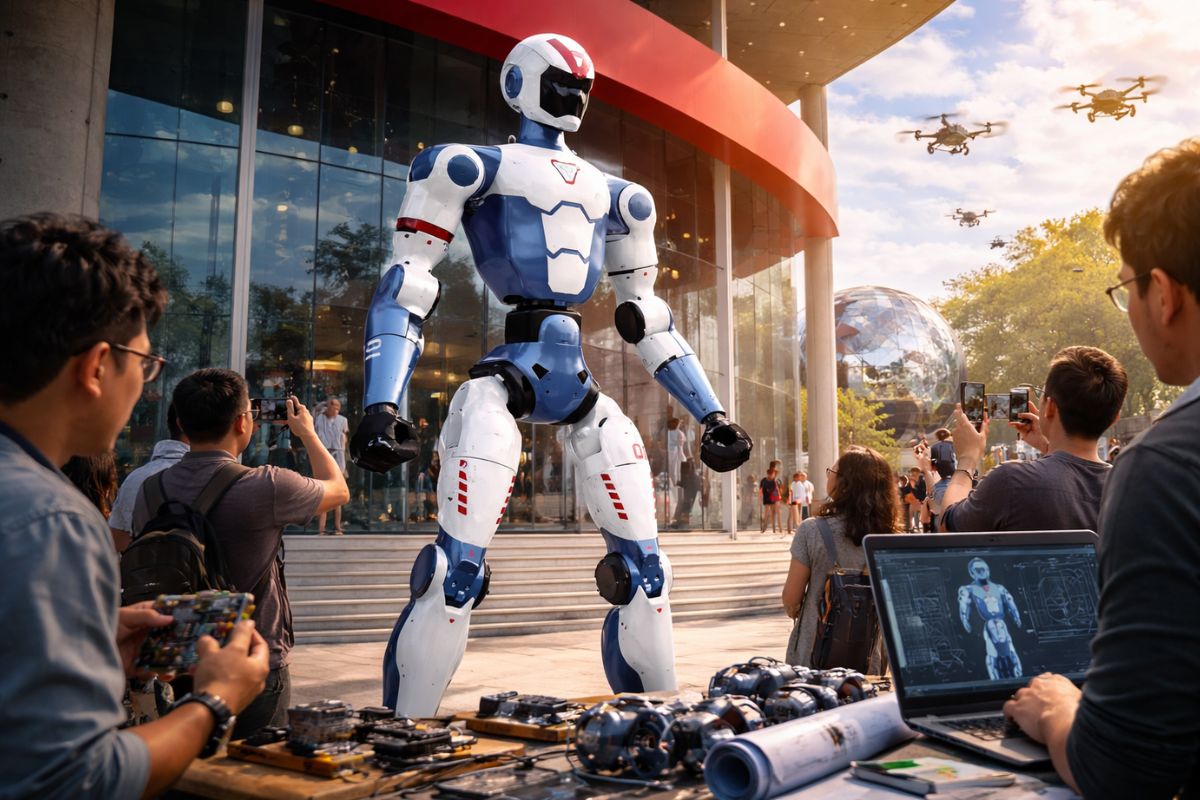
An accessible humanoid robot from Unitree Robotics hits the market for around $4,900, with 26 joints, the ability to run and perform acrobatics, and promises to democratize robotics by putting advanced technology in the hands of researchers, startups, and laboratories that could not afford it before.
The robot humanoid is no longer exclusive to billion-dollar laboratories and research centers with unreachable budgets. The R1, developed by the Chinese Unitree Robotics, has just hit the market with an initial price of around $4,900, a fraction of what humanoid robotics platforms usually cost. With a height of 1.2 meters, weighing between 25 and 27 kilograms and 26 joints that allow complex movements, the robot is capable of running, lifting objects, kicking, and performing acrobatics, in addition to integrating image recognition and voice commands. For those following the evolution of artificial intelligence, this is not just another robot: it is a turning point.
What makes the R1 relevant is not just the price, but what this price enables. Universities, startups, and independent inventors around the world can now acquire a humanoid robotics testing platform for the cost of a high-performance laptop. This changes the innovation equation: instead of relying on million-dollar funding to access a robot with advanced capabilities, researchers can buy an R1, connect it to their artificial intelligence algorithms, and start experimenting immediately. The entry barrier that kept humanoid robotics confined to technology giants has just fallen.
What makes this robot such a different platform from what existed before

Before the R1, a humanoid robot with minimal locomotion, manipulation, and interaction capabilities cost tens or hundreds of thousands of dollars. Platforms like Boston Dynamics’ Atlas or Tesla’s humanoid robots are billion-dollar projects that are not available for purchase by universities or small laboratories. The R1 does not compete with these giants in sophistication, but offers something they do not: accessibility.
-
Study solves great ancient mystery: remains of Philip II, father of Alexander the Great, are identified in Vergina and resolves the enigma of the Macedonian royal tombs that had lasted half a century.

-
Scientists detect for the first time an invisible halo around the iconic Sombrero galaxy 30 million light-years away, three times wider than the visible galaxy itself, and researchers say that the more material around it is mapped, the sooner the universe may reveal the true origin of dark matter that sustains its orderly rotation.

-
Built in 1773 by two rival British inventors, the mechanical Silver Swan still works perfectly 253 years later inside the Bowes Museum, in the English county of Durham, without any electric motor, powered only by clock springs wound once a day, and Mark Twain described it in Paris in 1867 as a creature with lively eyes.
-
57 years and one day ago, the Soviet probe Venera 6 traversed the clouds of Venus for 51 minutes under parachutes and stopped transmitting 10 kilometers from the surface because the pressure of 60 bar and the heat of 320 degrees Celsius crushed its 405-kilogram hull, and no space agency has managed to replicate the feat to this day.




The robot functions as an open testing platform, on which researchers can run their own artificial intelligence algorithms, computer vision, and motion control. With 26 joints, the R1 allows the simulation of human movements with enough complexity for academic research and prototype development. The integration with image recognition and voice commands adds layers of interaction that make the robot useful not only for hardware engineers but also for software developers and machine learning specialists.
Why the price of this robot matters so much for global innovation
According to the R7 portal, the cost of $4,900 is not just a marketing number. This price puts the robot within reach of university departments with modest budgets, early-stage startups, and independent inventors working in garages and makerspaces. In the history of technology, whenever an advanced tool has become accessible to a broader audience, innovation has accelerated exponentially. This was the case with personal computers in the 1980s, with 3D printing in the 2010s, and it could be the same with humanoid robotics now.
The logic is straightforward: the more people have access to a capable robot, the more ideas are tested, more applications are discovered, and the faster the field advances. An engineering student in Brazil, an AI researcher in India, or a startup in Nigeria can now experiment with humanoid robotics for the same cost they would pay for basic laboratory equipment. This democratization not only broadens the development base but diversifies the types of problems researchers try to solve, which historically is the greatest driver of innovation.
What the R1 robot can do in practice
The technical capabilities of the R1 go beyond what one would expect from a robot in this price range. Its compact structure of 1.2 meters and weight between 25 and 27 kilograms facilitates mobility and transport, allowing the robot to be used in different environments without the need for special infrastructure. The 26 joints are distributed to simulate the range of human body movements, focusing on arms, legs, and torso.
In practice, the robot can run, lift light objects, kick, and perform acrobatic movements that demonstrate the level of balance control achieved by Unitree Robotics. The image recognition system allows the robot to identify objects and people in the environment, while voice commands add a layer of natural interaction. For researchers, the value lies less in the acrobatics and more in the ability to use these capabilities as a foundation to develop their own applications, from elderly assistance to autonomous navigation in complex environments.
Who the R1 robot was really designed for
Despite its humanoid appearance and impressive demonstrations, the R1 was not designed for conventional home use. The robot is a research and development platform, intended for those who need functional hardware on which to build and test artificial intelligence solutions. This audience includes universities that want to provide students with hands-on experience with humanoid robotics, startups that need a physical prototype to validate algorithms, and research laboratories studying bipedal locomotion, object manipulation, or human-machine interaction.
Unitree Robotics, already known for its low-cost quadrupedal robots, applied the same philosophy to the R1: to offer maximum functionality at the lowest possible price. If global distribution is confirmed, markets like the United States, Japan, and Europe could incorporate the robot into academic programs and technology incubators, multiplying the number of tests, prototypes, and innovative solutions emerging from the global robotics community.
What the R1 robot means for the future of humanoid robotics
The R1 is not the most advanced robot in the world, and Unitree Robotics does not try to convince anyone that it is. What it represents is something potentially more important: proof that humanoid robotics can be manufactured at a cost that allows for scale. If thousands of researchers around the world gain access to a robot like this, the volume of discoveries, applications, and improvements that will emerge in the coming years could be transformative.
Cost reduction may be the main driver of the next revolution in humanoid robotics. As more people gain access to platforms like the R1, new ideas will emerge from unexpected places, and the robot will cease to be just a laboratory tool to become the starting point for applications that have yet to be imagined. The R1 is not the destination; it is the gateway. And now this gateway is open to those who could only look from the outside before.
A $4,900 humanoid robot promises to democratize robotics for universities, startups, and inventors. Do you think this type of accessible technology will accelerate artificial intelligence, or will the limits of cheap hardware stifle innovation? Share your opinion in the comments.




Be the first to react!