






 Portuguese
  Spanish
  4 min of reading
  0 comments


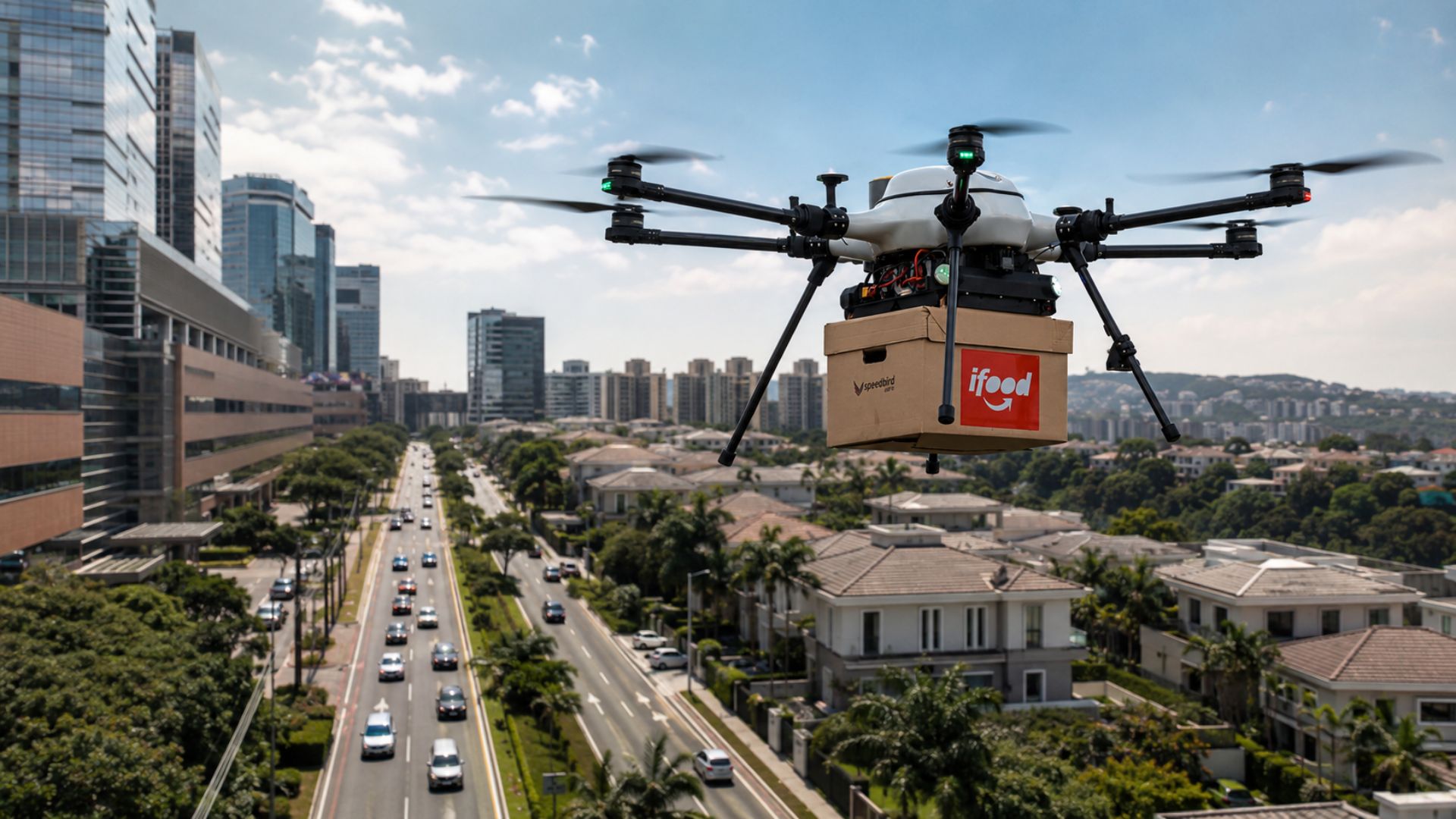
iFood started using drones for deliveries in Barueri, in Greater São Paulo. The aircraft, manufactured by Speedbird Aero, connect the Iguatemi Alphaville shopping mall to a gated community, crossing 3.6 km in five minutes to bypass traffic, queues, and gates and reduce delivery time in the region.
iFood began using drones for deliveries in Brazil. The operation started this Monday (June 1st) in Barueri, in Greater São Paulo, with a clear objective: to bypass traffic, queues, and delays at the gates of gated communities, bottlenecks that hinder delivery in hard-to-access regions like Alphaville.
In practice, the drones connect the Iguatemi Alphaville Shopping Mall in Barueri to a local gated community, covering an aerial route of 3.6 kilometers in about five minutes. The aircraft were developed by the Brazilian company Speedbird Aero and operate in an integrated manner with robots and delivery personnel, in a model the company calls multimodal.
How iFood’s drone delivery works

The process is divided into stages. It all starts inside the mall, where a messenger or the autonomous robot ADA picks up the order from the restaurants and takes it to the take-off base. Then, the drone makes the 3.6 km flight in five minutes to the gated community, where it lands at a dedicated iFood base. From there, a partner delivery person takes over the final stage and delivers the meal to the customer’s door.
-
Survivor of 1966 SS Daniel J. Morrell Shipwreck in Lake Huron Recounts 38-Hour Ordeal in Extreme Cold

-
The Greatest Hoax in World Cup History? The Film That Denied Brazil’s 1958 Victory and Exposed How Fake Evidence Can Seem Convincing on TV
-
Fake South Korean Online Stores Offer Shopping Thrill Without Spending Money or Receiving Products
-
The War of Jenkins’ Ear: How a Severed Ear Sparked One of the 18th Century’s Most Unusual Conflicts


There are two aircraft available for the route, which can fly simultaneously, with daily operations from 10:30 AM to 10:30 PM. The consumer tracks the order through the app in the same way as with deliveries made by motorcycle couriers. According to iFood, the model does not replace human labor: the idea is that the drone expands possible routes and improves productivity precisely in complex areas, keeping the delivery person as a central piece.
Why iFood chose Alphaville and Barueri

The choice of Alphaville, a region of high-standard gated communities in Barueri, is linked to what the company calls “rejection routes,” areas with high refusal rates by delivery personnel. In this case, almost half of the orders destined for the location were refused, largely due to the complexity of access and time lost at the gates. The drone “jumps” this bottleneck and delivers the package directly to a delivery person already inside the community.
The first residential area served is Alphaville Residencial Zero, which has about 2,500 residents. According to the senior director of Logistics at iFood, Mariana Werneck, the technology is meant to complement the work of delivery personnel, not to replace them. The company also states that the change should not result in a loss of income for professionals, as the time previously spent waiting for gate clearance tends to be compensated by a larger volume of deliveries available in the area. It is also the first delivery route in the country authorized to fly over residential areas.
The drones of Speedbird Aero: what they do
The aircraft are manufactured by Speedbird Aero, a Brazilian company partnered with iFood since 2020. Each drone carries loads of up to 5 kg, flies at up to 50 km/h and at an altitude of 60 meters, withstanding winds of up to 55 km/h and light rain, up to 5 mm per hour. For emergencies, the equipment is equipped with parachutes, as well as GPS and real-time remote monitoring.
The operation has certifications from the National Civil Aviation Agency (Anac) and the Department of Airspace Control (Decea). Anac has even authorized Speedbird Aero to operate in regions with a density of up to 5,000 inhabitants per square kilometer. Interestingly, the flights are not locally controlled: the control of the aircraft is based in an operations center in Franca, in the interior of São Paulo, almost 400 km from Barueri.
From Aracaju to São Paulo: iFood’s bet on drones
Barueri is not the first address for the technology. iFood already operates with drones in Aracaju, in Sergipe, where the aircraft connect a shopping mall to the municipality of Barra dos Coqueiros in a flight of about 4 km made in a few minutes. There, according to the company, some restaurants have increased their number of deliveries by up to 50%, as the service unlocked supply and demand.
It is this history that supports the expansion into Greater São Paulo, seen as a test in a much more populous region with hard-to-access condominiums. The company’s expectation is to bring the model to other residential areas in Barueri and Alphaville, gradually expanding the drones network as the operation proves viable on a larger scale.
The arrival of iFood drones in Alphaville opens a discussion that goes beyond a pizza arriving faster: are air deliveries the future of delivery or just a niche solution for high-end neighborhoods?
Tell us in the comments if you would like to receive your order by drone and if you trust this type of operation flying over residential areas.





Be the first to react!