






 Portuguese
  Spanish
  5 min of reading
  0 comments


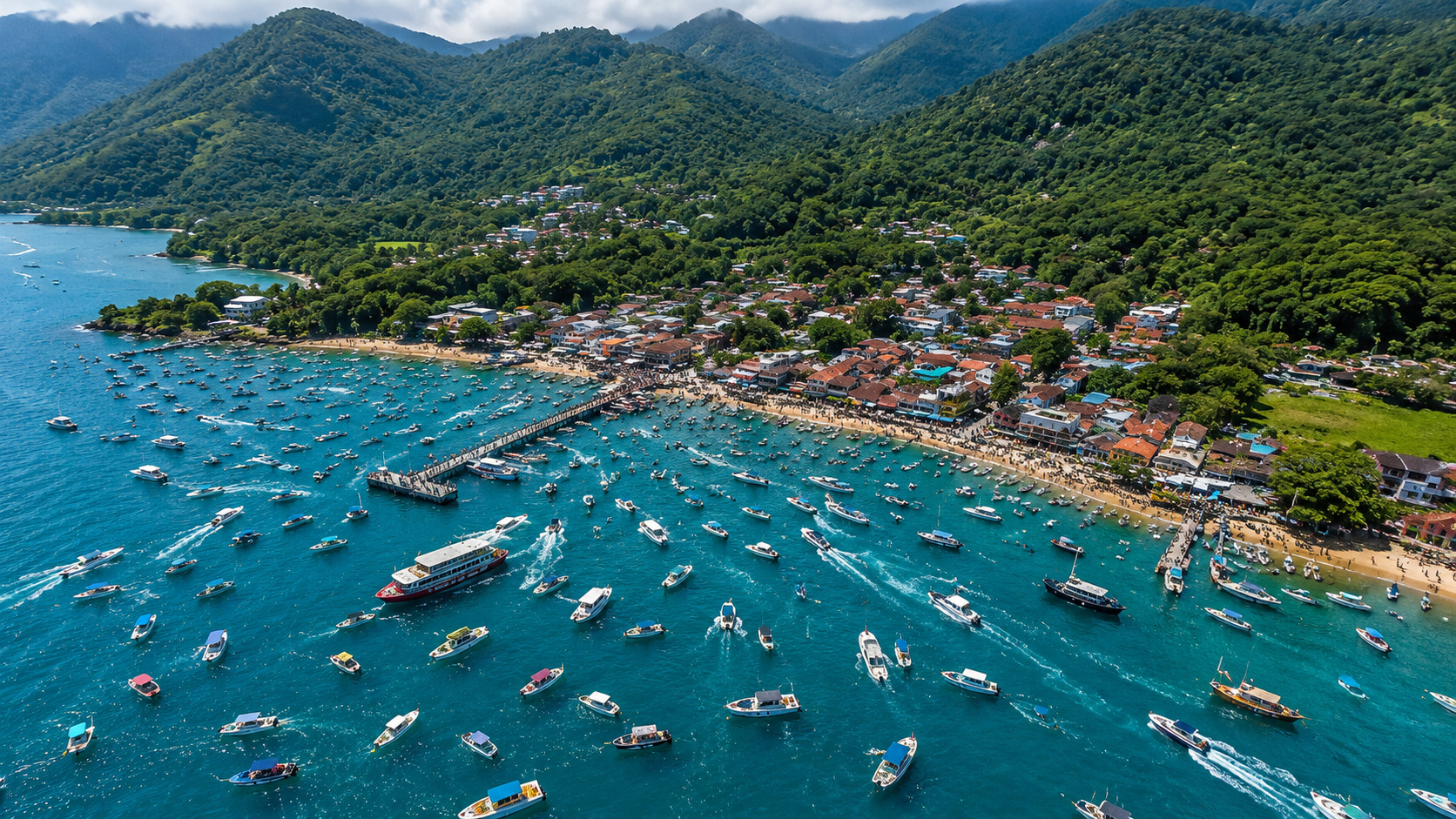
Protests took over Vila do Abraão on the first day of the Sustainable Tourism Tax in Angra dos Reis, after criminal fire destroyed payment kiosks and vessels blocked access to Ilha Grande
The implementation of the new Sustainable Tourism Tax (STT) in Angra dos Reis, on the Costa Verde of Rio de Janeiro, caused a real wave of tension on Ilha Grande this Monday (02). The first day of charging was marked by protests at sea, vessel blockades, turmoil with police, and even a criminal fire that destroyed part of the payment structure installed in Vila do Abraão.
According to information released by the Angra dos Reis City Hall and reports published by O GLOBO and Diário do Rio, the kiosks used for issuing and paying the tax were set on fire during the night by hooded men. The incident occurred around 3:25 AM at Abraão Station, the main arrival and departure point for flexboats on Ilha Grande.
Videos circulating on social media show the moment when two men break the glass of the structure and then set the space on fire using a canister with flammable liquid. The Fire Department was quickly called and managed to control the flames without any injuries reported.
-
Survivor of 1966 SS Daniel J. Morrell Shipwreck in Lake Huron Recounts 38-Hour Ordeal in Extreme Cold

-
The Greatest Hoax in World Cup History? The Film That Denied Brazil’s 1958 Victory and Exposed How Fake Evidence Can Seem Convincing on TV
-
Fake South Korean Online Stores Offer Shopping Thrill Without Spending Money or Receiving Products
-
The War of Jenkins’ Ear: How a Severed Ear Sparked One of the 18th Century’s Most Unusual Conflicts


Even after the fire, the city hall officially maintained the start of the tourist tax collection.


Protest by land and sea paralyzed access to Ilha Grande
Hours after the fire, residents, tourism workers, and local business owners organized a large demonstration in Vila do Abraão. The pier was crowded with protesters wearing t-shirts with phrases against the charge, as well as banners and signs calling for the end of the tax.
On the water, dozens of vessels surrounded the access area to the pier, temporarily preventing the circulation of flexboats that transport people between Angra dos Reis and Ilha Grande. As a result, some routes departing from Conceição de Jacareí, in Mangaratiba, were suspended during the morning.
Tour guide Daniele Lopes reported that the sector had already been feeling impacts since the announcement of the measure last year.
— We had many cancellations since they started talking about the fee. It was a completely different summer. Some businesses recorded more than 60% cancellations — he stated.
Despite the blockade of private vessels, the regular ferry service continued to operate normally, according to the responsible operator.
The tension increased in the afternoon when videos captured intense discussions between protesters and civil police who arrived at the scene to conduct an investigation after the fire. Fireworks were set off during the turmoil.
According to the Civil Police, a teenager was taken to the police station for acts analogous to the crimes of disobedience, contempt, and resistance. He was later released after the arrival of his guardians.
The corporation also stated that the agents were surrounded and harassed by protesters during the police action in Vila do Abraão.

How the new tourism fee works in Angra dos Reis
The Sustainable Tourism Fee officially began being charged on June 2, 2026. The measure was created by the Municipality of Angra dos Reis with the argument of financing improvements in infrastructure, environmental preservation, and tourism organization on the region’s islands.
Payment is mandatory for visitors disembarking on the municipality’s islands, including Ilha Grande.
The amounts vary according to the type of visit, length of stay, and place of embarkation.
Currently, the main amounts are:
- Day use departing from Angra dos Reis: about R$ 28
- Day use departing from neighboring cities: approximately R$ 50
- Overnight with registered accommodation: about R$ 50
- Overnight without proof of regular accommodation: approximately R$ 100
Additionally, there is a 12% service fee charged by the platform responsible for operating the system.
According to the municipality, payment can be made virtually through the Viva Angra portal or at kiosks spread throughout the city and Ilha Grande. Tourists receive a digital voucher with a QR Code after payment.
The legislation also provides for a fine equivalent to double the fee for visitors caught without tourist authorization during inspections.
Residents and business owners criticize the fee model
Although the city hall claims that the revenue will be allocated to environmental preservation and urban improvements, the fee faces strong resistance among residents and business owners in the tourism sector.
One of the main points criticized involves the current infrastructure of Ilha Grande. Professionals linked to tourism state that the city still faces serious problems with basic sanitation, public lighting, and maritime transport.
Tourism expert Waldeck Tenório classified the charge as “inconceivable” given the reality faced by the region.
— There is sewage being discharged into the sea and serious structural problems. Before charging tourists more, the service needs to improve — he stated.
Another focus of criticism involves the perceived unequal enforcement. Business owners claim that control is mainly concentrated in Vila do Abraão, while tourists arriving by private boats on beaches and isolated areas could escape the charge.
The situation also worries owners of properties rented informally for the season. This is because visitors without proof of registered accommodation may end up paying significantly higher fees.
Political and legal questions increase pressure on the city hall
The implementation of the Sustainable Tourism Fee has also generated political and legal debates in Angra dos Reis.
As published by Diário do Rio, councilor Jorge Felippe Neto (PL), president of the Environmental Committee of the Municipal Chamber, took legal action questioning the legality of the charge and the hiring of the company responsible for the system.
The main criticism involves the absence of a public tender for selecting the administrator of the Viva Angra platform.
Additionally, residents of Ilha Grande claim that recent changes made by the city hall to the law’s text have further increased the climate of conflict with the local population.
The amendment project was sent to the Municipal Chamber by Mayor Cláudio Ferreti (MDB) a few days after tense meetings between residents and political representatives.
Meanwhile, the city hall maintains that the fee is essential to ensure sustainable tourism and expand public investments on the municipality’s islands.
In an official statement, the municipal government stated that the Viva Angra program represents “a fundamental tool to balance sustainability and economic development.”
Despite the strong popular reaction, the municipal administration confirmed that the charge will continue as usual in the coming days.





Be the first to react!