






 Portuguese
  Spanish
  4 min of reading
  1 comment


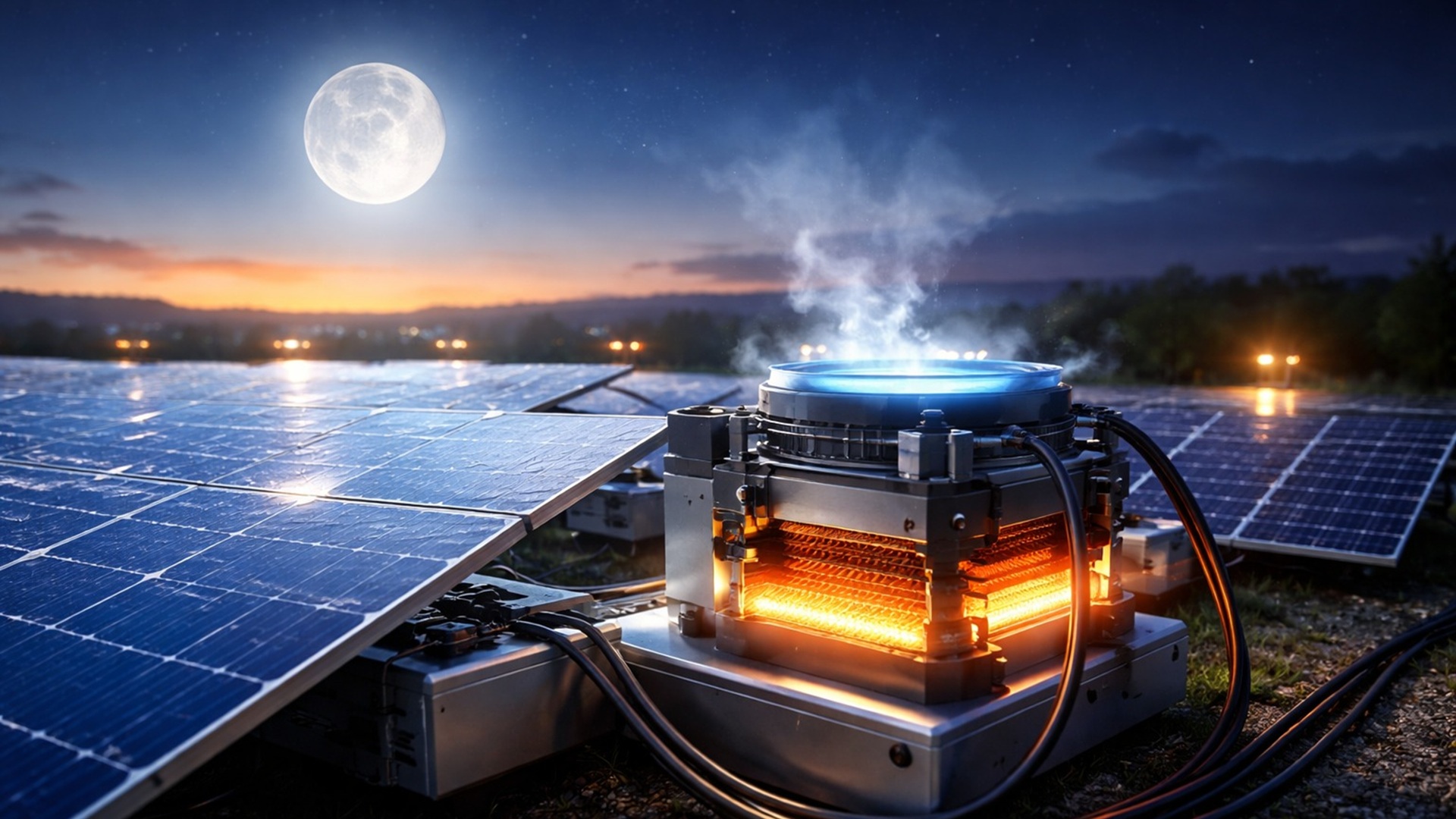


Research Conducted by UCLA Scientists Rescues a Physical Principle Described in 1821 to Demonstrate the Generation of Electricity from Nighttime Radiative Cooling, Expanding the Possibilities of Solar Energy Beyond Exclusive Dependence on Direct Sunlight
The year 2025 recorded a significant increase in globally installed renewable capacity, with a focus on solar energy, driven by innovative projects like the “Dark Photovoltaic Electricity” developed by UCLA, which revisits a scientific concept from 1821 and demonstrates nighttime electric generation at a low cost.
Growth of Renewable Capacity and the Role of Solar Energy
In 2025, global installed renewable capacity advanced significantly compared to 2024, with solar energy reaching new heights. This growth was associated with innovative solar projects that expand generation possibilities beyond the traditional limits of photovoltaic technology.
Among these projects, the creation of the so-called “Dark Photovoltaic Energy” by researchers at the University of California, Los Angeles stands out. The proposal explores a rare natural phenomenon and points to ways to increase electric generation during periods without direct sunlight.
-
In the Atacama Desert, a Tropical Oasis with Pool and Palm Trees Hosts Astronomers Studying the Universe

-
São Paulo Unveils 500 Electric Buses with $1.3 Billion Investment, Aiming to Cut 20 Million Liters of Diesel Annually and Showcase Clean Mobility

-
Robot Works 900 Hours to Build World’s Tallest 3D-Printed Concrete Tower, 30 Meters High, in Swiss Village of 12 Residents
-
Brazilian Nuclear Science Uses Advanced Techniques to Combat Microplastics in Waterways and Food, Paving the Way for Innovative Environmental Solutions



The initiative emerges in a context of accelerated expansion of solar energy, where solutions capable of operating at night or under adverse conditions gain technical and strategic relevance for the global energy sector.
Historical Origins of the Concept and Rescue of the Idea from 1821
The conceptual basis of Dark Photovoltaic Energy dates back to 1821 when Thomas Seebeck developed a pioneering device known as a thermocouple. At the time, the device was a significant technological hurdle but established the principle now referred to as the Seebeck Effect.
The Seebeck Effect occurs when two different types of metallic wires are joined at their ends and subjected to distinct temperatures. This thermal difference generates an electrical voltage, which can be converted into a temperature reading through calibration data.
Researchers at UCLA and Stanford University drew inspiration from this principle to create a new type of electric generation, adapting the historical concept to a natural phenomenon observed in open environments at night.
Scientific Development and the Team Responsible for the Study
The project was led by Aaswath Raman, an assistant professor of materials science and engineering at UCLA. The study was published in 2019 in the scientific journal Joule, bringing together researchers from two academic institutions.
In addition to Raman, the work involved Wei Li, a postdoctoral student at Stanford University, and Shanhui Fan, a professor of electrical engineering. The team combined knowledge from materials science, electrical engineering, and thermal physics.
The researchers sought to demonstrate, on an experimental scale, that the conversion of heat radiated to the night sky could result in measurable electric generation, even in the absence of direct sunlight.
Device Functionality and Prototype Results
The device developed by the team consists of an aluminum disk painted black on one side, positioned with the dark side facing the sky. This disk radiates heat from the surrounding air through the phenomenon known as sky radiative cooling.
The temperature difference generated is then captured by a thermoelectric generator, which converts the thermal gradient into electricity. According to the results obtained, the prototype was capable of producing up to 25 milliwatts per square meter.
This amount of energy is sufficient to power an LED lamp, demonstrating the technical viability of the concept. The cost of the prototype was less than US$ 30, making the experiment economically accessible for initial testing.
Application Potential and Improvement Outlook
According to Raman, the device can be used to produce electricity both during the day and at night, especially when integrated with existing solar installations. This feature enhances the continuous utilization of photovoltaic infrastructure.
The International Energy Agency estimates that over 1 billion people worldwide lack reliable access to electricity. In this context, the technology could represent a stepping stone for populations living or working in extremely remote areas.
Raman also stated that the production of the technology could be improved by up to 20 times compared to the current prototype if advanced components are used. The efficiency tends to be greater in dry and hot climates with high levels of sky radiative cooling.
Implications for Clean Energy and Future Steps
The research demonstrates that clean energy production can become commercially viable even during dark hours. This result broadens the scope of renewable technologies available to diversify the global energy matrix.
As the team moves forward to new phases of investigation and development, the focus remains on technical validation and optimization of the device’s performance. These steps are considered essential prior to any large-scale application.
Other advancements mentioned in the field of solar energy include innovative panels, such as the Apollo Panda, which involve various objects. These examples illustrate how ongoing research continues to push the boundaries of photovoltaic generation, even as some challenges persist.


Sun-Up Energia Fotovoltaica Ltda.
Ribeiro Neto.
Essa é a verdadeira explosão científica do setor da Energia Solar,
Com Geração no escuro, sem a incidência de raios solares.
A verdadeira MARAVILHA PARA O SETOR ENERGÉTICO DA ENERGIA LIMPA.