Portuguese
  Spanish


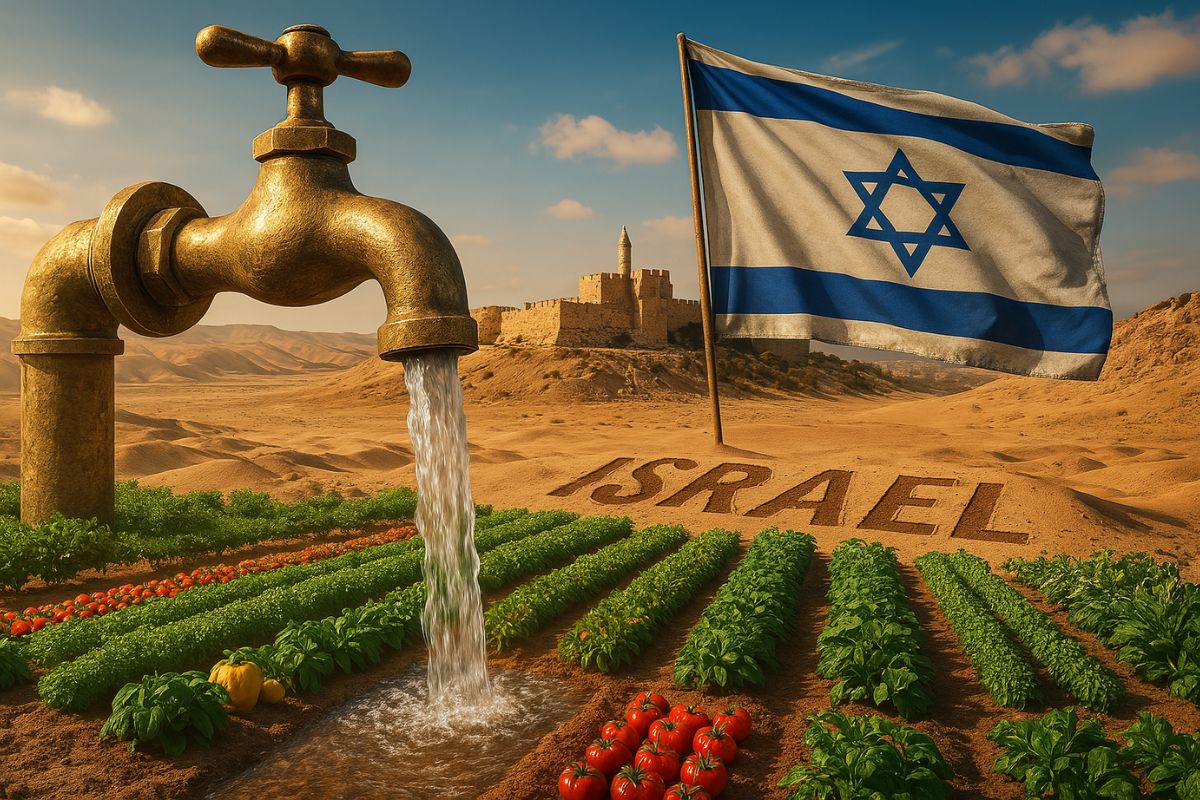


Even With Extreme Water Scarcity, Israel Became a Global Reference in Irrigation, Productivity, and Innovation in Agriculture, Exporting Food and Technology
Israel harvests up to 300 tons of tomatoes per hectare, irrigates orchards with recycled water, and grows flowers in the middle of the desert. With less than 500 cubic meters of water per inhabitant per year, the country has become a symbol of agricultural efficiency, combining science, rigorous management, and cutting-edge technology.
Surrounded by deserts, with dry soil and extreme climate, Israel was poised to be an agricultural failure. But it did the exact opposite. It turned scarcity into strategy and challenged the traditional logic of agriculture. With bold public policies and constant innovation, the country emerged as an agricultural powerhouse in the arid Middle East.
How Agriculture in Israel Was Born from Extreme Scarcity
At the end of the 19th century, the first Jewish immigrants arriving in Palestine found an arid territory with little water and low fertility soils. In this scenario, kibbutzim and moshavim emerged, cooperative settlements that allowed for the sharing of land and resources. The need was urgent: the impossible had to become cultivable.
-
Brazil’s Largest Sewage Plant Boosts Capacity with New High-Performance Pumps, Treating Over 1 Billion Liters Daily

-
Brazilian Mother and Homemaker Becomes Bioconstructor, Builds 24-Ton Earth Dome and Teaches Technique Across Argentina
-
Manchester Builds 40 Furnished Homes for the Homeless Under Railway Arches, Complete with Community Hall, Laundry, Garden, and Sports Court
-
New Highway Section in Brazil’s Serra das Araras Opens: $300 Million Investment, 24 Viaducts, and Promised Travel Time Cuts of Up to 50% to Rio de Janeiro and 25% to São Paulo


Israel and the Water Management Revolution
Water in Israel has never been abundant. The country is among the 15 with the greatest water scarcity in the world. For each inhabitant, there are less than 500 cubic meters of water per year, while in Brazil, this average exceeds 10,000.
Therefore, since its founding, Israel has treated water as a national priority. All potable water is reserved for human consumption, while agriculture relies on treated wastewater reuse, controlled groundwater extraction, and large-scale desalination.
Desalination and Treated Sewage, the Pillars of Irrigation
Israel has become a global reference in desalination. Plants scattered throughout the country transform seawater into drinking water, freeing up freshwater resources for other purposes. About 90% of urban wastewater is treated and reused for irrigation. This recycled water, rich in nutrients, is distributed through purple pipes, exclusive for agricultural use.
In the 1960s, an Israeli engineer observed a tree growing next to a leaky pipe. This inspired one of the greatest agricultural revolutions in history. The drip irrigation system was born, commercially developed by the company Netafim. The technique consists of releasing small amounts of water directly at the plant’s root, minimizing waste and increasing productivity. Today, the technology is used in dozens of countries, including Brazil.
Technology, Biotechnology, and Precision Agriculture
Israel heavily invests in agricultural science. Seeds are genetically developed to withstand heat and salinity. Drones fly over fields, sensors analyze soil in real-time, and algorithms indicate where to irrigate, fertilize, or harvest. This allows for meticulous control and extremely efficient use of available resources.
The country has specialized in high-quality vegetables, tropical fruits, and flowers. Tomatoes, zucchinis, cucumbers, and bell peppers are cultivated in highly technological greenhouses. Mangoes and avocados are exported to Europe. Roses and gerberas are sent from the desert heat straight to the markets in London, Paris, and Berlin. Even Israeli wines have been gaining international recognition, with grapes grown in arid regions.
Water in Israel is a public good, regulated by the government. Farms operate with quotas, and those who exceed the limit pay higher rates. To supply desalination plants without overloading the electrical grid, the country heavily invests in solar energy. The result is a sustainable cycle: clean energy generates water, and this water feeds high-performance agriculture.