Portuguese
  Spanish


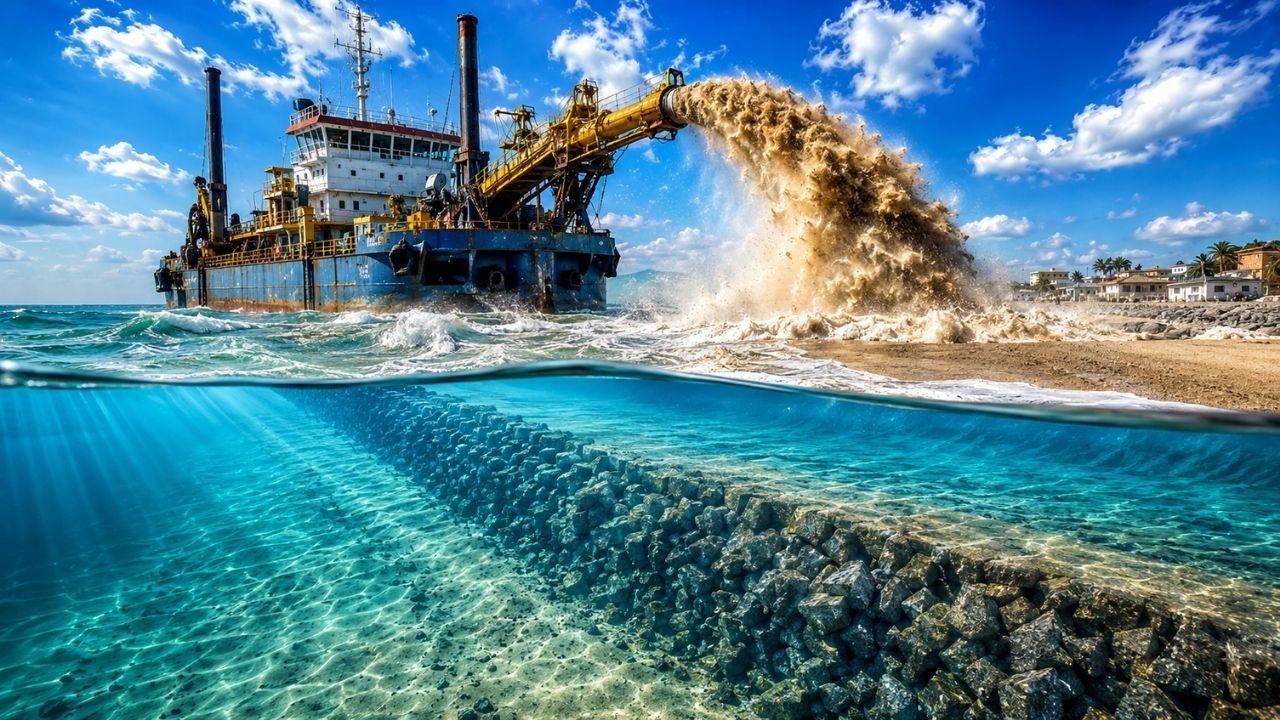


Sand will be deposited by Boskalis around an underwater breakwater in Benin to contain coastal erosion, protect houses and beach activities in Avlékété, and form a wider platform capable of calming South Atlantic waves with more than 3.5 million m³ of sediments.
Sand has returned to the center of a major coastal project in Benin. On July 8, 2025, Boskalis announced its return to the West African country to dump more than 3.5 million m³ of sand around an already installed underwater breakwater on the coast.
According to information from dredgingtoday, the intervention aims to contain coastal erosion in Avlékété, where the absence of natural defenses and free winds from the South Atlantic make the coastline vulnerable. The idea is to transform a narrow submerged structure into a wider sand platform, capable of reducing the force of the waves before they reach the beach.
Sand will be used to reinforce underwater breakwater

Boskalis’ new work in Benin involves a trailing suction hopper dredger. This equipment will be used to deposit more than 3.5 million m³ of sand around a previously installed underwater breakwater.
-
Architect Converts 1955 Grain Silo into 31m² Home with Full Amenities, Including Kitchen, Bathroom, Curved Living Room, and Loft Bedroom

-
Egypt Partners with China to Build 2 GW Wind Turbine Factory and 2,000 MW Wind Farm in Gulf of Suez, Aiming to Export Across Africa

-
Family of Six Leaves Georgia to Live in a $300,000 Cold War-Era Underground Bunker Since 2020: Unlikely 557 m² Home with 60 cm Concrete Walls
-
Self-taught Brazilian Mechanic Builds 10-Ton Aluminum Sailboat in Backyard, Now Navigates the Brazilian Coast at 50


The breakwater is 5 km long and runs parallel to the Beninese coast. Its function is to break the energy of the waves before they reach the beach, helping to reduce erosion and protect houses and coastal activities.
In Benin, the sand will be used as a reinforcement layer around the underwater breakwater, creating a broader platform against coastal erosion. The intervention aims to protect Avlékété, where houses and beach activities are more exposed to the force of South Atlantic waves.
The project does not start from scratch. The submerged structure already exists, but according to the presented assessment, it is not sufficient alone to fully protect the coast. Therefore, the sand acts as a reinforcement layer and expansion of the coastal defense.
In practice, the project attempts to change the behavior of the waves. Instead of hitting hard on an exposed coast, they should encounter a wider platform, lose energy, and reach Avlékété beach more gently.
Sand platform should enhance coastal protection

Image: Boskalis
Boskalis states that the sand deposit around the breakwater will transform a kind of steep underwater dike into a wider platform. This change is important because it alters how wave energy is distributed.
When the wave encounters a very abrupt structure, part of the force can continue reaching the beach with intensity. A wider platform allows for gradual dissipation, reducing the direct impact on the coastal strip.
The sand acts as a flexible defense, different from an isolated rigid barrier. It can help create a more natural transition between the open sea, the breakwater, and the beach.
This type of solution is especially relevant in areas where the coastline is under continuous pressure. In Benin, the combination of little natural protection and South Atlantic winds makes erosion a persistent risk for communities near the sea.
Benin had already received a 6.4 million m³ project in 2022
Boskalis’s return comes about two years after another significant project in the country. In 2022, the company built a so-called sand motor with 6.4 million m³ to protect a vulnerable stretch of Benin’s coast.
This history shows that coastal defense in the country is not an isolated action. Benin’s coastline has been requiring large-scale interventions to try to contain beach loss and protect occupied areas.
The new phase maintains the same logic: using large volumes of sand as a coastal adaptation tool. The difference now is that the material will be placed around an already existing underwater breakwater.
The strategy combines marine engineering and artificial reshaping of the coastal profile. Instead of relying solely on concrete or rock, the project uses sediments to enhance the wave absorption capacity.
Erosion threatens houses and activities on the beach
A coastal erosion is not just an environmental problem. In the case of Avlékété, it also threatens homes, beach activities, and the routine of the local community.
When the sea advances over the sand strip, areas previously used by residents, visitors, and coastal workers may lose space. Over time, structures near the beach become more exposed to the action of the waves.
Therefore, the 5 km breakwater was designed to reduce the impact of the sea on the coast. However, the source indicates that the absence of natural defenses and the strength of the South Atlantic winds made additional reinforcement necessary.
The sand intervention seeks to protect the community before the erosion advances even further. The goal is not only to preserve the landscape but to maintain minimum safety conditions for housing and beach use.
Breakwater alone was not considered sufficient

The Boskalis text points out that the existing breakwater has become insufficient given the local conditions. The coast of Benin lacks robust natural defenses, and the unrestricted winds coming from the South Atlantic increase the pressure on the coastal strip.
This scenario helps explain why the adopted solution is not limited to maintaining the submerged structure as it is. The project proposes to expand its function through the deposition of sand, creating a more efficient surface to dissipate energy.
Instead of viewing the breakwater merely as a barrier, the work treats it as the base of a wider coastal platform. The sand changes the role of the structure, making the defense less abrupt and more integrated with the behavior of the waves.
This logic is common in coastal protection projects that try to balance engineering works and the natural dynamics of the coastline. Still, it requires monitoring because beaches and sediments are always in motion.
Suction dredger will play a central role in the operation
To move more than 3.5 million m³ of sand, Boskalis will use a suction dredger with a hopper. This type of vessel removes sediments, transports the material, and deposits the load in defined areas of the project.
The scale of the operation shows the dimension of the intervention. It is not a small beach replenishment, but a substantial reinforcement around a 5 km underwater structure.
Precision will also be important. The sand needs to be placed in such a way as to transform the profile of the breakwater and form a wider platform, without just accumulating material irregularly.
The success of the work depends on engineering, bathymetry, volume control, and reading wave behavior. In coastal projects, the location where the sand is deposited can be as important as the amount used.
Project attempts to make waves reach the beach more gently

According to Boskalis, the sand platform around the breakwater should calm the waves and allow them to reach Avlékété beach more gently. This is the desired effect of the intervention.
With less energy reaching the coast directly, the tendency is to reduce the removal of sediments from the beach. This can help preserve the coastal strip and decrease the exposure of houses and community use areas.
The work does not eliminate the force of the Atlantic, but tries to reorganize its arrival on the coast. It is a defense based on dissipating energy before it turns into damage.
In vulnerable coastal regions, this type of project can be decisive to gain time, protect communities, and maintain economic activities linked to the beach.
Benin bets on coastal engineering against sea advancement
The project in Avlékété shows how coastal countries are resorting to increasingly larger solutions to deal with erosion. In Benin, the combination of an underwater breakwater and millions of cubic meters of sand reveals an attempt to create protection on a territorial scale.
The intervention also shows that coastal defense does not depend on a single structure. The 5 km breakwater alone was not enough. The sand platform emerges as a complement to improve the system’s performance.
This type of work involves costs, maritime logistics, and continuous planning. As coastal dynamics change with winds, waves, and currents, maintenance and technical monitoring are essential parts of the solution.
In the end, Benin tries to transform sand into defense infrastructure against Atlantic erosion.
Do you think works of this magnitude are the best way to protect coastal communities, or should countries invest more in natural solutions and planned retreat from risk areas? Share your opinion.