Portuguese
  Spanish


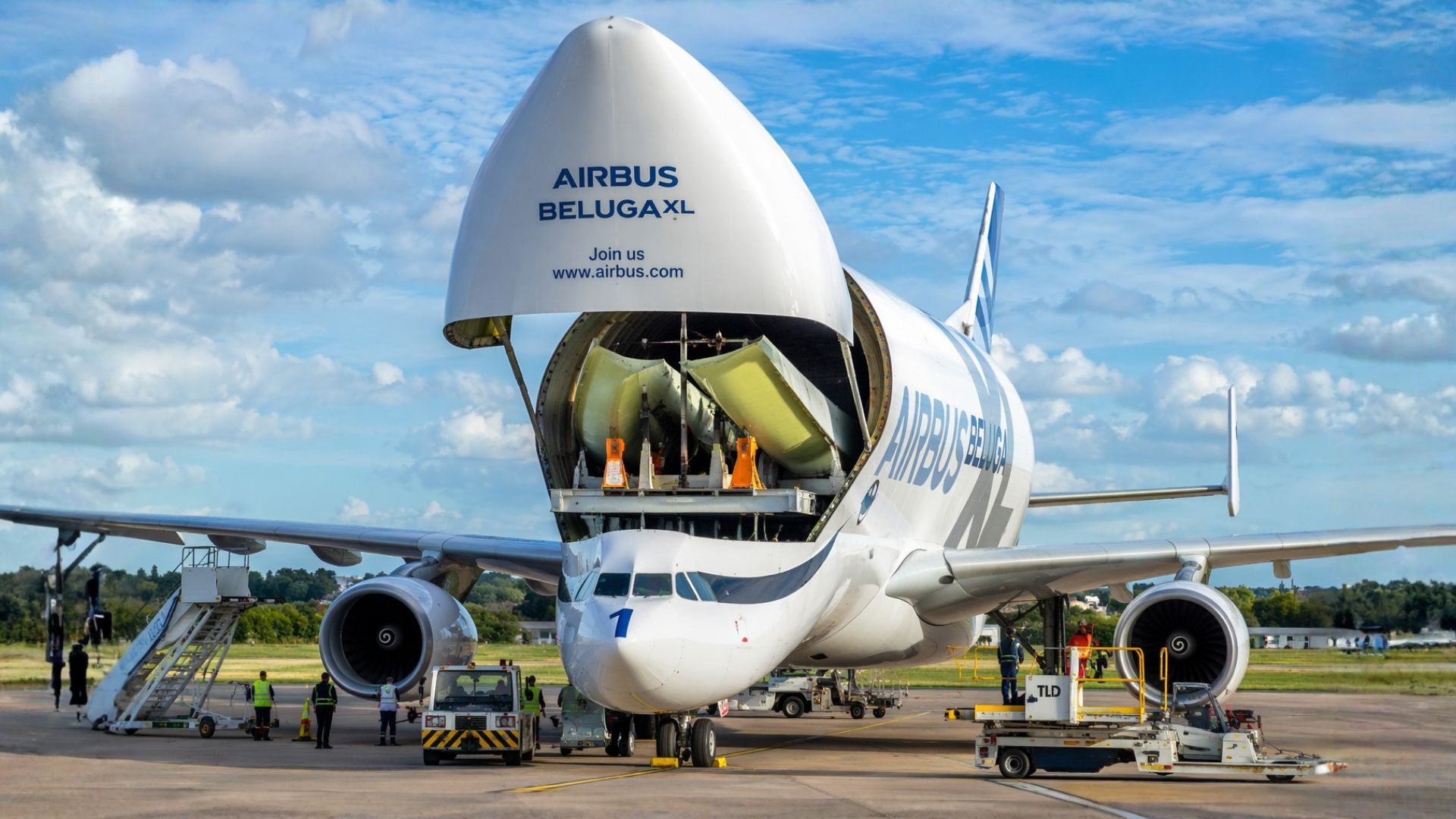


Giant structure and strategic function in the European aerospace industry transform the BelugaXL into an essential link between factories, ensuring efficient transport of oversized components with logistical precision and direct impact on commercial aircraft production.
The Airbus BelugaXL was developed for a task that few aircraft can fulfill regularly: transporting large aerospace components between Airbus factories in Europe without requiring additional disassemblies or compromising the final assembly pace.
With a 51-ton payload, 63.1 meters in length, and enough space to carry, in a single flight, two 30-meter wings of the A350 or the largest fuselage section of this program, the freighter has established itself as an operational link in European production, and not just as an aircraft with an unusual design.
This industrial function helps explain why the model occupies a unique place in cargo aviation.
-
Twin Earthquakes of Magnitude 7.2 and 7.5 Strike Venezuela, Leaving Over 1,400 Dead and Affecting Millions, Potential Losses Estimated at $6.7 Billion

-
Latin America’s Largest Residential Complex Located in São Paulo Boasts 1,160 Apartments, 72 Shops, 22 Elevators, and 104 Staff Members

-
Rare 1747 Lutheran Bible from Germany, Preserved in Southern Brazil, Showcases Unique Engravings and Handcrafted Techniques
-
Before Japan Became a Football Powerhouse, Zico Transformed the Amateur League, Boosted the J.League, and Was Honored with a Statue at Kashima Antlers




Although there are aircraft with large weight capacities, the difference of the BelugaXL lies in the internal volume and the geometry of the main compartment, described by Airbus as the largest cross-section of hold among existing freighters.
In practice, this allows for the air transport of subassemblies that exceed the physical limits of conventional freighters and need to arrive at other units already integrated into the production flow.
Industrial logistics and internal transport of Airbus

Unlike cargo planes aimed at the general freight market, the BelugaXL operates in a network designed to meet Airbus’s internal needs.
The manufacturer reports that the fleet serves 11 European destinations, connecting facilities where different parts of the same aircraft are produced before moving on to final assembly, which reduces logistical bottlenecks in an industrial chain spread across several countries.
This arrangement responds to a concrete demand from the aerospace industry.
Wings, fuselage sections, and other large subassemblies need to circulate within strict time windows and under controlled conditions, because delays or extra handling can affect more than one assembly line at the same time.
In this context, the BelugaXL functions as dedicated air infrastructure, absorbing a critical part of the transportation between production units.
Airbus itself links the program to the increase in industrial pace.
According to the company, the BelugaXL was launched in November 2014 to meet the need to expand internal transport capacity in light of the acceleration of production, especially with the advancement of the A350 program and the increase in rates on other commercial lines.
The first flight took place on July 19, 2018, and it entered service in January 2020, after certification.
Structural Modifications and Increased Capacity
Based on the A330-200, the BelugaXL received deep modifications to accommodate oversized cargo.
Airbus highlights the lowered cockpit, the enlarged cargo hold structure, changes to the rear and tail, and specific loading systems, a combination that transformed the original jet into a specialized transporter for non-standard industry volumes.

This redesign did not serve an aesthetic function, although the appearance helped popularize the aircraft.
The rounded profile and raised front exist to free up space in the main compartment and facilitate the handling of bulky parts, something crucial when operations need to maintain a constant pace between factories.
Instead of prioritizing commercial range or market flexibility, the design favored the logistics of components that do not fit into traditional cargo solutions.
The comparison with the BelugaST, the previous generation used for decades by Airbus, makes this leap clearer.
According to the manufacturer, the BelugaXL offers 30% more transport capacity than the model it gradually replaced, a necessary advancement to respond to both the increase in production and the growth in the size of components transported between the company’s European facilities.
As a result, the new freighter began to perform tasks that previously required more steps or operational limitations.
The ability to transport two A350 wings in a single flight nicely summarizes this evolution, as it reduces the number of trips and better fits the transport of parts into the industrial schedule.
When the cargo is oversized, the logistical gain depends not only on the weight transported but also on the shape and volume that fit in the hold.
BelugaXL Fleet and Continuous Operation in Europe
The fleet currently in service consists of six aircraft, a number that will be completed in June 2024, when the last unit joins the others at Airbus Transport International, the subsidiary responsible for the operation.
Airbus itself describes ATI as the group’s “internal airline” since 1996, responsible for sustaining the regular circulation of large components between the manufacturer’s industrial hubs.
This fact corrects a common perception in the early years of the program.
When the BelugaXL made its inaugural flight and began the certification phase, official communications still referred to the new generation as a fleet of five aircraft being gradually deployed; later, Airbus began to inform that the operation would be completed with six units, a situation confirmed with the final delivery in 2024.
Assembled in Toulouse, France, the model has ceased to be merely a visual novelty and has become a permanent part of the machinery that supports Airbus’s commercial aircraft production.
Although it does not operate as a general cargo aircraft nor was designed to compete in the traditional freight market, the BelugaXL has gained relevance precisely because it solves a very specific problem: moving entire aircraft structures between different points on the continent with predictability and high operational efficiency.


Iconic Design and Impact Beyond Appearance
The public fame of the BelugaXL has also grown due to its whale-inspired paint scheme, featuring stylized eyes and a smile on the front.
Airbus reports that this visual scheme was chosen by employees in an internal vote held before the first flight, and later became one of the most recognized elements of the aircraft outside the technical environment.
Still, the visual appeal has never been the central reason for the program.
The interest surrounding the BelugaXL is sustained because it combines unconventional design and concrete utility on a rare scale: its oversized cargo hold does not serve an engineering curiosity, but a daily production necessity.
When a manufacturer relies on the rapid transport of large subassemblies between several countries, logistics cease to be a supporting step and become a direct part of the industrial process.
In this scenario, the BelugaXL has established itself as a niche solution with a broad impact within European commercial aviation.
The freighter conveys less the idea of an extraordinary aircraft and more that of a mobile production system, capable of linking factories, preserving schedules, and reducing limitations imposed by the size of the parts.
It is this combination of physical capability, operational specialization, and integration into the industrial network that explains why the aircraft has become a key asset for Airbus in Europe.