Portuguese
  Spanish


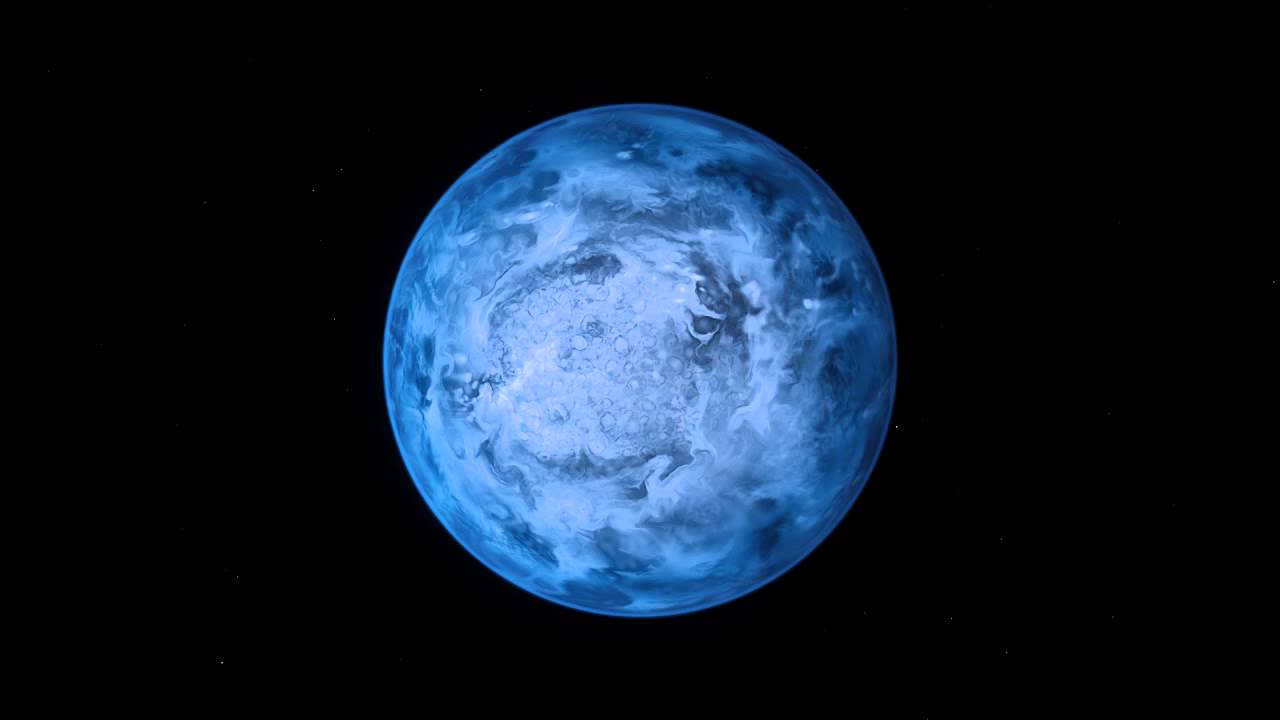

Exoplanet HD 189733 b has intense blue color, winds of up to 8,690 km/h and may have glass rain in its extreme atmosphere.
In 2013, NASA announced on July 11 results obtained with the Hubble Space Telescope that placed the exoplanet HD 189733 b among the most extreme worlds ever analyzed by modern astronomy. Located about 63 light-years from Earth, the planet drew attention because Hubble allowed the determination of its visible color: a deep blue, similar at first glance to the color of Earth when viewed from space.
But the similarity ends in appearance. According to NASA itself, the blue of HD 189733 b does not come from oceans, but from an overheated atmosphere, with clouds rich in silicate particles capable of scattering more blue light than red. The agency reported, in the publication of July 11, 2013, that the planet can record daytime temperatures close to 2,000 °F and winds of about 4,500 mph, while a later publication from NASA, on October 31, 2016, described winds of up to 5,400 mph, equivalent to approximately 8,690 km/h, with the possibility of glass rain being blown sideways by the atmosphere.
This contrast between appearance and reality has made HD 189733 b one of the most emblematic examples in exoplanet research: a world that seems visually familiar but harbors a violent, hot atmosphere incompatible with any known environment in the Solar System.
-
Robots Clean Solar Panels in Desert Power Plants Without Water, Preventing Energy Losses

-
AI Radar Built with Old Camera and $20 Gains Attention After Alleged $317,000 Sale to Chinese Government, But Lack of Documentation and Official Confirmation Raises Questions

-
Amateur Detectorist Discovers 3,400-Year-Old Bronze Age Gold Treasure with 121 Pieces in Transylvania, Including a Unique Ring

-
Italian Designer Develops Solar-Powered Terracotta Water Purifier Producing Up to 5 Liters of Drinking Water Daily Without Electricity


HD 189733 b: Why is the planet blue if it has no oceans
The blue coloration of HD 189733 b was initially interpreted as a possible indication of oceans or an Earth-like atmosphere. However, detailed studies have shown that the origin of this color is completely different.


According to NASA, the blue hue is a result of the presence of microscopic particles in the atmosphere, possibly composed of vaporized silicates, which scatter blue light in a manner similar to what occurs in Earth’s atmosphere. However, unlike our planet, where the blue comes from the scattering of light by air and oceans, on HD 189733 b this color is associated with extremely hot and violent conditions.
These particles form clouds laden with solid material in suspension, creating a dense, hot, and highly dynamic environment.
In other words, the blue that resembles a habitable planet is actually a sign of an atmosphere filled with abrasive particles and extreme temperatures.
A gas giant glued to its star with winds of up to 8,690 km/h
HD 189733 b is classified as a “hot Jupiter,” a type of gas exoplanet that orbits very close to its star. It has a mass comparable to Jupiter, but completes an orbit in just about 2.2 Earth days.
This extreme proximity causes the planet to receive an enormous amount of stellar radiation, raising its temperature to levels far above those found on any habitable planet.

Additionally, like many exoplanets of this type, it is likely tidally locked, meaning one side of the planet is permanently facing the star, while the other remains in darkness.
This configuration creates an intense thermal contrast between the two hemispheres, which is one of the main drivers of the extreme atmospheric conditions observed.
Winds faster than any known hurricane
One of the most impressive features of HD 189733 b is its extremely fast winds. Measurements based on spectroscopic data indicate speeds that can reach about 8,690 km/h.
For comparison, the most intense hurricanes ever recorded on Earth reach about 300 km/h. This means that the winds of this exoplanet are almost 30 times faster than the most extreme atmospheric phenomena on our planet.

These winds are driven by the thermal contrast between the illuminated side and the dark side of the planet. The intense heat on the side facing the star creates air currents that rapidly move to cooler regions, generating a continuous and extremely energetic atmospheric flow.
This dynamic transforms the atmosphere of HD 189733 b into a permanently turbulent system, with enough energy to transport solid particles at high speeds.
The possibility of glass rain on the exoplanet HD 189733 b
Among the most impressive phenomena associated with HD 189733 b is the possibility of glass rain. This concept may seem exaggerated, but it is based on scientific models and indirect observations.
According to NASA, the atmosphere of the planet contains silicate particles, material similar to glass. At extremely high temperatures, these materials can vaporize and, as they move to cooler regions of the atmosphere, condense again.
The result would be a kind of precipitation of solid particles, which can fall in the form of “glass rain.” However, due to the extreme wind speeds, this rain would not fall vertically like on Earth, but would be blown sideways at very high speeds.
This creates an environment where abrasive particles are constantly hurled horizontally, making the planet’s surface one of the most hostile places imaginable.
Temperatures that make the atmosphere unstable in HD 189733 b
The temperatures on HD 189733 b are extremely high, especially on the side facing the star. Estimates indicate values exceeding 1,000°C, enough to completely alter the composition and behavior of the atmosphere.
These thermal conditions cause complex molecules to be constantly broken down and reformed, creating a dynamic and unstable chemical environment.
Moreover, the intense heat contributes to the expansion of the atmosphere, making the planet more “inflated” than it would be under cooler conditions. This phenomenon is common in hot Jupiters and helps explain their physical characteristics.
Exoplanet HD 189733 b is blue and has winds of up to 8,690 km/h
HD 189733 b has become one of the most studied exoplanets precisely because it offers a natural laboratory to understand extreme atmospheric phenomena.
Observations with the Hubble Space Telescope and other instruments have allowed scientists to detect the composition of the atmosphere, measure wind speeds, and analyze the distribution of heat on the planet.
This data helps scientists develop models that can be applied to other exoplanets, expanding knowledge about how atmospheres behave under extreme conditions. Each new observation of this planet contributes to refining theories about atmospheric dynamics, cloud formation, and energy transport in environments outside of Earth’s norm.
Fundamental differences compared to Earth
Despite its blue appearance, HD 189733 b is completely different from Earth in almost every aspect. It has no solid surface, no oceans of water, and its atmosphere is dominated by gases and particles at extreme temperatures.
The comparison with Earth serves only to highlight the contrast between appearance and reality. While our planet is capable of sustaining life, HD 189733 b presents conditions that make any known form of life impossible. This difference reinforces the importance of detailed analyses when studying exoplanets, as visual characteristics can be misleading.
The role of the Hubble Space Telescope in discoveries
The Hubble Space Telescope has played a central role in the analysis of HD 189733 b. Through advanced spectroscopic techniques, scientists have been able to identify elements present in the planet’s atmosphere and infer its physical conditions.
These observations allowed for the detection of water vapor, methane, and other substances, as well as measuring the light scattering responsible for its blue coloration.
The Hubble continues to be one of the main tools for studying exoplanets, even decades after its launch.
What this planet with winds of up to 8,690 km/h reveals about the universe
HD 189733 b shows that the universe is capable of producing worlds with characteristics far beyond what is observed in the Solar System. It demonstrates that appearance is not a reliable indicator of habitability and that extreme conditions can generate unique physical phenomena.
This type of discovery broadens the understanding of the diversity of planets and helps refine criteria for identifying potentially habitable worlds.
The discovery of HD 189733 b raises a direct reflection on how the universe can be both visually stunning and physically hostile. A planet that appears blue and calm from a distance may hide conditions completely incompatible with life.
In light of this, do you believe that there are still exoplanets with even more extreme characteristics waiting to be discovered?