






 Portuguese
  Spanish


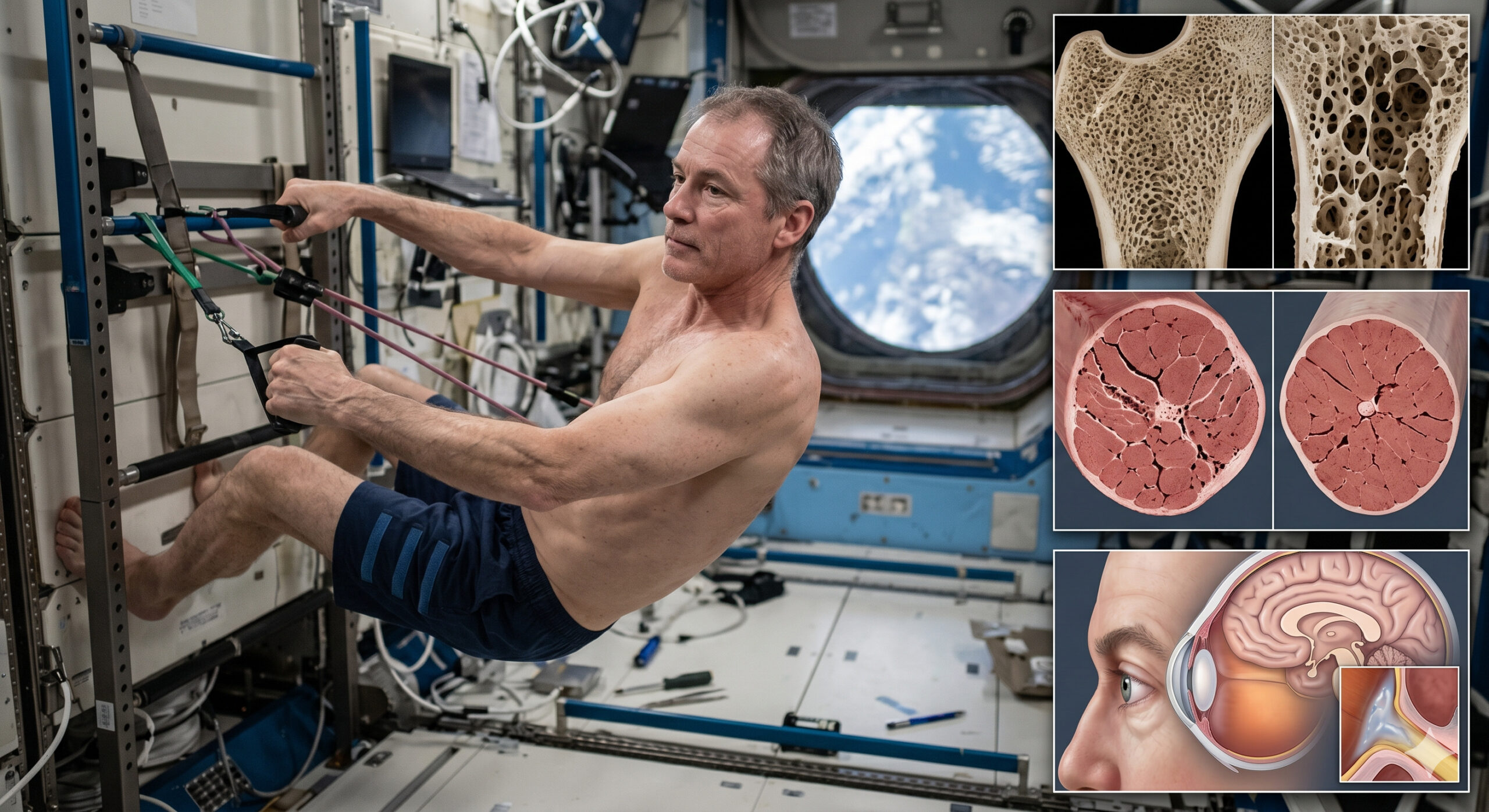

The Inspiration4 mission showed that just 3 days in space already alter immunity, telomeres, and cells, revealing rapid impacts of microgravity on the body.
In September 2021, SpaceX launched the Inspiration4 mission, the first orbital flight made up entirely of civilians, with no professional astronauts on board, in a Crew Dragon capsule that departed from the Kennedy Space Center in Florida and remained in low Earth orbit for about three days. According to the scientific documentation published in Nature on June 11, 2024, the mission launched on September 15, 2021 reached an altitude of 590.6 kilometers, above the average orbit of the International Space Station, and carried four crew members: Jared Isaacman, Hayley Arceneaux, Sian Proctor, and Christopher Sembroski.
The results showed that just three days in microgravity, space radiation, isolation, and a closed environment were enough to provoke detectable changes at different levels of the organism, including physiological, cellular, molecular, cognitive, and immunological alterations. The scientific collection linked to the Space Omics and Medical Atlas, released on June 11, 2024 by researchers from Weill Cornell Medicine, SpaceX, and over 100 institutions from more than 25 countries, gathered about 40 articles in journals from the Nature family and expanded the public volume of human omics data on space flights by more than ten times.


Among the most striking findings are changes in gene expression, in markers of the immune system, in inflammatory proteins, and in telomeres, structures located at the ends of chromosomes and associated with DNA stability. Nature itself emphasizes, however, that almost all observed changes did not remain different from baseline after returning to Earth, indicating that the study does not point to a “permanent transformation” of the body, but rather a rapid and measurable biological response to short-duration space flight.
-
Crab Trapped in Plastic Bottle for 62 Days Near Okinawa Highlights Little-Known Impact of Marine Pollution on Small Animals

-
Esperanza’s Bamboo Barrier in Oaxaca Redirects River and Reduces Erosion by 85% in Five Years

-
Family Builds Homemade Wind Turbine to Power Off-Grid Home, Video Reaches 555,000 Views on Ngô Thị Huyền’s Channel
-
Indian Brand Creates Sneakers from Recycled PET Bottles and Discarded Tires, Repurposing Over 1 Million Bottles and Raising $4 Million for Expansion





Changes in the immune system show immediate response of the human body to the space environment
One of the most relevant findings of the study was the activation of the participants’ immune system shortly after the mission. Laboratory tests indicated changes in inflammatory markers and in the activity of defense cells, suggesting that the organism recognized the space environment as a condition of physiological stress.
“`html
This type of response is considered expected, but the speed at which it occurred surprised researchers, as the participants were only about 72 hours away from Earth.
In longer missions, such as those conducted on the International Space Station, immunological changes had already been recorded, but the impact over such a short period reinforces the sensitivity of the human body to space conditions.
The microgravity environment, combined with radiation and isolation, creates a completely different scenario from Earth, requiring rapid adaptations from the organism. Immunological activation can be interpreted as a defense mechanism in response to these unusual conditions.
Telomeres underwent changes even in short missions and raise questions about cellular aging in space
Another central point of the study involves telomeres, structures located at the ends of chromosomes that play a fundamental role in protecting DNA. Changes in telomeres are associated with aging processes and various health conditions.
In the Inspiration4 mission, scientists observed changes in the length and dynamics of the participants’ telomeres. Although some of these changes proved to be temporary, with a tendency to return to the normal pattern after returning to Earth, the fact that they occurred over such a short period is considered significant.

This data reinforces the hypothesis that the space environment can directly influence deep cellular mechanisms, even in short-duration exposures, which has direct implications for future longer missions, such as trips to the Moon or Mars.
Gene expression was modified during flight, indicating cellular adaptation to the space environment
The analysis also revealed changes in the gene expression of the participants. This type of change does not mean a change in the DNA itself, but rather in how certain genes are activated or deactivated in response to the environment.
“`The data showed that genes related to the immune system, cellular stress, and the inflammatory response exhibited variations during and after the mission. This type of adaptation is known as an epigenetic response, and it represents a rapid way for the organism to adjust to new conditions.

From: Molecular and physiological changes in the SpaceX Inspiration4 civilian crew
The modulation of gene expression indicates that the human body not only reacts to space but actively tries to adapt to it, even in an extremely short period of time.
This type of evidence is considered essential to understand how the organism would behave in longer missions, where these changes could become more intense or permanent.
Altitude above the International Space Station increased exposure to radiation
One of the differentiators of the Inspiration4 mission was the altitude achieved. The capsule orbited the Earth at about 590 kilometers, while the International Space Station operates on average between 400 and 420 kilometers.
This difference, although it seems small in absolute terms, is significant from the perspective of protection against radiation. Low Earth orbit still benefits from some protection from the planet’s magnetic field, but the higher the altitude, the less this protection.

This means that the mission participants were exposed to higher levels of radiation than astronauts on conventional missions at the ISS, although still much lower than levels in deep space.
Space radiation is composed of high-energy particles that can penetrate tissues and cause cellular damage. Even short exposures are monitored closely, as their cumulative effects are still under study.
Civil mission opened a new field of study on human health outside NASA’s professional environment
Historically, the majority of studies on the impact of space on the human body have been conducted with professional astronauts, subjected to intense training and rigorous health protocols.
The Inspiration4 mission brought a new perspective by including civilian participants, broadening the scope of research to individuals with profiles closer to the general population.

This allowed for observation of how organisms not conditioned by years of space training react to the orbital environment, a piece of information extremely relevant for the future of space tourism and commercial missions.
The study published in Nature is considered one of the first to integrate clinical, genetic, and molecular data from a civilian mission, establishing a new standard for future research.
Results show that even short trips can have measurable impact on the human body
One of the main turning points of this topic lies in breaking a paradigm: the idea that only long missions would cause significant changes in the organism.
The data from Inspiration4 shows that this is not necessarily true. Even a mission of just three days was enough to generate complex biological responses.
This finding has direct implications for the future of the space sector, especially with the growth of orbital tourism, which promises to take more and more people to space for short periods. Understanding these effects is essential to ensure the safety of participants and to develop appropriate medical protocols.
Comparison with long missions shows that time is not the only determinative factor
Long-duration missions, such as those conducted on the International Space Station, remain fundamental to understanding the cumulative effects of space on the human body.
However, Inspiration4 showed that time is not the only determining factor. The intensity of the environment, altitude, exposure to radiation, and the absence of gravity are already sufficient to trigger biological responses in just a few days.
This indicates that the human body reacts to space immediately, rather than progressively, which increases the complexity of studies on space health.
Expansion of space tourism requires new medical protocols based on real evidence
With private companies expanding their operations in the space sector, the trend is that the number of crewed flights with civilians will increase in the coming years.
This creates an urgent need for evidence-based medical protocols, such as those provided by the Inspiration4 mission.
The data collected helps define safety limits, monitoring strategies, and possible medical interventions to ensure the integrity of participants, especially on repeated or longer flights.
Furthermore, these studies contribute to the planning of future interplanetary missions, where the risks will be significantly greater.
What do you think about the impacts of space on the human body even on short trips
The Inspiration4 mission showed that space is not just a technological challenge, but also a biological one. Even brief exposures can provoke measurable changes in the body, raising new questions about the limits of human adaptation outside of Earth.
Do you believe that the human body is prepared for an era of frequent space travel, or are we still far from fully understanding the risks involved?


