






 Portuguese
  Spanish


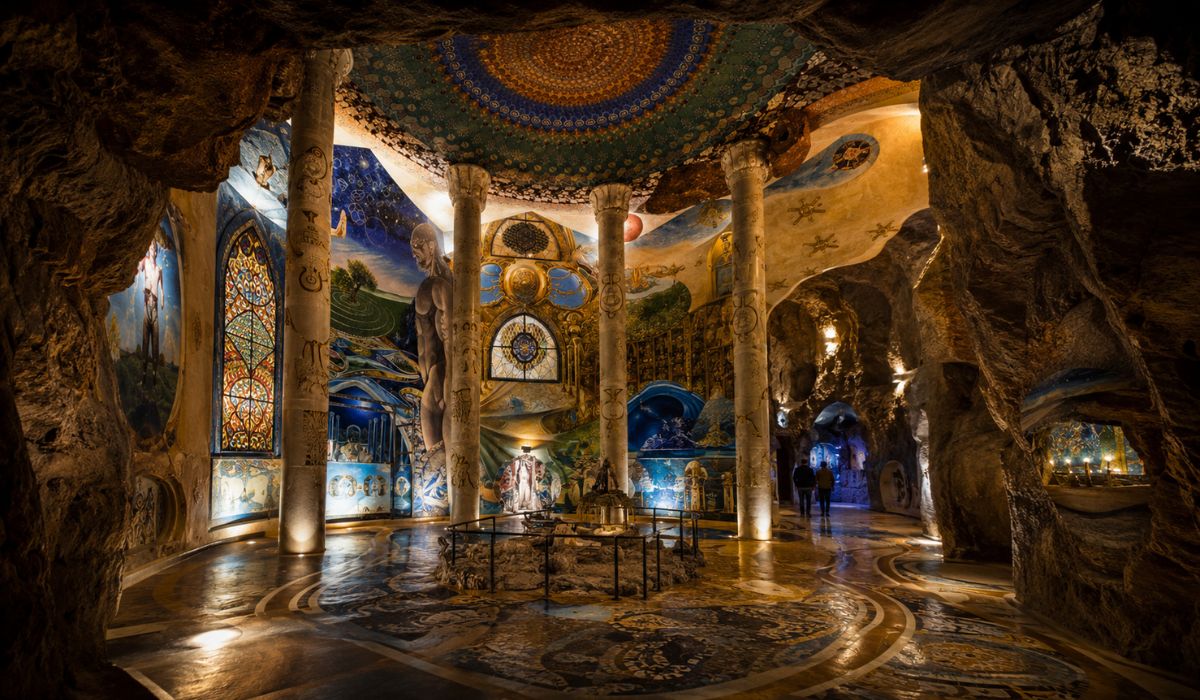

Under a mountain in northern Italy, the Damanhur community secretly built an underground complex with decorated halls, corridors carved into the rock, and a history marked by the discovery of the Italian authorities.
An Italian spiritual community known as Damanhur built, under a mountain in Piedmont, northern Italy, a set of underground temples that remained unknown to the public for years.
The work began in 1978, in Vidracco, about 50 kilometers from Turin, and was only revealed to the Italian authorities in 1992, after the existence of the structure came to the attention of the police.
Called the Temples of Humankind, the complex is described by the Damanhur Foundation as a hand-built underground work, with halls, corridors, mosaics, stained glass, murals, and sculptures distributed on different levels under the rock.
-
Workers renovating a playground in northern England uncover 176 World War II bombs buried underground; training artifacts still contained explosives.

-
Brazilian Architect Transforms Waste into Sustainable Homes with Solar Power and Rainwater Systems for 40 Years

-
Security Guard Becomes Doctor at Louisiana Hospital Where He Once Worked, Studied Chemistry Between Shifts

-
Woman Rescued from Luxury Complex in Brazil Worked Without Pay for 55 Years, May Be Entitled to Over $300,000




According to a report by the Times of India, the construction was carried out by about 500 people over 16 years, without initial authorization and without the use of large machines.
The publication also reported that the temple would reach about 30 meters deep and cover 8,500 square meters.
Other sources documenting the site, such as Atlas Obscura and ABC News, describe the work as a large underground complex, associated with the community founded by Oberto Airaudi, also known as Falco Tarassaco.
Underground Temple in Piedmont
The Temples of Humankind are connected to the Federation of Damanhur, a community founded in the 1970s and structured around community, spiritual, and artistic practices.
The group began occupying properties in the Vidracco region, where the underground complex was excavated under a mountainous area in northern Italy.
According to the Damanhur Foundation, the project began in August 1978.
In the version released by the organization itself, community members opened the first sections in the rock with simple tools and kept the work reserved until the early 1990s.
The structure brings together environments with their own symbolic functions.
Among the halls mentioned by the foundation are the Hall of Water, the Hall of Earth, the Hall of Spheres, the Hall of Mirrors, the Hall of Metals, the Blue Temple, and the Labyrinth.
Damanhur itself defines the complex as a “three-dimensional book” dedicated to representing the human journey through different forms of art.
Inside the mountain, the internal areas combine paintings on walls and ceilings, mosaics, decorated columns, stained glass, and sculpted elements.
These environments are also associated, by the community, with spiritual and symbolic themes adopted by Damanhur.
How the construction remained hidden
The construction remained secret because it was conducted within the community itself and without public disclosure.
In an interview with ABC News published in 2008, a spokesperson for Damanhur stated that the group managed to maintain secrecy and that when there was noise during the construction, the members played music to disguise the sounds.
This account helps explain how the work could continue for years without wide exposure outside the community.
The ABC News report stated that the temple was built by about 150 people over 15 years, a number different from that cited by the Times of India.
The most reliable information for the article is that the work involved Damanhur members over several years and was carried out without regular authorization at the beginning.
The excavation progressed gradually, amidst the community’s routine.
According to the Damanhur Foundation, the initial work was done with manual tools, such as hammers, pickaxes, shovels, and buckets.
The absence of large machines is one of the most cited elements in accounts of the complex’s construction.
The foundation itself presents the temples as a manually crafted work, from the labor of community members.
Decorated halls under the mountain
The interior of the Temples of Humankind is composed of different environments connected by underground corridors.
Atlas Obscura describes the complex as a construction distributed over five levels, connected by hundreds of meters of passages carved into the rock.
The organization of the halls follows a symbolic logic adopted by the community.
In the official description, each environment represents themes related to humanity, nature, the elements, and Damanhurian spirituality.
The Hall of Mirrors, the Hall of Earth, and the Hall of Spheres are among the most cited spaces in materials about the site.
Other environments, such as the Labyrinth and the Blue Temple, are also part of the structure presented to visitors.
The walls and ceilings received paintings, geometric shapes, mosaics, and colorful stained glass.
The combination of these elements transformed the clandestine construction into one of the main public symbols of the Damanhur community.
The arrival of the police in 1992
The existence of the temples became public in 1992, when Italian authorities arrived at the site following information about the underground construction.
According to Atlas Obscura, the police demanded access to the space after hearing rumors about the existence of the temple.
The report states that three police officers and a prosecutor were led inside the complex.
The entry of the authorities marked the end of the period during which the work remained hidden from inspection.
After the revelation, the structure was not demolished.
The temples underwent a process of regularization and later began to be promoted as part of the artistic and spiritual heritage of the community.
The Damanhur Foundation reports that on October 9, 1992, it held the first press conference to publicly announce the existence of the Temples of Humankind.
The following day, images of the complex were broadcast on Italian national television, according to the foundation itself.
From that moment on, the space became part of Damanhur’s public identity.
Damanhur, beliefs, and visitation
Over time, the Temples of Humankind ceased to be a construction known only to community members and began to receive visitors in activities organized by Damanhur.
Today, the foundation presents the complex as a space of art, spirituality, visitation, and symbolic research.
The community also disseminates materials about its halls, its history, and its practices on official channels.
Some ideas associated with the group, such as sacred language, specific meditations, and concepts linked to Damanhurian spirituality, appear in reports about the community.
These elements are part of Damanhur’s belief system and are treated by the organization as components of its spiritual experience.
The expression “eighth wonder of the world” also frequently appears in texts about the Temples of Humankind.
In this context, the phrase is used in promotional materials and reports to highlight the symbolic and visual dimension of the space, without equating to an official title granted by an international entity.
The trajectory of the temples brings together an underground construction made by a spiritual community, the maintenance of secrecy for years, and the subsequent opening of the space to the public.
The case continues to attract readers interested in underground architecture, alternative communities, historical curiosities, and works created outside traditional construction models.
Under a mountain in Piedmont, the Temples of Humankind remain an example of a collective project kept secret until the arrival of the Italian authorities.


