Portuguese
  Spanish


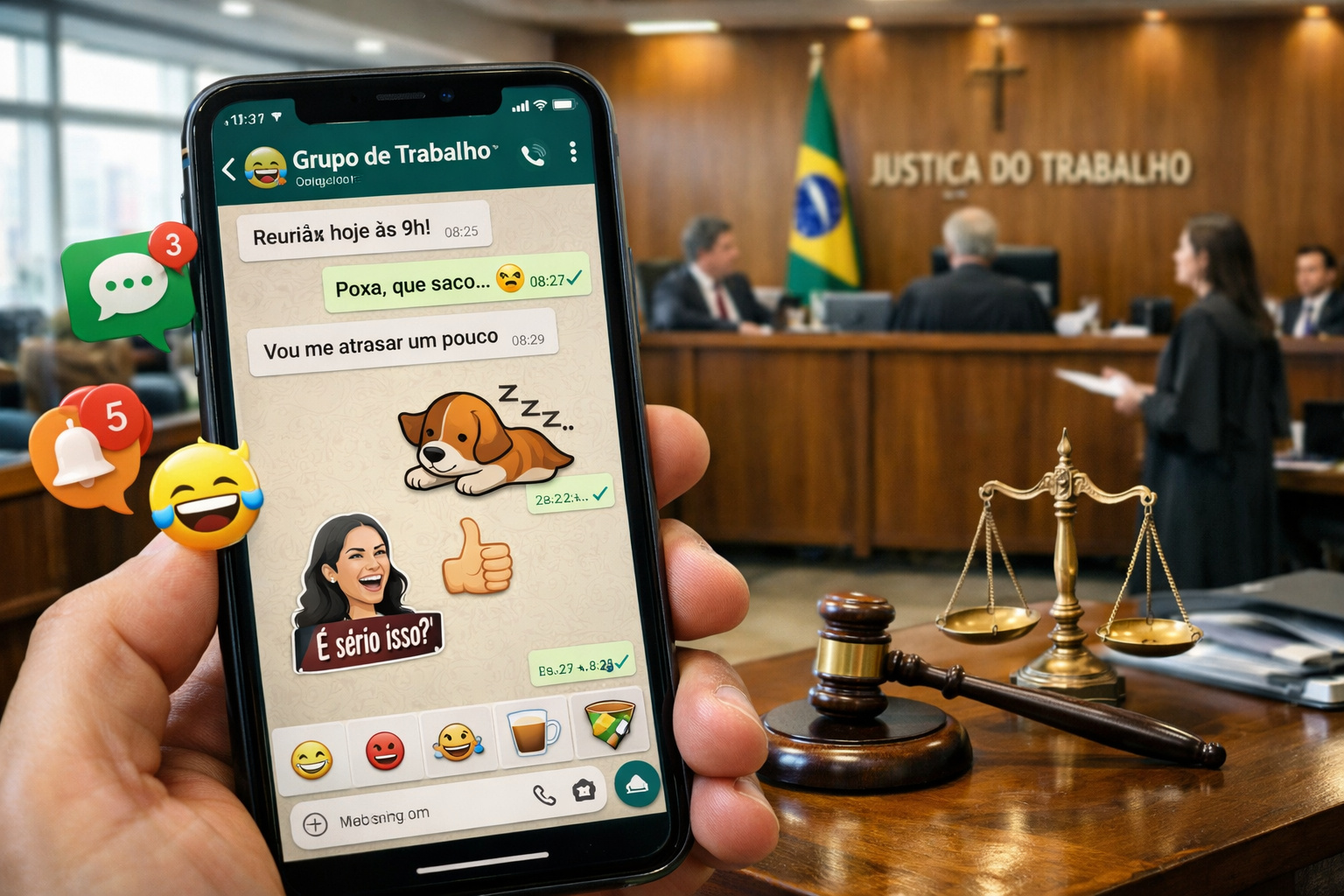

Labor Court Decision Reinforces That Extreme Punishments Require Robust Evidence and Recognizes Severance Rights After Dismissal Considered Disproportionate
The Labor Court of Minas Gerais reversed the dismissal for just cause of a worker accused of posting what were considered “disrespectful” stickers in a corporate WhatsApp group, determining the full payment of severance payments typical of an unjust dismissal. The decision draws attention for reinforcing clear boundaries between the use of internal communication tools and the application of the most severe penalty provided in labor legislation.
The case was analyzed by Judge Marcelo Oliveira da Silva, head of the 12th Labor Court of Belo Horizonte, who concluded that there was not enough seriousness in the employee’s conduct to justify the definitive breach of trust necessary for maintaining the employment contract. As a result, the company in the graphic services sector was ordered to pay compensated notice, FGTS with a 40% fine, and other labor indemnities.
Understand What Motivated the Dismissal for Just Cause
The worker had been with the company for over 13 years when he was dismissed on the grounds of misconduct and insubordination. The incident occurred after the company itself informed, in a corporate WhatsApp group, of the delay in salary advance payments to employees.
-
Are Companies Required to Release Employees During Brazil’s World Cup Matches? Understanding Workers’ Rights

-
Brazilian Family’s Homeschooling Success Sparks International Debate: Daughters Read 30 Books Annually and Speak Multiple Languages

-
Piauí Governor Enacts Law Requiring State Contractors to Reserve Jobs for Former Inmates with Minimum Wage and Verification Before Payment
-
Providing Your Tax ID at Supermarkets: A Routine Step That Can Unlock Discounts and Rewards but Also Reveals Your Shopping Habits




Following that, the plaintiff published stickers in the group, which the company owner also participated in. The employer argued that the images were “disrespectful,” caused turmoil in the corporate environment, and encouraged inappropriate behavior among colleagues, which, according to the company’s defense, justified the application of just cause.
However, upon reviewing the records, the judge noted that the worker was not the first to publish stickers related to the salary delay, dismissing the thesis that he had instigated other colleagues. Furthermore, it was proven that other employees also sent similar messages without facing any punishment.
Unequal Treatment and Lack of Evidence Weakened the Accusation
A central point of the decision was the recognition of unequal treatment. The company’s own representative, in testimony, admitted that no other employee was dismissed, despite having exhibited the same behavior in the corporate group.
According to the judge, this fact illustrates the lack of proportionality in the punishment applied only to the claimant. “I find that only the claimant was sanctioned, which indicates clear unequal treatment for individuals who exhibited the same behavior,” highlighted the magistrate in the ruling.
Additionally, the company’s claims that the posting caused “chaos,” “unjustified absences,” and “mockery” in the workplace were rejected due to lack of concrete evidence. Another relevant factor was the analysis of the internal rules of use of the WhatsApp group, which did not prohibit the sending of stickers or jokes, provided that the content was not pornographic, sensitive, prejudiced, or discriminatory, which was not verified in this case.
The information was disclosed by the Regional Labor Court of Minas Gerais (TRT-MG), according to a decision published in the process records, based on the testimonies and documents presented by the parties.
What Indemnities Did the Company Have to Pay?
By reversing the just cause, the Court recognized that the termination should be treated as dismissal without just cause, ensuring the worker access to all rights provided in the Consolidation of Labor Laws (CLT).
As a result, the company was ordered to pay the following amounts:
- Compensated notice of 66 days
- Proportional 13th salary
- Proportional vacation plus 1/3 constitutional
- FGTS deposits, with 40% fine
- Fine of article 477 of the CLT, for irregularities in the termination
In addition to the financial amounts, the company was also required to provide all necessary documentation for the former employee to withdraw the FGTS and register for unemployment insurance.
In the ruling, the judge reinforced that just cause should only be applied in extreme situations. “Dismissal for just cause is characterized as the most severe penalty imposed on the worker and, for this reason, should only be allowed when robustly proven that a serious fault exists sufficient to definitively break the trust inherent to the employment contract,” he pointed out.
Although the company appealed the decision, the issue related to the reversal of just cause was not questioned in the appeal, maintaining the understanding established in the first instance.
Do you consider it fair to dismiss an employee for messages or stickers in corporate groups, or was the punishment excessive?