Portuguese
  Spanish


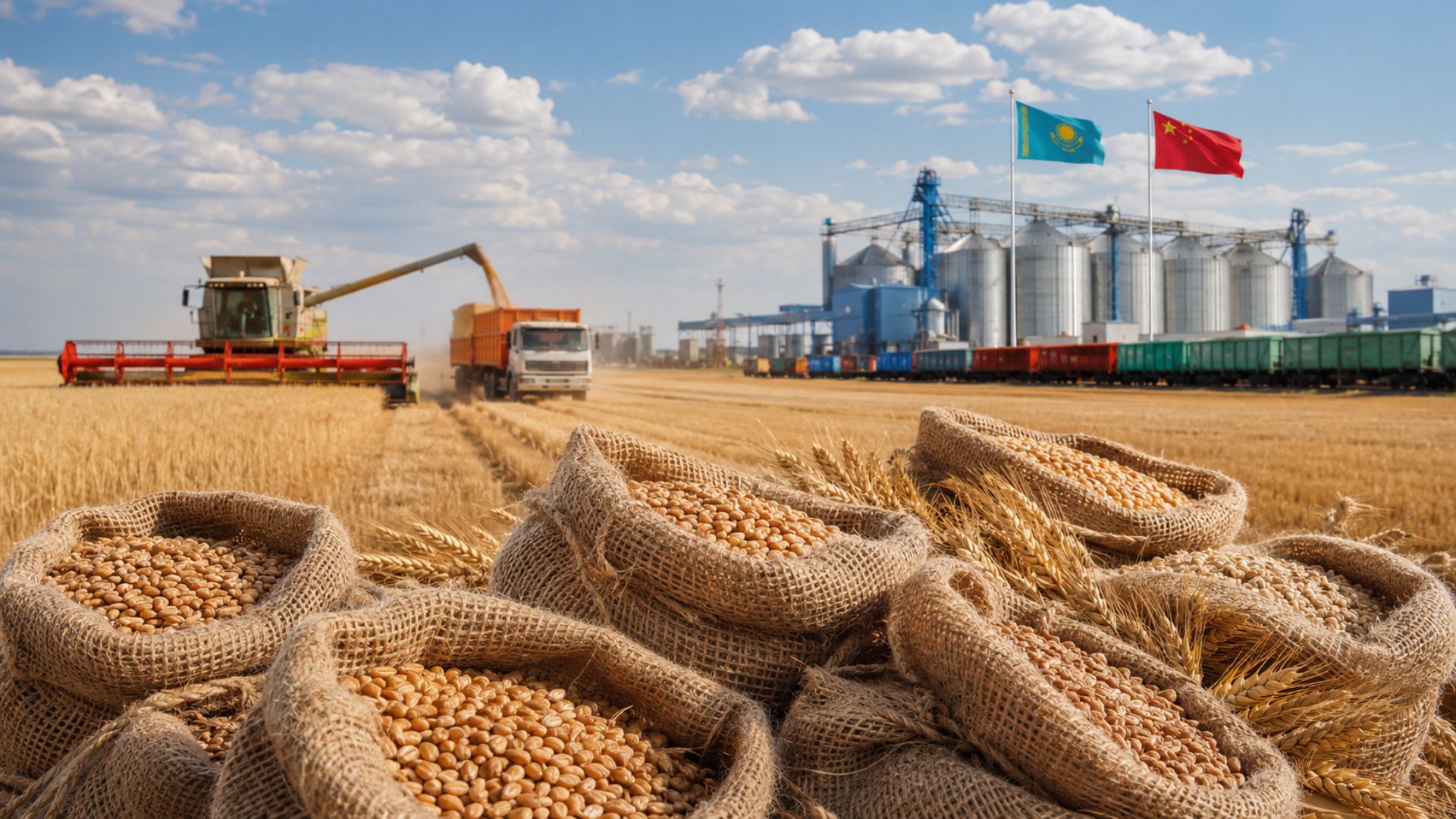

China and Kazakhstan agreed to create a joint grain trade platform that will operate based on China’s National Online Grain Trade Platform. Agricultural trade between the two countries grew 36.8% in 2025 and reached 1.97 billion dollars. According to TV Brics, in the first three months of 2026, Kazakh exports to China advanced 82.4% and reached 550 million dollars. The platform is part of the Action Plan of China and Central Asian countries, linked to the Belt and Road Initiative.
China is quietly setting up a grain supply network with its neighbor Kazakhstan that goes far beyond a simple trade relationship. Kazakhstan’s Deputy Minister of Agriculture, Ermek Kenzhekhanuly, and Liu Huanxin, head of the State Administration of Food and Strategic Reserves of China, announced the creation of a joint grain trade platform that will allow companies from both countries to trade soybeans, oilseeds, and oil sector products through direct agreements and competitive negotiations. Agricultural trade between the two countries reached 1.97 billion dollars in 2025, a growth of 36.8% compared to the previous year, and Kazakh exports to China in the first three months of 2026 have already advanced 82.4%, reaching 550 million dollars.
Liu Huanxin stated that “Kazakhstan is an important partner for China in ensuring food security and developing sustainable supply chains for agricultural products.” The platform will be developed based on the current National Online Grain Trade Platform of China, a digital infrastructure that already operates internally and will now be expanded to include Kazakh suppliers. The agreement is part of the Action Plan of China and Central Asian countries, integrated into the Belt and Road Initiative.
What the joint platform will do in practice

The grain trading platform will allow Kazakh and Chinese companies to conduct business operations through two mechanisms: competitive negotiations, similar to auctions, and direct agreements between buyers and sellers. The main focus will be on soybeans, oilseeds, and products from the oils and fats sector, categories in which Kazakhstan has surplus production and China has growing demand.
-
Solar-powered agricultural robots operate 24/7, remove weeds with 8mm precision, and aim to cut herbicide use without fuel consumption in the fields.

-
Brazilian Farmer Invents Low-Cost Tractor Using Motorcycle Parts, Efficiently Working 2 Acres on 1 Liter of Diesel

-
Regenerative Farmers Use Keyline Plow to Improve Pasture Hydration, Storing 1 Gallon of Water Every 30 Centimeters

-
Bicolor Pumpkin Resembling Hand-Painted Art Discovered by Brazilian Researchers in the Capital Due to “Spontaneous Mutation”





During the negotiations, the parties discussed the creation of logistics centers and dry ports at the border between the two countries, as well as the exchange of storage and processing technologies. The logistics infrastructure is essential because Kazakhstan is a landlocked country, and the flow of grains to China depends on efficient land corridors. The digital platform eliminates intermediaries and reduces transaction costs, making Kazakh exports more competitive in the Chinese market.
The numbers that show the speed of advancement
The trade indicators between the two countries show an acceleration that draws attention. In 2025, the trade of agricultural products grew by 36.8% and reached 1.97 billion dollars. Kazakh agro-industrial complex exports to China totaled 1.43 billion dollars in the same year, an increase of 35.3%. The main products sent were feed, vegetable oils, flaxseed and sunflower seeds, as well as rapeseed oil.
In the first three months of 2026, the acceleration became even more evident: Kazakh exports to China grew by 82.4% and reached 550 million dollars. The total volume of agricultural trade in the quarter reached 697 million dollars, an increase of 61.7%. If this pace continues throughout the year, bilateral trade could exceed 2.7 billion dollars in 2026.
Why China seeks grains in Central Asia
China’s strategy to diversify grain suppliers is not new, but it has gained urgency in recent years. The trade war with the United States, tensions with Australia, and the risk of disruptions in the Strait of Malacca maritime routes have led Beijing to seek land-based food sources that do not depend on ships and ports to reach the Chinese market.
Kazakhstan offers exactly that: it shares more than 1,700 kilometers of border with China, has vast agricultural lands, and surplus production of grains and oilseeds. The direct land connection eliminates the vulnerability of maritime routes and ensures that, in the event of a global food crisis or naval blockade, China maintains access to essential supplies. The grain trading platform formalizes this relationship and transforms it into permanent infrastructure.
What the agreement means for global food security
The creation of the joint platform positions China as a structural buyer of grains from Central Asia, which may affect the global market. Long-term contracts for the supply of grains and oilseeds, combined with logistical centers at the border, mean that an increasing share of Kazakh production will be directed to China instead of competing in the open market.
For exporters like Brazil, the United States, and Argentina, who also supply soybeans and oilseeds to China, the Kazakh agreement represents an additional competitor operating with the logistical advantage of land proximity. The platform is another piece in China’s strategy to build food redundancy: multiple suppliers, multiple routes, and multiple platforms, ensuring that no external crisis can compromise the supply for 1.4 billion people.
Did you know that China is building a grain trade platform with Kazakhstan to avoid relying on maritime routes? Do you think this could affect Brazil’s exports? Tell us in the comments.