






 Portuguese
  Spanish
  4 min of reading
  1 comment


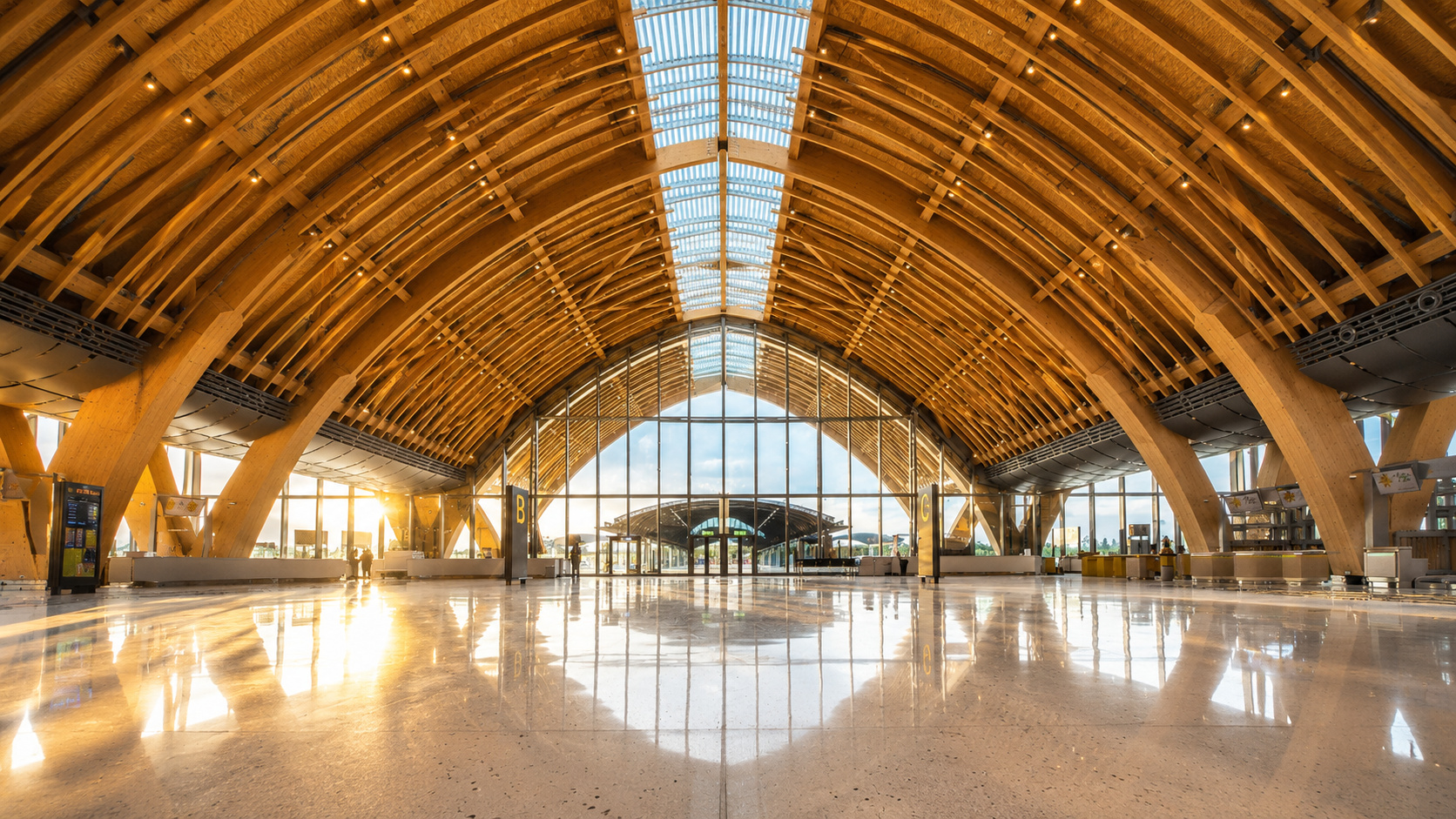


Terminal 2 of Mactan Cebu International Airport shows how glued laminated timber can transform an airport into a work of engineering, tropical architecture, and local identity, with a wavy roof reminiscent of traditional boats, breaking away from the cold standard of terminals made only with glass, steel, and concrete
While common airports resemble boxes of glass and concrete, in the Philippines a 65,500 m² terminal features laminated timber arches and a roof that looks like the inverted hull of a boat.
The project draws attention because it transforms a boarding and disembarking area into a visual experience. Instead of hiding the structure, the terminal showcases the wooden arches and creates a wavy roof, connected to the sea and local culture.
The report was published by Arup, a global engineering and project consultancy. The company states that Terminal 2 of Mactan Cebu International Airport has 3 floors, 65,500 m², and an arched wooden roof.
-
Son finds father’s forgotten notebooks and helps scientists solve the mystery of a 55-million-year-old marine fossil that remained unanswered for almost three decades.

-
Sailor sails alone from Panama to Cuba carrying just over US$ 7,000 in food, medicine, and baby formula, spends hours at Santiago de Cuba customs, and delivers everything to Cáritas, linked to the Catholic Church, to distribute to the population.

-
In the middle of a forest in the USA, a couple transforms over 1,500 recycled tires, bottles, cans, and clay into an ecological mansion, builds 90% of the house with their own hands, and puts the nearly 7-acre self-sustaining refuge up for sale for $1.3 million.

-
Cutting board created in the Netherlands uses material made by microorganisms, measures 30 x 20 cm, and aims to eliminate microplastics that can end up in food during daily preparation.




Why laminated wood became the highlight of the airport terminal
The choice of wood changes the passenger’s first impression. In many airports, the internal environment is cold, repetitive, and dominated by smooth surfaces of glass, metal, and concrete.


In Terminal 2 of Mactan Cebu International Airport, wood appears as a central part of the work. The arches create a sense of shelter, as if the roof were a large vessel turned over the internal area.
This detail makes the airport more memorable. The passenger does not just encounter gates, lines, and panels. They enter a space marked by laminated wood, curves, and a visual language connected to the territory.
What is glued laminated timber and why it appears in large coverings
Glued laminated timber is formed by layers of wood joined to create larger and more resistant pieces. In simple terms, it is industrialized wood, made to gain strength and allow for broad formats.
This type of material can be used in curved structures and large coverings. In the Filipino terminal, it helps form arches that give identity to the roof and make the internal space more imposing.
Rubner, a company specialized in wooden constructions, presents the project as the first wooden airport terminal in Asia and reports the use of 4,500 m³ of glued laminated timber in the construction.
The roof resembles an overturned boat and brings the airport closer to the culture of the Philippines
The shape of the covering is not just an aesthetic choice. The image of the curved roof resonates with the maritime environment of Cebu and with the traditional boats known as bangka.
Therefore, the comparison with an inverted boat hull works so well. The structure seems to cover the terminal like a large overturned canoe, creating a simple, strong, and easy-to-understand image.
This feature brings the airport closer to the local identity. Instead of appearing as a generic terminal, the building uses form, material, and scale to remind that it is in a region marked by the sea.
A terminal of 65,500 m² shows that an airport can also be a work of architecture
Airports are usually remembered for capacity, delays, gates, and queues. However, Terminal 2 of Mactan Cebu International Airport shows another path, where the structure also becomes part of the experience.
The construction uses the wooden arches as the main visual element. This helps the passenger perceive the size of the space and gives the terminal a different appearance from most international airports.

Arup, a global engineering and project consultancy, detailed the central points of the project and highlighted the building of 3 floors with 65,500 m². These data reinforce the scale of the construction and the weight of the architectural solution.
Why airports are trying to create their own identity
An airport is the first image many visitors have of a destination. Therefore, some terminals have started to seek elements that showcase something of the local culture, landscape, and history.
In the case of Mactan Cebu, the wood, the curves, and the reference to traditional canoes create a direct connection with the island. The terminal ceases to be just a transit point and starts to function as a calling card.
This choice also helps to differentiate the airport in a very standardized sector. When many terminals look alike, a glued laminated timber roof inspired by boats becomes a rare and memorable element.
What makes this terminal different from common airports
The main highlight is the combination of scale and visual language. The terminal has 65,500 m², uses laminated wood arches, and features a wavy roof reminiscent of a ship’s hull.
This union creates an unusual work for an international airport. The wood does not appear just as decorative finishing. It helps to build the image of the building and strengthens the project.
In an area where concrete and steel usually dominate, Terminal 2 of Mactan Cebu International Airport shows that infrastructure can also have identity, cultural memory, and visual impact.
The Filipino terminal draws attention because it transforms a transportation work into a reference of tropical architecture. The wooden roof, the exposed arches, and the image of an inverted boat make the airport stand out from the standard.
Instead of being just a transit place, the building shows how large structures can tell local stories. Do you think Brazilian airports should also use more cultural elements and striking materials to create a more unforgettable arrival?






This project of MCIA Terminal 2 was created, constructed i believe by Megawide Contruction. The airport had recieved many accolades after its expansion throughout the years. But because of politics and cheap tactics of bigger corporation who wants to take over the operation of the airport business they sued the Megawide Construction Corp to boot them out and take over the honor from the original creator of this ingenious project.