Portuguese
  Spanish


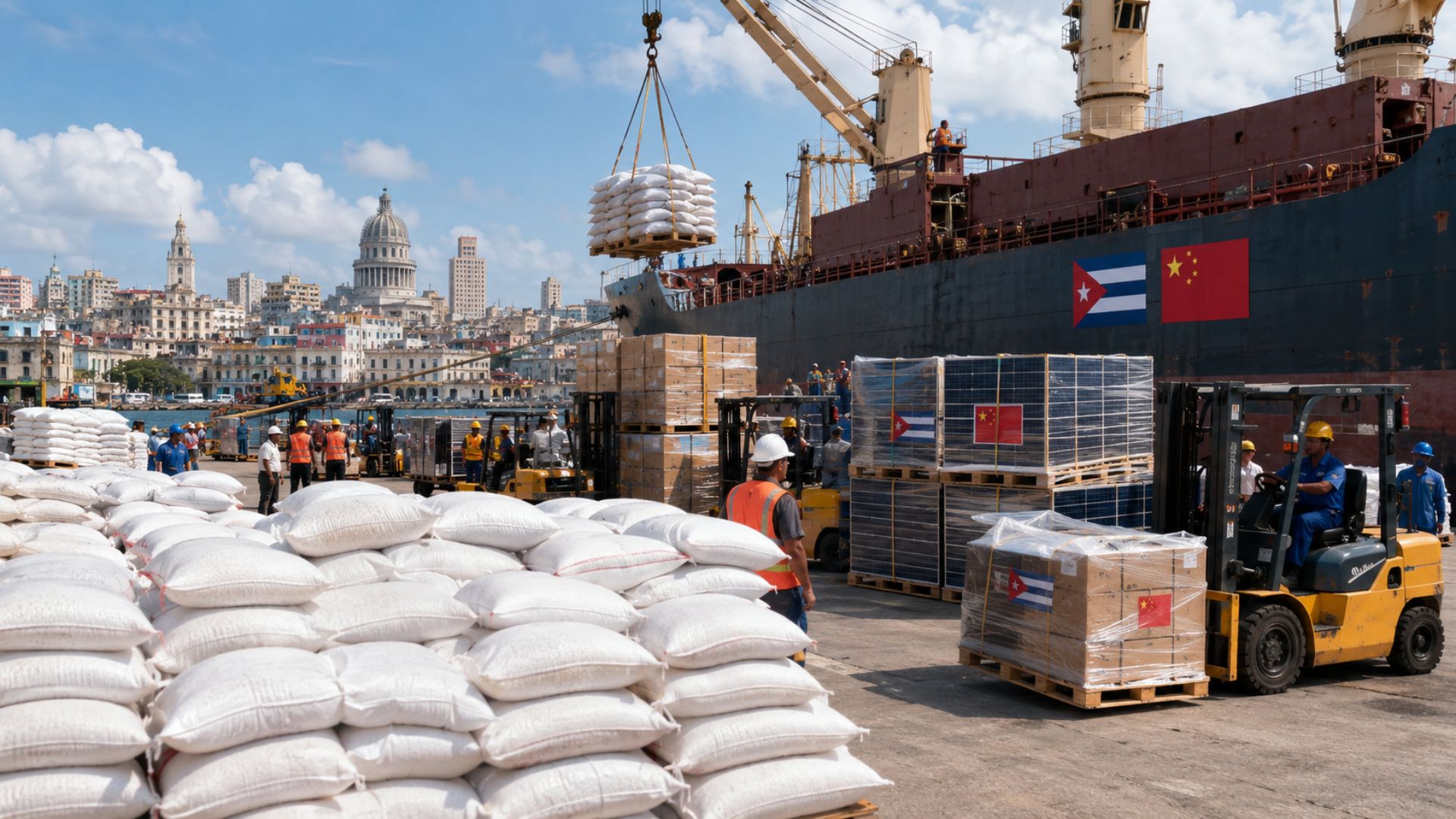


China delivered this Saturday (23) a shipment of 15,000 tons of rice at the port of Havana as the first installment of an emergency donation of 60,000 tons approved by President Xi Jinping in January. According to CNN Brasil, China’s aid package to Cuba also includes 80 million dollars in emergency funds, photovoltaic equipment, and solar kits for hospitals. The delivery takes place amid the tightening of the United States blockade, which intensified tariffs on nations supplying oil to the island.
China has just unloaded 15,000 tons of rice at the Haiphong terminal of the port of Havana, marking the start of a food aid operation that promises to send 60,000 tons of grain to Cuba over the coming months. The Chinese ambassador in Havana, Hua Xin, stated that the delivery “once again shows the fraternity and solidarity between the two countries” and that the remainder of the donation will continue to arrive in regular shipments managed by the China International Development Cooperation Agency.
The donation is part of a billion-dollar package personally approved by President Xi Jinping in January 2026, which includes 80 million dollars in emergency funds aimed at the recovery of the Cuban electrical system. China is also sending photovoltaic equipment and solar kits intended for hospitals, polyclinics, and communities affected by prolonged blackouts on the island. The spokesperson for the Chinese Ministry of Foreign Affairs, Mao Ning, urged the United States to “immediately cease the blockade and sanctions against Cuba, as well as any form of coercion or pressure.”
What China is sending to Cuba

The aid package approved by Xi Jinping is composed of three fronts: food donation, financial support, and energy infrastructure. The food donation totals 60,000 tons of rice, of which 30,000 had already been delivered in January under Xi Jinping’s directive. The 15,000 tons landed this Saturday are the first batch of a new shipment that left Shanghai on May 19, and the remainder will arrive in the coming months.
-
Brazilian Construction Worker Moves to France, Earns Up to €2,500 Monthly with Home Renovations, Gains Social Media Attention

-
US Navy Sinks USS Oriskany with 230 kg of C-4, Creating World’s Largest Artificial Reef in 37 Minutes

-
U.S. Dumped Tanks, Jeeps, and Coca-Cola into the Pacific in 1945 After British and French Lowball Offer, Creating “Million Dollar Point”
-
WHO Warns of Unnecessary Interventions in Natural Births Worldwide, Advocates for More Human-Centered Care, Reigniting Debate on Medicalization





The 80 million dollars in emergency funds will be mainly directed towards the recovery of Cuba’s electrical system, which has suffered recurring collapses since 2024. In the energy sector, China is sending solar parks, photovoltaic equipment, and solar kits to hospitals and isolated communities, aiming to reduce Cuba’s dependence on imported diesel for electricity generation.
The US blockade that made China’s aid urgent
Cuba is experiencing its worst economic crisis in decades, with shortages of food, fuel, and medicine affecting the entire population. The tightening of the blockade by the United States under the Trump administration included the imposition of tariffs on nations supplying oil to Cuba, a measure that further restricted the island’s access to essential fuels for transportation, power generation, and agricultural production.
The distribution of China’s 15,000 tons of rice reached 11 Cuban provinces, from Pinar del Río to Las Tunas, as well as essential public service centers. The Minister of Domestic Trade, Betsy Díaz Velázquez, attended the reception ceremony alongside Deputy Prime Minister Oscar Pérez-Oliva Fraga, signaling the political importance the Cuban government attributes to China’s aid.
What China gains from solidarity with Cuba
China’s aid to Cuba is not just humanitarian, it is geopolitical. By supporting the island amid the American economic siege, China shows the world that it can be an alternative to the United States as a partner for countries in difficulty, especially in Latin America and the Caribbean. The message is directed both to Cuba and to dozens of countries observing the confrontation between Washington and Havana.
Ambassador Hua Xin reinforced this narrative by stating that “Cuba is a peaceful country and poses no threat to anyone” and that China “has always resolutely opposed the US blockade and its illegal unilateral sanctions.” The Chinese Consul General in São Paulo, Yu Peng, went further and declared that Beijing “never forced Latin America and the Caribbean to participate in any political bloc,” positioning cooperation as voluntary and respectful.
International mobilization around Cuba
China is not alone in aiding Cuba. Brazil announced the shipment of over 20,000 tons of food through the UN World Food Program. American legislators visited the island and expressed rejection of Washington’s hostile policy, and a coalition formed by Brazil, Mexico, and Spain demanded an end to the blockade.
Two sailboats with medical and food supplies departed from Mexico in March and arrived in Havana after losing communication for days, in a crossing that highlighted the urgency of the situation. China, however, is the player operating on the largest scale: 60,000 tons of rice, 80 million dollars in funds, and energy infrastructure constitute the largest aid package Cuba has received from a single country in years, all approved by Xi Jinping. For the island, it’s oxygen. For China, it’s influence.
Do you think China’s aid to Cuba is genuine solidarity or geopolitical strategy? Should the American blockade be maintained or is it harming the civilian population? Tell us in the comments.