






 Portuguese
  Spanish
  3 min of reading
  0 comments


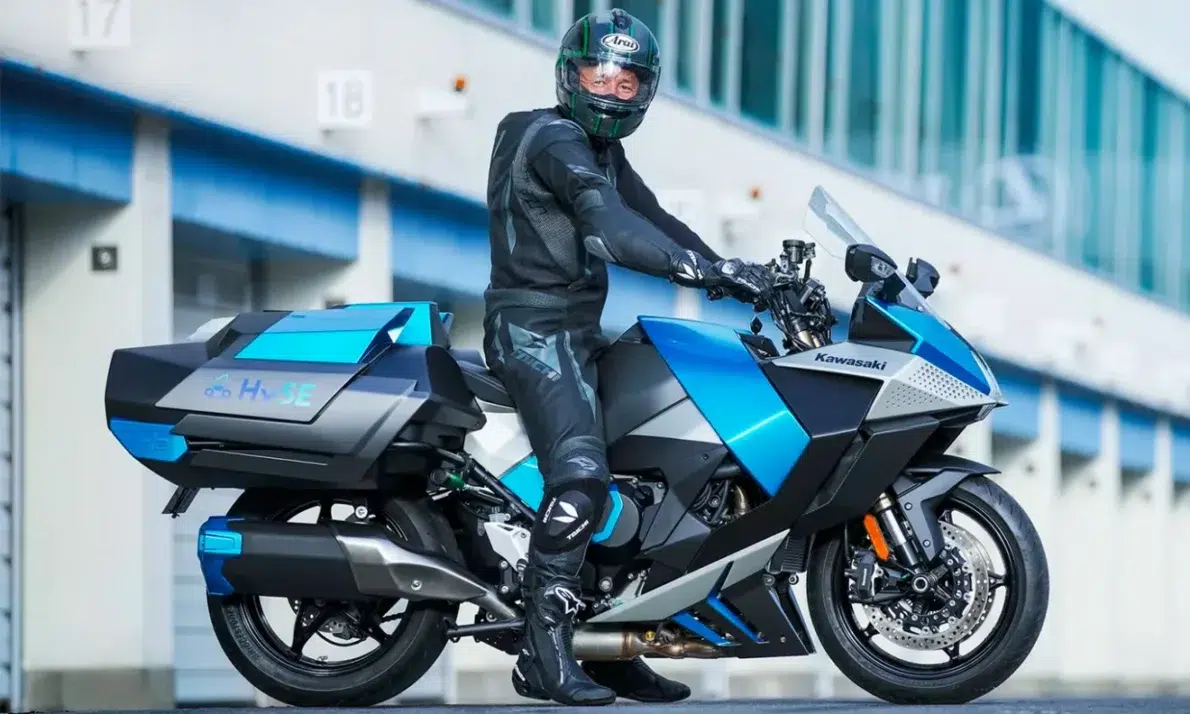
Japanese Brand Launches New Motorcycle Powered by Sustainable Fuel. New Hydrogen-Powered Kawasaki Ninja Could Change the Two-Wheeler Segment and Reinvent Motorcycles.
The Kawasaki Motors held its first worldwide public demonstration of a hydrogen motorcycle at the Suzuka Circuit in the Japanese city of Suzuka. The hydrogen-powered Kawasaki Ninja was developed and built as part of research initiated in March 2023, with testing that started this year and culminated in the recently held public demonstration.
Check Out All the Details of the Hydrogen-Powered Kawasaki – The First Motorcycle in the World Powered by Hydrogen
The hydrogen motorcycle is equipped with a hydrogen engine based on the 998 cm³ turbocharged four-cylinder engine found in the brand’s Kawasaki Ninja H2, with specific modifications to allow direct injection of hydrogen into the cylinders, and respective combustion in four-stroke cycles.
The hydrogen-powered Kawasaki Ninja frame was designed to accommodate low-temperature cylindrical fuel tanks and a compatible fuel injection system.
-
Uber Faces Shareholder Scrutiny as Board Accused of Ignoring Safety, Compliance, and Harassment Warnings Amid Over 3,500 U.S. Lawsuits

-
Ferrari’s First Electric Car Divides Fans, Priced at $630,000, Amid Concerns Over Limited Editions; Brand Clarifies It’s Not Just for Future Perks
-
BYD Dolphin Mini: The Electric Car That Defies Depreciation, Losing Only 3.58% in a Year and Becoming the Best-Selling Retail Model Under $22,000

-
Electric Car JAC E-JS4 Loses $19,000 in Value in One Year, Leading Record Depreciation of Used Cars in Brazil Due to Expensive Battery and New Models


Hydrogen internal combustion engines produce the sound and pulsing sensation that motorcyclists enjoy when accelerating, emitting primarily water in its gaseous state. The Japanese brand refers to the emissions of the hydrogen Kawasaki Ninja as equivalent to those of a household humidifier.
As part of its carbon neutrality initiative, Kawasaki Motors is currently conducting research and development with the goal of finalizing a functional motorcycle, with a hydrogen internal combustion engine as an option for carbon-neutral mobility for motorcyclists in the early 2030s.
Hydrogen Kawasaki Ninja Is Produced in Partnership with Other Companies
Kawasaki Motors is a full member of Hydrogen Small Mobility & Engine Technology (HySE), a research association focused on hydrogen technology that is conducting fundamental research on engines powered by this sustainable fuel, hydrogen refueling systems, and fuel supply systems, with the aim of manufacturing hydrogen-powered urban mobility vehicles, including motorcycles.

This is a research association founded by major Japanese manufacturers, including Kawasaki Heavy Industries, Ltd., Kawasaki Motors, Suzuki Motor Corporation, Toyota Motor Corporation, Honda Motor, and Yamaha in May of last year.
In order to further strengthen the Japanese brand, Kawasaki Motors will provide products and services that meet the needs of customers and society, including efforts to achieve a zero ecological footprint, exploring all possibilities in the pursuit of happiness and joy for all. The hydrogen-powered Kawasaki Ninja has not had technical data, availability, price, or even viability disclosed.
Difficulties Faced by the Brand During the Production Phase of the Hydrogen Motorcycle
This hydrogen Kawasaki Ninja represents a milestone in the search for sustainable mobility means, being powered by a H2 Supercharged engine, a four-cylinder inline with a centrifugal compressor.
The challenge now lies in adapting the engine to use hydrogen, requiring a specific injection system for the fuel, whose combustion point is lower than that of gasoline. Despite the challenges related to hydrogen storage, the Japanese brand highlights the environmental benefit of the technology, evidenced by the emission of polluting gases.
Hydrogen is a clean fuel, given that the only waste it produces is water vapor. In its free state, it consists of two atoms that, when combined with oxygen during use, generate water.
These conditions, according to scientists, are sufficient to address the environmental emergency, something that can no longer be postponed. With ongoing studies and experiments, the expectation is that this percentage can be significantly increased, while the gasoline or diesel engine can no longer be optimized.





Be the first to react!