






 Portuguese
  Spanish
 4 min of reading
  7 comments


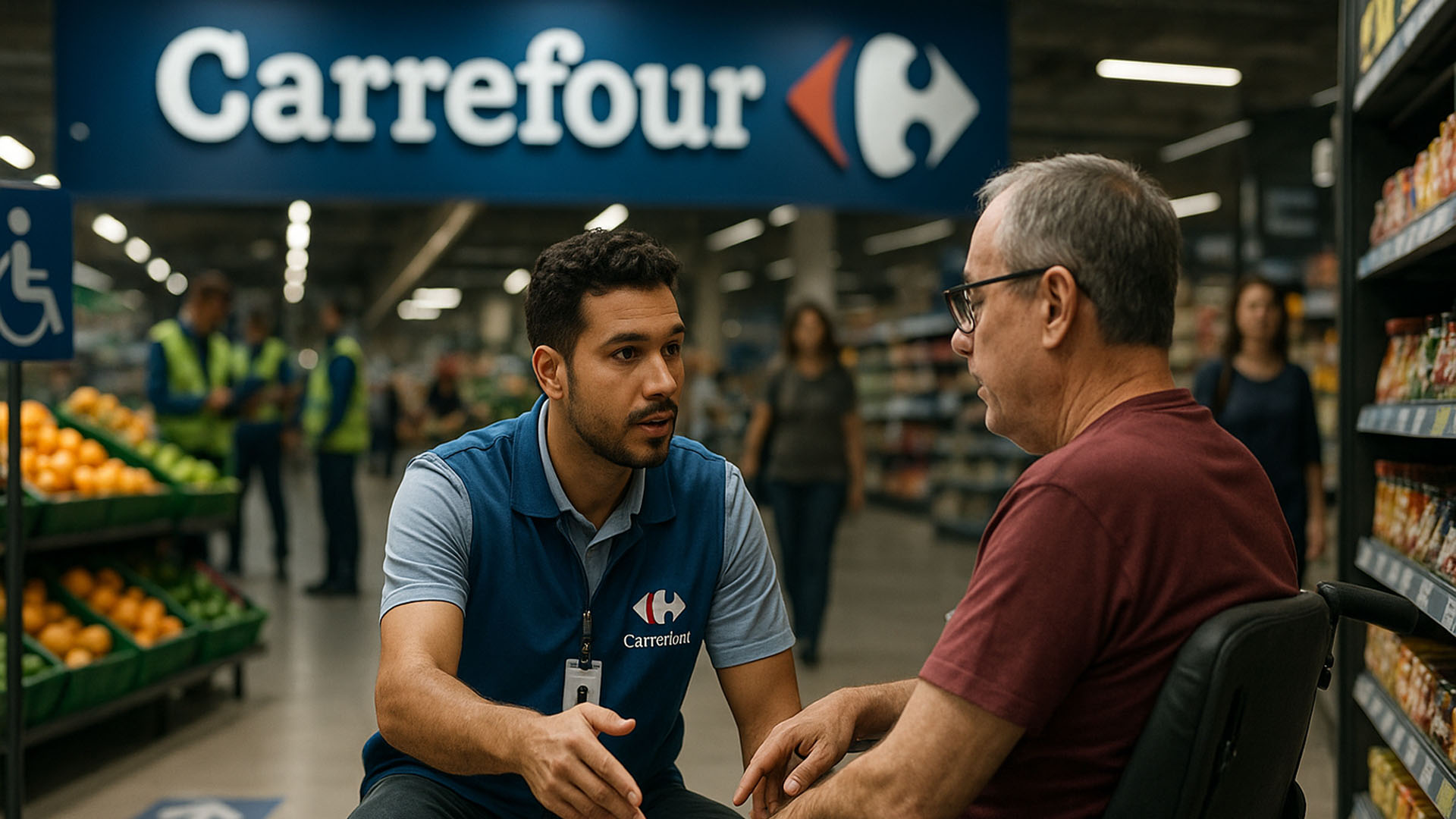


In 2025, Law 14.771/2024 came into effect in Bahia, requiring assistance for people with disabilities in hypermarkets, supermarkets, and similar establishments. The rule also applies to national and local chains and imposes fines of R$ 2,000 to R$ 10,000 for non-compliance.
Law 14.771/2024 requires establishments with more than ten employees to train and provide staff to assist people with disabilities or reduced mobility during shopping. Support includes guiding inside the store, indicating product locations, and reading labels.
The regulation also mandates a visible poster informing about the right to assistance. The request can be made at the information desk or to any employee, which standardizes the service flow and facilitates enforcement.
Non-compliance results in a fine of R$ 2,000, increased to R$ 10,000 in case of recurrence; the amounts go to a fund of the State Council for the Rights of Persons with Disabilities (Coede/BA).
-
Detran RJ starts requiring a toxicological test for those obtaining their first driver’s license in the car and motorcycle category starting June 29; see who will be affected.

-
Florida takes TikTok to court and accuses the Chinese giant ByteDance of ignoring the law that bars minors under 14, while parents and authorities demand more protection for children on social networks.
-
Chamber approves constitutional amendment reducing the age of criminal responsibility from 18 to 16 years; what now?

-
Justice confirms that old debts in tax executions that have been stalled for more than 15 years can no longer be collected through judicial or administrative means.


The law applies to hypermarkets, supermarkets, convenience stores, wholesale markets, and department stores throughout the state. It came into effect in March 2025, after its promulgation in September 2024 by ALBA.
Who Needs to Comply
The obligation applies to all physical stores in these segments in Bahia, regardless of size. The guideline aligns with federal landmarks such as the Brazilian Inclusion Law (13.146/2015) and Law 10.098/2000, which already require accessibility and proper service.
Large chains with a presence in the state such as Carrefour and Assaí, fall under this scope and must adjust processes and train teams to comply with Law 14.771/2024. Assaí lists branches in Salvador, such as Barris and Paralela. Carrefour advertises an address in Pituba (ACM) among 24-hour operations.
Operational guidance includes mapping request points, standardizing approaches, and recording service interactions for compliance and internal auditing purposes, mitigating the risk of penalties. (Technical context, aligned with the LBI.)
Enforcement, Penalties, and Consumer Communication
The requirement for a notification poster standardizes the right and facilitates proof in case of complaints. The request channel must be clear: service desk or identified professionals.
Fines start at R$ 2,000 and increase to R$ 10,000 if there is recurrence. The allocation to the Coede/BA fund connects the sanction to public inclusion policy, creating a financing cycle.
Consumer defense agencies can be contacted. In terms of governance, quick response procedures and training proof reduce liabilities.
Economic and Operational Impact on the Sector
The law demands ongoing training and scaling adjustments during peak hours. For chains with a high density of stores, the marginal cost tends to be diluted in volume, while medium-sized markets need to optimize staff allocation.
There is synergy with national trends: food retail reached R$ 1.067 trillion in 2024, according to the ABRAS 2025 Ranking, reinforcing the sector’s financial capacity to incorporate accessibility protocols.
Employee training in Bahian supermarkets and fines for denying assistance to persons with disabilities are points of attention in audits. Accessibility in supermarkets also represents a competitive edge given a more demanding consumer.
Who Are the Leading Networks in Bahia and Brazil
In Brazil, Carrefour and Assaí lead food retail revenue, with R$ 120.59 billion and R$ 80.57 billion respectively, in 2024. Grupo Mateus follows in sequence.
In Bahia, among the networks headquartered in the state, Atakarejo reached R$ 5.23 billion and ranks 22nd nationally. RMix recorded R$ 1.09 billion and Hiperideal, R$ 1.04 billion in the ABRAS 2025 Ranking.
According to the 2024 survey, Hiper Compras Atacado totaled R$ 688 million, making up the group of local players that will need to adjust service and signage to the new law.
What Changes for the Consumer
Consumers with disabilities will have explicit rights to assistance in locating items and in reading information such as price, validity, and weight, with a visible request point.
The state law operates in addition to federal accessibility standards, which already guarantee priority service and eliminate barriers. The expected outcome is a more autonomous shopping experience.
In case of denied assistance, the customer can contact consumer protection agencies and file a complaint, which may result in a fine for the establishment. Keeping records (photos of the poster, protocol) is advisable.
Share your opinion. Do you think that the requirement for trained teams increases costs and may impact prices or pushes the sector toward a new service standard? Comment below and say if your shopping experience has already improved after the law.





Supermercado agora será obrigado a fazer o papel dos familiares. Era só o que faltava.
Vai ter que esse carrinho para aqueles bando de gordo folgado,fresco e chorão sempre usa a desculpa da gordofobia para dizer que tá a fim de discriminada que ****.
Só pode ser um ****… Pra ser tão podre e imundo!
Sugiro voltar pra escola e aprender a escrever direito… Quem sabe ajuda a desenvolver o caráter e a empatia ao próximo…
Concordo em número, gênero e grau! Essa determinação é justa! Há também, a necessidade do Procon agir nesses grandes mercados com ênfase na exigência que por exemplo, o Assaí Atacadista de forma INTERNA e procurando otimizar o fluxo de consumidores no interior dessas lojas, limitarem em até 15(QUINZE) volumes as compras de quem estiver utilizando os caixas expressos! Isso pode até funcionar, porém, alguns clientes preferenciais que adquirem pouco mais do que essa quantidade estipulada nem sempre irão encontrar os caixas preferenciais com fila pequena! Normalmente, os carrinhos com compras nessas filas estão lotados e muitos preferenciais ali durante quase o dia inteiro! Desde ontem, 23-10-2025, enviei um e-mail ao PROCON RJ (reclame@procon.rj.gov.br) alertando sobre esse problema recorrente e até mesmo citei um epis**** recente onde uma lactante e seu filho muito pequeno precisou descartar alguns itens para se adequar aos tais 15(QUINZE) volumes permitidos naquela fila expressa. Conversando com ela antes, enquanto estávamos aguardando chegar a nossa vez de pagar, mencionou que a fila preferencial estava muito longa e por isso resolveu arriscar na fila expressa com mais que a quantidade permitida ali por cliente. Outro consumidor também estava ali com.muito mais itens do que ela e decidiu ir para a fila regular antes que fosse tarde demais! O sistema de alto falante dessa loja Assaí localizada na Avenida Presidente Kennedy, 429 no centro de São Gonçalo, comunica à todo instante essa característica da fila expressa, entretanto, nem todos os clientes estão prestando atenção ao que é falado pela comunicadora e isso, sem mencionar os consumidores portadores de deficiência auditiva! Espero que o Procon RJ seja proativo e resolva esse problema o quanto antes!