






 Portuguese
  Spanish


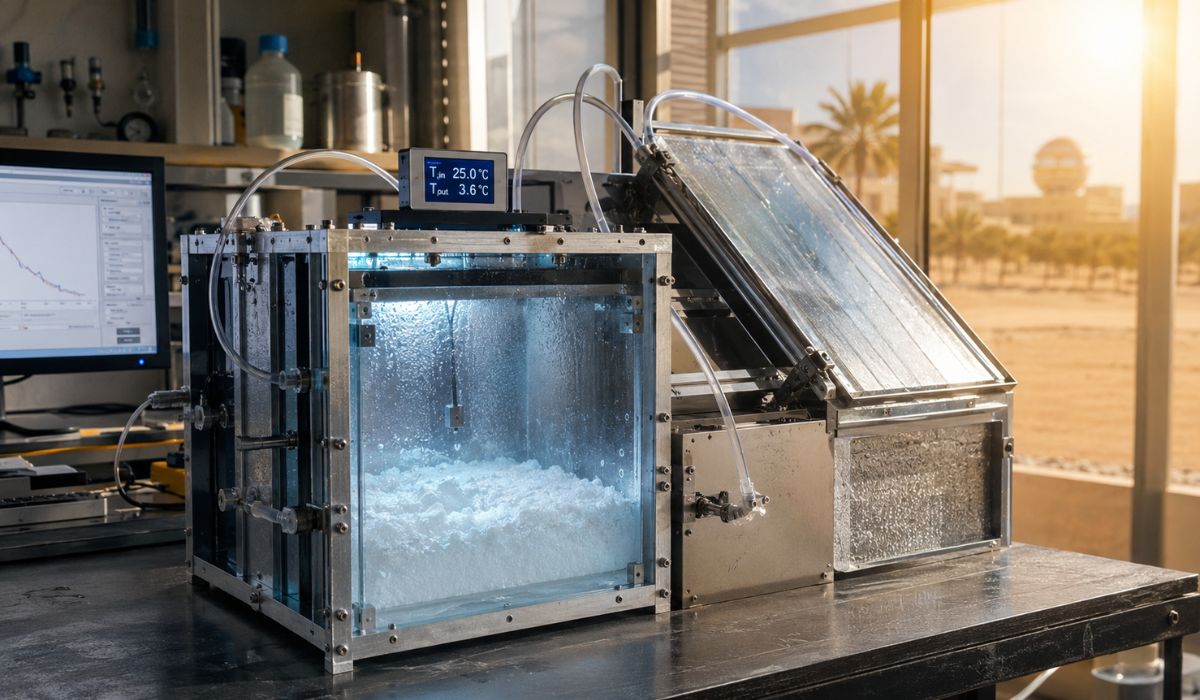


Technology studied in Saudi Arabia shows how simple principles of chemistry can open up cooling alternatives in hot, remote locations with limited access to electricity, still in the experimental phase.
Researchers at King Abdullah University of Science and Technology, KAUST, in Saudi Arabia, have developed an experimental cooling system that operates without electricity during the cooling process.
Called NESCOD, the method uses the dissolution of ammonium nitrate in water to extract heat from the surroundings and relies on sunlight to recover the salt after use.
The technology was presented in a study published in the journal Energy & Environmental Science, by the Royal Society of Chemistry.
-
AI Radar Built with Old Camera and $20 Gains Attention After Alleged $317,000 Sale to Chinese Government, But Lack of Documentation and Official Confirmation Raises Questions

-
Amateur Detectorist Discovers 3,400-Year-Old Bronze Age Gold Treasure with 121 Pieces in Transylvania, Including a Unique Ring

-
Italian Designer Develops Solar-Powered Terracotta Water Purifier Producing Up to 5 Liters of Drinking Water Daily Without Electricity

-
New Hydrogel Made from Algae and Shrimp Shells Absorbs 60 Times Its Weight in Water to Combat Drought in Spanish Agriculture


The work describes a solution based on chemical reactions and solar energy, focusing on applications where the power grid is unstable, nonexistent, or insufficient to maintain conventional cooling systems.
NESCOD should still be regarded as a scientific demonstration, not as a commercially available product on a large scale.
According to the study, tests were conducted under controlled conditions, which limits direct comparisons with refrigerators, cold rooms, or air conditioning equipment used in everyday life.
Cooling system without electricity uses chemical reaction
The principle of the system lies in the so-called endothermic dissolution.
In this process, a substance absorbs thermal energy from the environment when dissolved in water.
In the case studied by KAUST, the compound used was ammonium nitrate, identified by the chemical formula NH4NO3.
When the salt comes into contact with water, the solution starts to extract heat from the nearby environment.
This exchange reduces the temperature of the assembly and allows the effect to be used to cool containers, food, or small spaces, according to the parameters evaluated by the researchers.
The choice of ammonium nitrate was made after comparison with other salts.
According to KAUST, the compound showed high solubility in water and superior performance to alternatives such as ammonium chloride.
The university reported that its solubility reached 208 grams per 100 grams of water, while other salts analyzed generally remained below 100 grams.
In one of the experiments, the researchers gradually dissolved the salt in water inside a metal container placed in a polystyrene foam box.
The temperature dropped to about 3.6 °C and remained below 15 °C for more than 15 hours, a range considered useful for preserving food and other heat-sensitive items.
The article also reports that the system reached a cooling power of up to 191 watts per square meter under illumination equivalent to “one sun,” a measure used in the laboratory to simulate standard solar radiation.
This data refers to the performance observed in the experiment and does not mean, by itself, that the same result will occur in any real environment.
Sunlight allows for the reuse of ammonium nitrate
The technology does not rely solely on the salt’s ability to cool the water.
To repeat the cycle, it is necessary to recover the ammonium nitrate after dissolution.
This step occurs through the evaporation of water, driven by sunlight.
In the study, the team describes a three-dimensional solar regenerator, similar to a cup, designed to absorb radiation and promote evaporation.
As the water leaves the solution, ammonium nitrate crystals reform on the outer surface of the device.
Once collected, the salt can be used again in another cooling cycle.
According to the research authors, this mechanism allows for separating the moment of “recharging” the material, done under solar exposure, from the moment when cooling is needed.
KAUST states that the recovered salt functions as a form of storage for the effect obtained with solar energy.
Instead of immediately converting light into electricity, the system uses the sun to return the compound to a solid state and prepare a new cooling round.
The study also mentions the possibility of recovering part of the water vapor generated in the process.
This application, however, depends on engineering adaptations and does not appear as a ready-to-use solution for everyday use.
Refrigeration in remote areas is the focus of the technology
Refrigeration plays a direct role in the preservation of food, medicines, and vaccines, as well as reducing risks associated with heat in certain conditions.
In many regions, however, conventional equipment requires constant electricity, technical maintenance, and infrastructure that are not always available.
For this reason, the researchers associate NESCOD with applications in remote areas, off-grid communities, temporary shelters, and facilities that need to maintain controlled temperatures with low energy consumption.
The study cites potential uses in food storage, space cooling, and preservation of sensitive products.
The technology also uses materials already known to the industry.
Ammonium nitrate is manufactured on a large scale and has established use, especially as a fertilizer.
Any practical application, however, would need to consider transportation, storage, and chemical safety regulations, as the compound requires proper handling control.
Another point described by the researchers is that cooling does not need to occur at the same time as solar exposure.
Regeneration can be done beforehand, while the recovered salt can be stored for later use.
This feature differentiates the system from methods that rely on immediate solar incidence to function.
Prototype still depends on new tests
The transition from a laboratory prototype to a product applied in homes, hospitals, or logistics operations depends on new tests.
Among the factors that need to be evaluated are humidity, ventilation, size of the environment, thermal loss, operating cost, device durability, and safety under different usage conditions.
There is also no secure public confirmation that NESCOD is in commercial operation or has been adopted on an industrial scale.
The available information indicates a technology demonstrated in a scientific study and disclosed by the university itself, but does not prove mass production.
The absence of electricity in the cooling cycle does not eliminate other practical challenges.
To function outside the laboratory, the system would need to be adapted to different volumes, usage routines, and regulatory requirements.
These points often determine whether an experimental technology can reach communities, companies, or public services.
Even so, the research shows how known chemical phenomena can be reorganized to tackle refrigeration problems in hot regions.
The proposal combines an endothermic reaction with solar regeneration and presents an alternative path to systems based exclusively on electrical equipment.
In places where intense heat, abundant sun, and limited infrastructure appear together, such solutions can broaden the debate on ways to preserve food, medicines, and environments without relying solely on the electrical grid.


