






 Portuguese
  Spanish
  4 min of reading
  0 comments


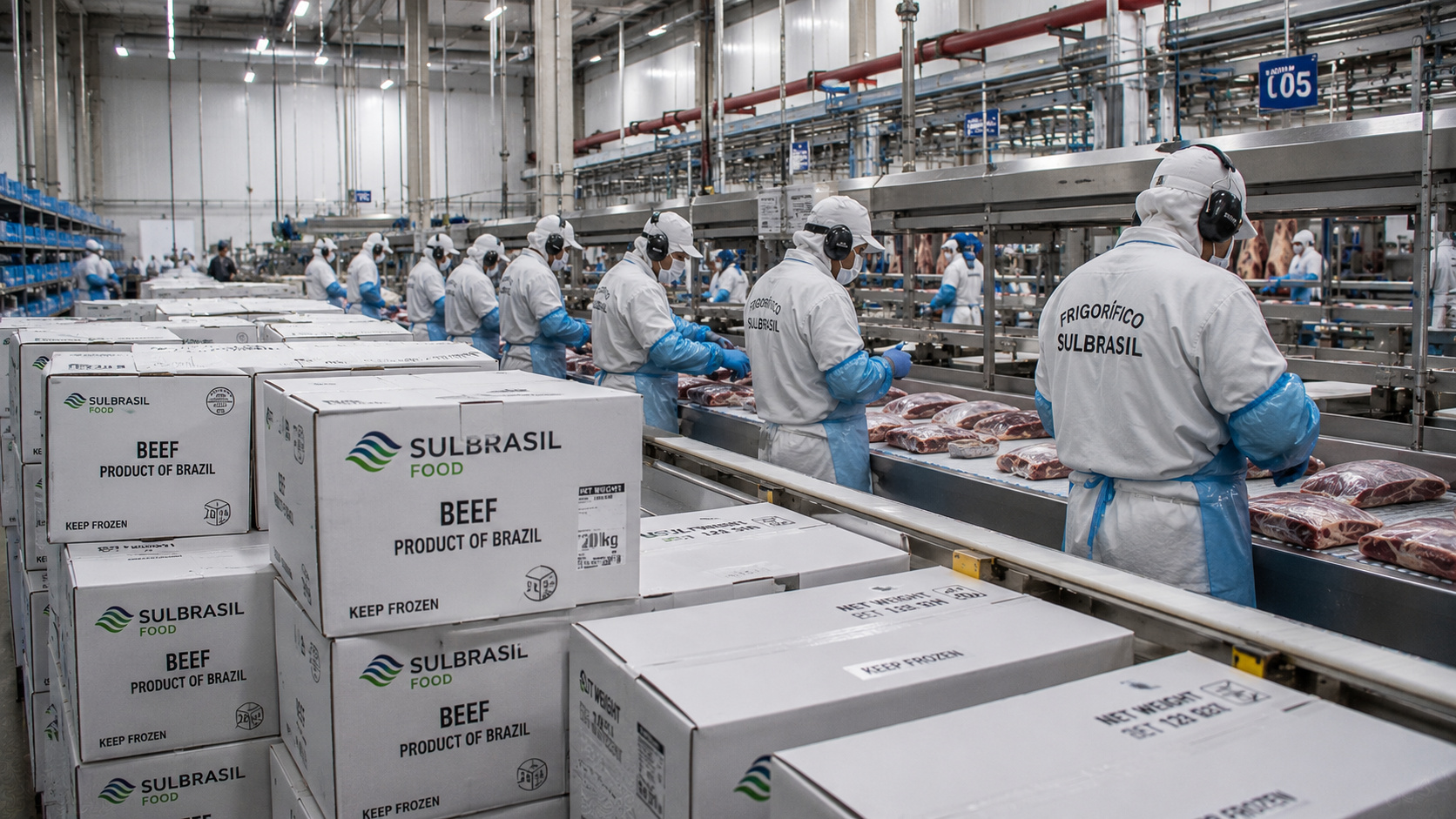
European measure raises questions about sanitary criteria, internal political pressures within the bloc, and direct economic impacts on international trade of Brazilian proteins
The information was disclosed by an “economic news portal,” based on official data and communications from the Brazilian government, which reacted firmly to the European Union’s decision to exclude Brazil from the list of countries authorized to export products of animal origin intended for human consumption.
President Luiz Inácio Lula da Silva’s government stated that it received the measure with “surprise” and guaranteed that it would act promptly to reverse the decision, which will take effect from September 3, 2026. Despite this, exports continue normally until that date, which provides a strategic window for negotiation and review of Brazil’s position.
Furthermore, the Ministry of Development, Industry, Trade and Services (MDIC) reinforced that the country has a robust and internationally recognized sanitary system. In this regard, Brazil highlights its position as the world’s largest exporter of animal proteins, in addition to being one of the main suppliers of agricultural products to the European market.
-
Not even the end of the ‘roller coaster’ described by the price of Brent crude oil (the main global benchmark) – which jumped from a price of $72 to $120, then dropped to $76 per barrel – due to the recent peace agreement between the US and Iran, was enough to relieve the Brazilian economy from inflationary pressures.

-
European Union looks again at Brazilian seafood after a nearly 8-year ban and may unlock a coveted market for lobster, tuna, tilapia, and shrimp.

-
Japanese retro sneakers become a sales phenomenon, help Asics achieve record profits, and gain their own operation to target Los Angeles, Milan, and Seoul.
-
Weg is the Brazilian company most exposed to Trump’s tariff hike. The multinational manufacturer of industrial motors and equipment, headquartered in Jaraguá do Sul (SC), is racing against time to reduce the impact of the new U.S. taxation.




Economic impact and relevance of the European Union for Brazil
First of all, it is essential to understand the economic weight of this decision. The European Union represents one of Brazil’s main trading partners in the meat sector, which makes the measure even more sensitive.
According to data from the Agrosat system, from the Ministry of Agriculture, Brazil exported US$ 1.8 billion in meats to the 27 countries of the European Union in 2025, including beef and white meats. This volume positions the bloc as the second largest destination for Brazilian meat exports in that year.
On the other hand, total Brazilian meat exports reached US$ 31.8 billion in 2025, highlighting the sector’s importance for the national economy. China leads as the main destination, with US$ 9.8 billion, while the European Union occupies a strategic position in global trade.
However, when analyzing the first three months of 2026, a relevant change is observed: the European Union moves to third position, falling behind the United States. Even so, the bloc remains an essential market for Brazil.
Furthermore, when European countries are observed individually, they do not rank among the largest buyers of Brazilian beef. According to Abiec, the main destinations are China, the United States, Chile, and Russia.
Reasons for the European decision and internal political pressure
Although the decision caused surprise in the Brazilian government, European authorities indicated that the exclusion occurred due to the absence of guarantees considered sufficient regarding the use of certain antimicrobials in animal husbandry.
In this context, the European Union maintains strict rules prohibiting the use of antimicrobials to accelerate animal growth or increase productivity. Furthermore, European legislation also prevents the use of antibiotics considered essential for the treatment of human infections.
These measures are part of a broader policy to combat bacterial resistance and reduce the excessive use of antibiotics in livestock farming. In this way, the bloc seeks to ensure that imported products meet the same standards required internally.
According to the European Commissioner for Agriculture, Christophe Hansen, the decision also reflects a firm stance in the face of criticism from European farmers.
— Our farmers follow some of the strictest health and antimicrobial standards in the world. Therefore, it is legitimate that imported products are subject to the same requirements — he stated.
Furthermore, the measure comes at a delicate moment, marked by the provisional entry into force of the trade agreement between Mercosur and the European Union. Consequently, the decision was also interpreted as a political and regulatory gesture, especially given the pressure from countries like France and European agricultural sectors.
Government promises swift reaction and negotiation with European authorities
Given this scenario, the Brazilian government made it clear that it does not intend to passively accept the exclusion. On the contrary, the strategy involves quick and direct action with European authorities.
In this regard, the head of Brazil’s delegation to the European Union already has a meeting scheduled for this Wednesday with the bloc’s health authorities. The main objective is to discuss the points raised by the European Union and present the necessary guarantees to reverse the decision.
Furthermore, the government stated that it will take all necessary measures to ensure the continuity of exports and Brazil’s return to the list of authorized countries.
Another important point is that European authorities indicated that the list could be updated soon, should Brazil respond to pending requests. Therefore, there is room for negotiation and a possible reversal of the current situation.
Meanwhile, Brazil reinforces its position as a strategic global supplier and highlights that it has been exporting to the European market for over 40 years, which strengthens the argument of sanitary reliability.
Finally, the European Union’s decision exposes not only technical issues but also commercial and political disputes within the international scenario. Thus, the outcome of this impasse could directly influence the future of trade relations between the blocs and the balance of the global protein market.
In your opinion, is this decision by the European Union truly technical, or does it have more political influence than it seems?







Be the first to react!