Portuguese
  Spanish


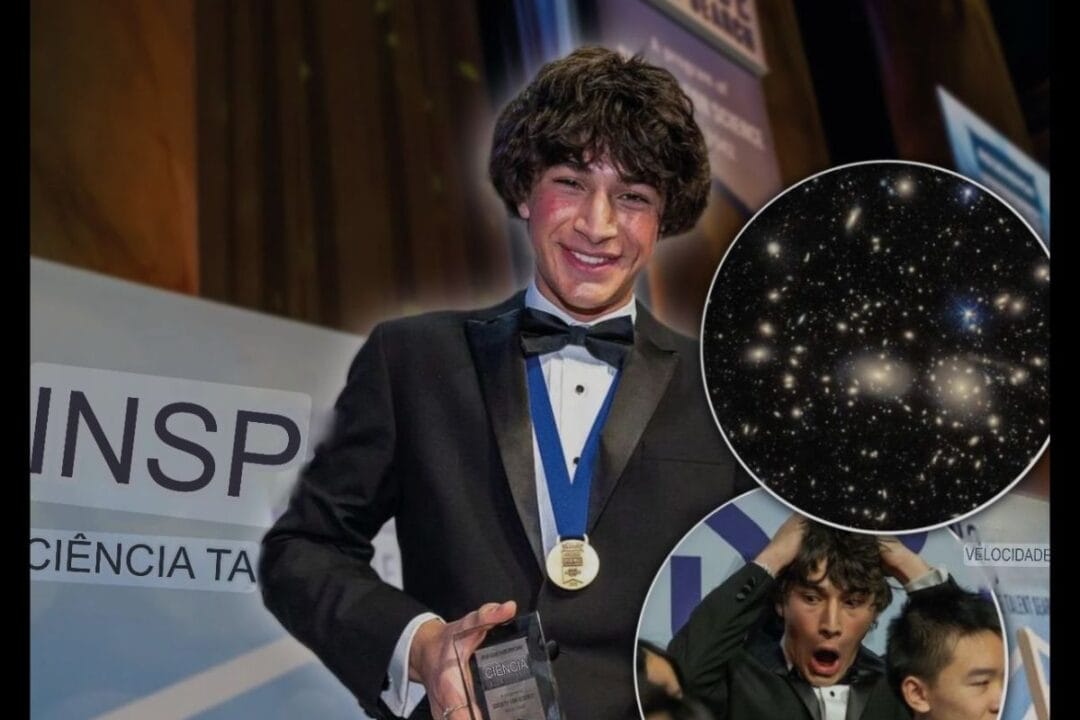


Using a Laptop and Persistence, Student Matteo Paz Discovered 1.5 Million Space Objects and Can Solve One of the Biggest Mysteries of the Cosmos.
At 18, Matteo Paz took first place in the Regeneron Science Talent Search, a $250,000 award, after developing an AI algorithm that analyzed NASA data and identified supernovas, black holes, and previously uncataloged objects. His research is already used by scientists at Caltech and could redefine the understanding of the universe’s expansion.
Discovery of 1.5 Million Space Objects Using AI
Matteo Paz, a high school student, revolutionized astronomy by discovering 1.5 million new space objects. It all began during an internship at NASA, where he had access to 200 terabytes of infrared data. With a regular laptop and an AI algorithm he developed, Matteo mapped regions never before explored.
How Matteo Paz’s Internship at NASA Changed Modern Astronomy
The internship at NASA was the starting point. Matteo created a system capable of processing complex data from space telescopes. His algorithm identified patterns imperceptible to traditional methods, revealing supernovas, black holes, and unknown celestial bodies. Many of these objects had never been recorded by science.
-
Brazil Constructs First Japanese SABO Barrier in Nova Friburgo to Prevent Landslides, a $3 Million Concrete Trap for Rocks, Logs, and Mud

-
Brazilian Navy’s Technology Plays Strategic Role in Future of Small Modular Reactors, Boosting Nuclear Energy Capacity with Innovative Solutions for Power Generation and Industrial Applications

-
China Surpasses U.S. and Russia Combined in Submarine Production
-
Xiaomi Unveils Smart Glasses in Brazil with 12MP Camera, 4K Video, and AI Features, Challenging Ray-Ban Meta


Algorithm Analyzes 200 TB of Data and Reveals Cosmic Secrets
The analysis of 200 terabytes of infrared data required precision. Matteo’s algorithm not only cataloged objects but also cross-referenced information to understand their properties. Among the discoveries are pieces of evidence that could help calculate the actual rate of the universe’s expansion – an old debate in astrophysics.
Matteo’s discovery has direct implications in cosmology. By identifying objects related to high-energy phenomena, such as supernovas, his research provides clues to calibrate the “Hubble constant”. This value defines the rate of the universe’s expansion and has been a subject of disagreement among scientists for decades.
Award and Recognition in the Regeneron Science Talent Search
Matteo’s work secured first place in the Regeneron Science Talent Search, a competition that recognizes young scientists in the U.S. The $250,000 prize attests to the potential of the research, which has already been adopted by institutions like Caltech. For Matteo, this achievement proves that innovation does not depend on expensive resources, but on creativity and persistence.