Portuguese
  Spanish




Climate change and ice melting are making the day last longer and may directly impact the rotation of the Earth
The melting of ice caused by climate change is already causing a curious and little-known effect: days are getting longer. The change is small, but it is happening increasingly quickly.
This process occurs because the rising sea level alters the planet’s balance. As a result, the rotation of the Earth slows down, causing the length of a day to increase, even if by fractions of a second.
Ice melting changes the shape of the planet and slows down rotation
Global warming intensifies the melting of polar ice caps and glaciers, which raises ocean levels. This water spreads across the planet, mainly in the equatorial region.
-
Tesla injected an additional $250 million into the German factory, doubled the battery cell target, and opened its own production line for startups.

-
No more TV stuck on the wall: Samsung The Freestyle+, the new projector with over 400 lumens projects on walls, floors, and ceilings, bringing cinema to any corner of the house.

-
A Japanese governor single-handedly stalled the construction of the world’s fastest train for nine years, and only now has he agreed to allow a tunnel excavated at a depth of 1,400 meters.
-
Almost 1 billion euros, two gigafactories, and a million-dollar public investment, Chinese company aims to turn Spanish city into Europe’s new battery hub.


This displacement makes the Earth a little wider in that area and flatter at the poles. This new shape directly interferes with the planet’s dynamics and causes a decrease in rotational speed.
The effect can be understood simply. When the weight spreads outward, the spin slows down. Therefore, the length of days increases.
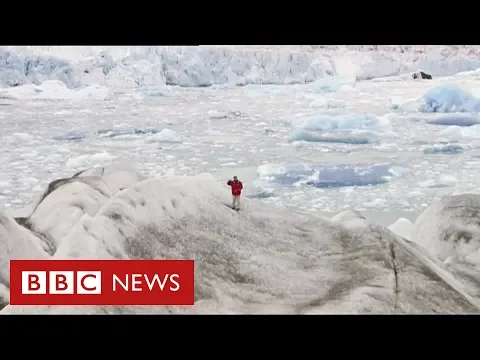

Days are increasing at the fastest rate in the last 3.6 million years
The length of days has always undergone small changes throughout Earth’s history. There have been variations between 10 and 30 milliseconds, but this occurred over millions of years.
Today the situation is different. The rate has reached 1.33 milliseconds per century, the highest rate recorded in the last 3.6 million years.
This shows that the impact of climate change is accelerating a natural process that previously occurred very slowly.
Study uses fossils and technology to understand the planet’s past
The findings were published in the Journal of Geophysical Research: Solid Earth, an international scientific journal in the field of geosciences. The study analyzed ancient data taken from fossils and corals.
This information helped reconstruct how the climate influenced the rotation of the Earth over time. The results indicate that the current moment presents a rate of change outside the historical pattern.
Scientist explains how sea level influences the length of the day
The geoscientist Mostafa Kiani Shahvandi from the University of Vienna explained that the rise in sea level is directly linked to the phenomenon.
He stated that the rise in sea level makes the Earth’s rotation slower and the day lasts longer.
The researcher also highlighted that the climate has increasingly influenced the functioning of the planet, reinforcing the relationship between climate change and the Earth’s rotation.
Changes may affect technology, internet, and global systems
Even though they are small, these changes can thus bring significant impacts. Modern systems rely on extremely precise time measurements.
With the difference between the Earth’s natural time and modern clocks, it may be necessary to make adjustments known as leap seconds.
These adjustments can affect computer networks, digital systems, and even space navigation, which requires high precision.
Impact is still small, but concerning due to the accelerated pace
Despite the change, the direct impact on daily life is still small. There is no significant effect on ocean circulation at this moment.
The finding was published by the Journal of Geophysical Research: Solid Earth, an international scientific journal in the field of geosciences, which emphasizes that the main impact is related to time measurement.
What stands out the most is the speed at which this is happening, something that was not common in the planet’s history.
The planet is already changing faster than it seems
The increase in the length of days shows that climate change is already affecting even the Earth’s rotation, something that many people did not even imagine.
Even though it is a small change, it reveals how the planet is undergoing rapid and silent transformations.
And you, did you know that the melting of ice could even change the time of our day? Do you think this type of change could bring greater impacts in the future? Leave your comment and share this news with others.