






 Portuguese
  Spanish


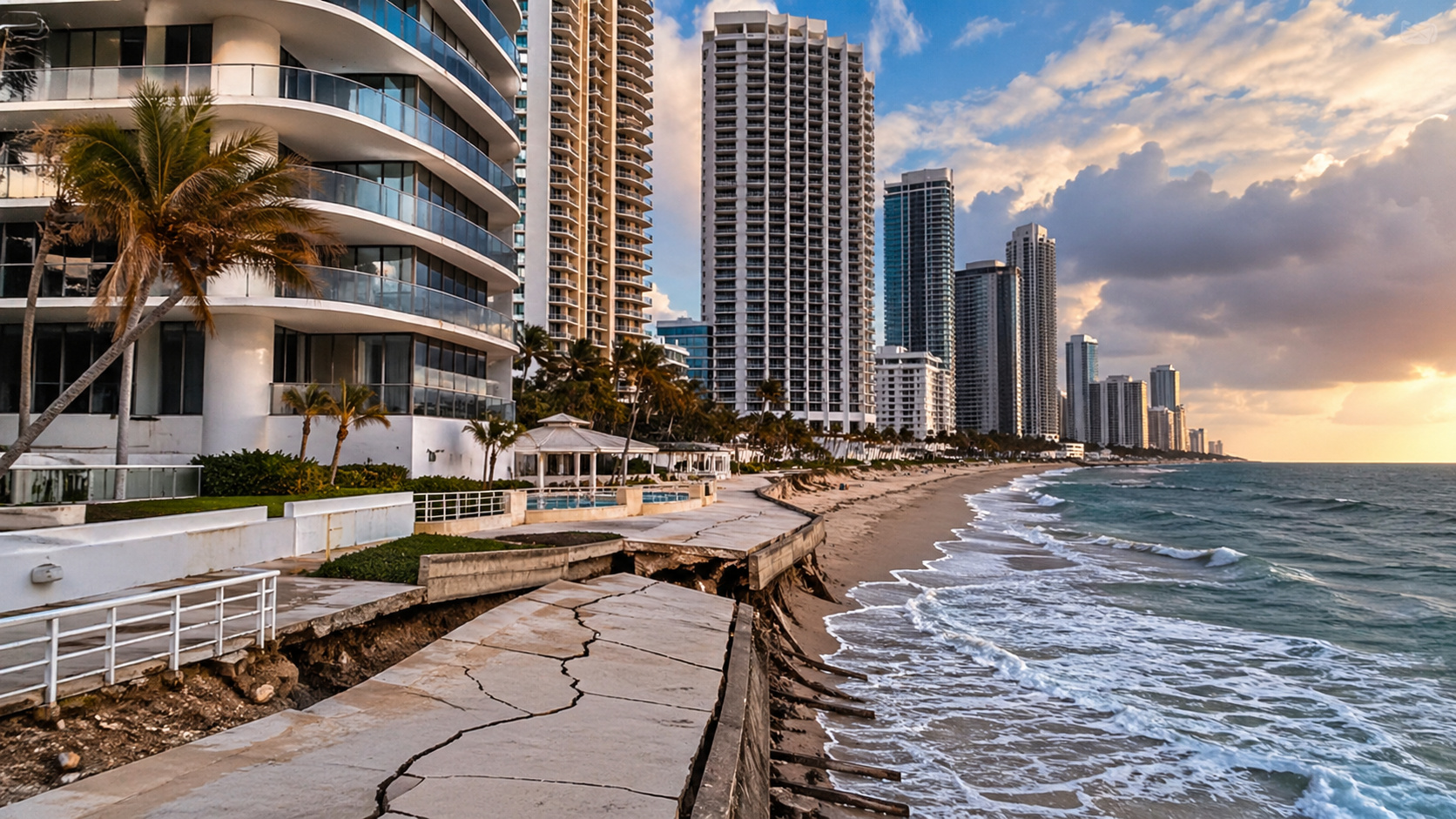

Miami luxury building subsidence draws global attention, involves luxury towers like Porsche Design Towers and Trump Towers, demands expensive engineering solutions, and raises questions about property safety and valuation
The subsidence of luxury buildings in Miami is no longer a topic restricted to engineering and has begun to concern residents and investors. High-end structures, such as Porsche Design Towers and Trump Towers, already show signs of subsidence, a process in which the ground slowly gives way.
This movement occurs gradually, measured in millimeters per year, but requires constant monitoring. The impact goes beyond the physical structure and directly affects the pockets of those who invest in luxury properties, as million-dollar works may be necessary to avoid greater risks.
Porous soil and water explain why Miami buildings are sinking
Miami was built on land formed by porous limestone, a type of soil that easily absorbs water. This behavior causes the soil to act like a sponge, losing stability over time.
-
Billionaire says the most valuable skill will help overcome job elimination caused by AI, following Bill Gates’ fears

-
A Dutchman created a ‘box’ that makes trees grow in the desert almost without water and without irrigation: the invention has already brought seedlings to dozens of countries and achieves up to 90% survival where common planting did not exceed 10%.

-
Abandoned warehouse hid a giant collection of rare computers, with over 2,000 artifacts from the 1930s to the 1980s.
-
Scientists warn that melting ice is triggering an alarming chemical transformation in preserved areas, and the first signs are already concerning researchers worldwide.





Constant infiltration, combined with rising sea levels and the weight of constructions, contributes to gradual subsidence. This phenomenon is known as subsidence and has already been identified in about 35 buildings in the region.
The investigation was published by Reuters, an international news agency, which detailed the presence of these cases in valued areas of the city.
Porsche Design Towers, Trump Towers, and other buildings already show signs
Among the affected buildings are high-end developments, such as Trump Tower 3, Porsche Design Towers, and Surf Club Towers. These constructions are located in areas like Sunny Isles and Surfside, known for the luxury real estate market.
Some of these luxury buildings house famous residents and feature sophisticated structures, such as exclusive car elevators. Even so, they already show signs of ground subsidence.
So far, there are no records of serious structural failures, but technical monitoring is continuous to prevent the problem from worsening.
Subsidence does not mean immediate risk of collapse
The phenomenon of subsidence is different from structural collapses. A striking example was the case of the building in Surfside, which resulted in 98 deaths in 2021.
In that episode, the problem was caused by structural corrosion and infiltration without proper maintenance, and not by ground subsidence.
Reuters, an international news agency, highlighted that this event led to important changes in the inspection rules for old buildings in the region.
New technologies try to contain the problem in newer buildings
To face the challenge of unstable soil, new developments in Miami are already using advanced engineering techniques. Deeper foundations and better weight distribution help reduce the effects of subsidence.
Furthermore, modern drainage systems prevent water accumulation, reducing the risk of soil saturation. These factors make newer buildings more resistant and valued in the market.
This type of technology also increases the confidence of investors seeking security in high-end properties.
Million-dollar renovations become a reality in old buildings
Older buildings face another important challenge, which is the need for constant maintenance. In many cases, detailed inspections and structural works were required.
There are records of condominiums that needed to invest more than 30 million dollars in renovations, with costs divided among residents.
These high expenses directly impact property values and can make it difficult to sell units that have not yet undergone improvements.
Real estate market remains strong, but requires more attention
Despite the challenges, Miami remains one of the most desired markets in the world. However, choosing a property requires careful analysis.
Buildings with up-to-date maintenance and modern technology continue to be valued. On the other hand, properties with structural issues may suffer a drop in value and less interest from buyers.
Evaluating maintenance history, future costs, and land characteristics has thus become essential for those who wish to invest safely.
The sinking of buildings in Miami shows that even luxury properties face natural and structural challenges. The combination of unstable soil and heavy constructions requires continuous solutions and high investments.
At the same time, the scenario creates opportunities for those who carefully analyze every detail before buying. Information has become the main ally to avoid losses and find good opportunities.
Would you invest in a luxury property knowing it might be slowly sinking, or do you believe engineering solutions are already sufficient to ensure safety? Share your opinion and send this content to those who follow the international real estate market.





