





 Portuguese
  English
  Spanish
  5 min of reading
  0 comments


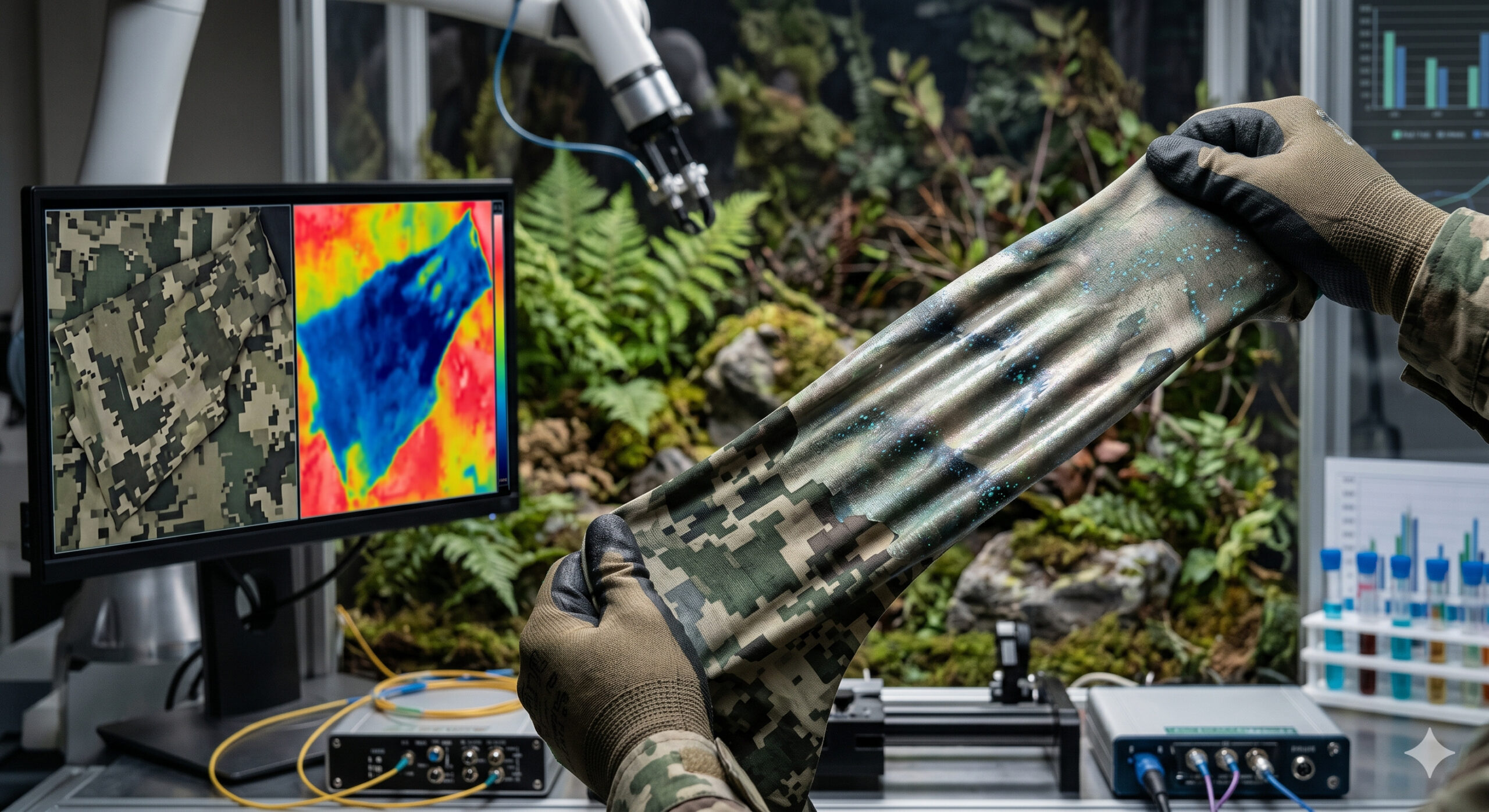
Material inspired by squid changes color and thermal signature, advancing as adaptive military camouflage against modern sensors.
In 2025, researchers from the University of California, Irvine, in partnership with the Marine Biological Laboratory in Woods Hole, Massachusetts, presented significant advances in the development of bioinspired materials capable of altering their appearance in response to environmental or mechanical stimuli. The work, described in the study “Gradient refractive indices enable squid structural color and inspire multispectral materials”, aimed to reproduce the optical properties of the skin of the squid Doryteuthis pealeii, known for its ability to transition from transparent states to intense colors through specialized cellular structures. The goal of the project was to transform this biological mechanism into a tunable multispectral response material, a new type of military fabric capable of adjusting its appearance in the visible and infrared spectrum in real-time. According to UC Irvine and the Marine Biological Laboratory, the researchers developed flexible composites inspired by the internal structures of the squid’s iridescent cells, with potential applications in camouflage, thermal management, sensors, and displays.
The research was funded by DARPA and the Air Force Office of Scientific Research, information confirmed by the MBL.
This type of technology is of direct interest to the defense sector because it enhances control over the visual and thermal signature of fabrics and surfaces, a factor increasingly relevant in environments monitored by optical and infrared sensors. Instead of promising total invisibility, the advancement fits more precisely as an important step in creating adaptive materials capable of modulating color, reflectance, and thermal emission dynamically, with the potential to reduce detectability in various scenarios.
-
It seems simple, but it generates electricity: scientists transform ambient humidity into electricity with gelatin and salt, and the generator still works for more than 30 days.

-
Soon, smartphones may be able to “see” objects hidden behind walls with LiDAR.
-
For the first time in France, solar electricity will power metro trains without going through the public grid. The pioneering Rennes project will begin construction in June with 6,000 square meters of solar panels, and users themselves can invest and earn a 5% annual profit.

-
United States releases a $2 billion investment in quantum computing with IBM’s participation, strengthening strategic technological infrastructure and accelerating the development of advanced processors that can change the internet, digital security, and global financial markets.




Military fabric based on nanoengineering allows color change without pigments
The operation of the material does not depend on traditional pigments, but rather on physical structures that manipulate light. The researchers replicated a mechanism present in squid skin based on reflective cells, using nano-structured Bragg reflectors combined with ultra-thin metallic films.
These structures are organized in layers capable of interfering with incident light, reflecting specific wavelengths. When the material is deformed — for example, when stretched or bent — the spacing between these layers changes, automatically altering the perceived color.
This process occurs passively, without the need for complex electronic systems, which represents an important advantage for military applications.
The new type of military fabric responds to mechanical and environmental stimuli in real time
One of the most relevant points of the technology is its immediate response capability to physical stimuli. Unlike active systems that rely on sensors and electronic processing, the material reacts directly to mechanical changes.

In practice, this means that:
- when stretched, the fabric can change color
- when folded, it can alter the reflection pattern
- when subjected to environmental variations, it can adjust its appearance
This direct response reduces the need for energy and increases reliability in operational environments.
Capacity to act in multiple spectra increases military relevance
In addition to visible light, researchers have demonstrated control over part of the infrared spectrum, especially in the near-infrared. This feature is particularly relevant for the defense sector, where sensors operate in different spectral ranges.
The material can:
- alter the way it reflects visible light
- partially modify its infrared signature
- reduce contrast with the environment

Although there is still no proof of complete invisibility in all spectra, the results indicate a significant advancement towards multispectral camouflage.
Reduction of thermal signature is one of the main challenges in development
One of the most complex aspects of modern camouflage is thermal control. Infrared sensors detect temperature differences between objects and the environment, making concealment more difficult.
Research associated with the project indicates that bioinspired materials can, in some cases, modulate thermal emission, reducing the detectable signature. However, completely matching the ambient temperature still poses a significant technical challenge.
Even so, any reduction in thermal signature can already represent an operational advantage.
Military funding indicates strategic interest in technology
The involvement of DARPA and the United States Air Force signals strategic interest in this type of material. Research programs funded by these institutions often aim to anticipate technologies capable of providing tactical advantage in future scenarios.
Adaptive camouflage is considered one of the critical areas, especially in light of the evolution of detection systems. In today’s battlefield, the ability to avoid detection can be as important as offensive capability.
Researchers have indicated that they have already managed to produce larger samples of the material, demonstrating that the process is not restricted to small laboratory scales.
Still, the transition to industrial production involves challenges such as:
- material durability
- manufacturing cost
- resistance to extreme conditions
These factors will be decisive for the practical adoption of the technology.
Technology responds to the evolution of sensors in the modern battlefield
The need for adaptive camouflage is directly linked to the advancement of detection systems. Today, military forces use a combination of technologies to identify targets, including:
- high-resolution cameras
- thermal sensors
- night vision systems
- advanced radars
In this scenario, traditional camouflage solutions become insufficient, requiring materials capable of dynamically adapting.
Bioinspired material represents a new approach to relative invisibility
Unlike the idea of total invisibility, the proposal of this type of technology is to reduce detectability to the point of making target identification difficult.
This may involve:
- breaking visual patterns
- reduction of contrast
- modulation of thermal signature
This approach is more realistic from a technical standpoint and already represents a significant advancement over current technologies.
Advancement raises debate about the future of military camouflage in a sensor-dominated scenario
With the development of materials capable of altering their appearance across multiple spectra, a central question arises for modern warfare: will it be possible, in the future, to drastically reduce detection capabilities in a sensor-saturated environment?
As bio-inspired technologies continue to evolve, camouflage ceases to be static and becomes a dynamic, adaptable system integrated into the environment — a concept that could redefine how military forces operate in the coming decades.









Be the first to react!