Portuguese
  Spanish


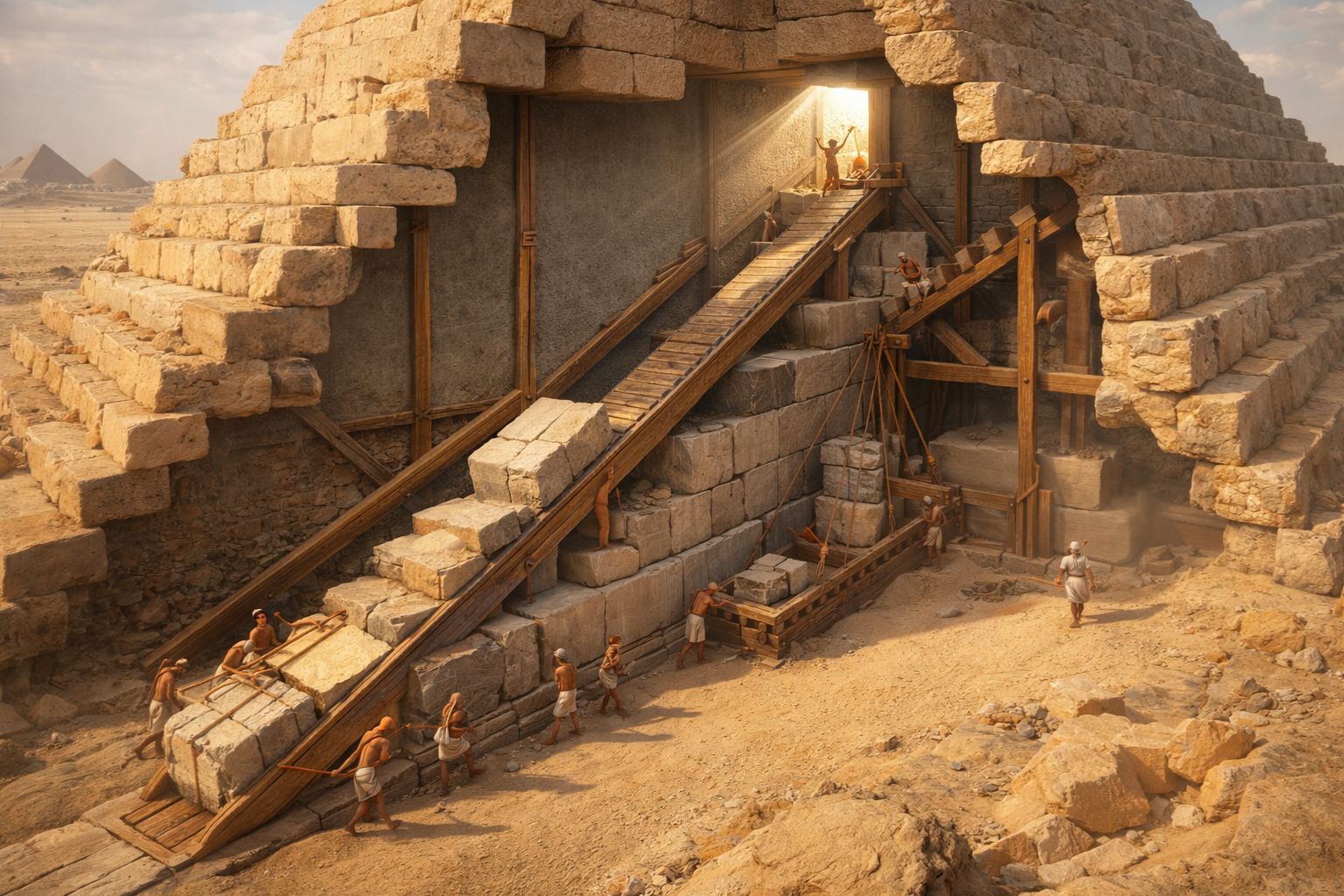

A new study proposes that the Egyptians used an internal system of pulleys and counterweights inside the Great Gallery to lift the blocks of the Pyramids of Giza. The theory suggests that internal spaces functioned as inclined ramps with elevation mechanisms, a more efficient alternative than traditional external ramps.
The way the Egyptians raised the Great Pyramids of Giza remains one of the most debated topics in archaeology, and a new study has just reignited this discussion with a proposal that challenges conventional explanations. The research suggests that the Egyptians did not rely solely on gigantic external ramps to elevate the 2.3 million stone blocks of the Great Pyramid, but used an internal system of pulleys and counterweights that operated within the structure itself. The hypothesis is based on the analysis of the internal architecture of the pyramids, especially the Great Gallery, a sloped corridor 47 meters long and almost 9 meters high that, according to researchers, could have been designed not only as a ceremonial passage but as a functional ramp to lift blocks weighing tens of tons.
The Egyptians’ proposal adds to a long list of attempts to explain how the largest pyramid was built. Over the decades, archaeologists and engineers have suggested everything from gigantic external ramps to internal helical systems and combinations of different techniques, with no explanation having solidified as definitive. What makes this new study particularly relevant is the way it uses the already known architecture of the pyramid to justify a construction mechanism, rather than proposing external structures that would have disappeared without leaving traces. The Egyptians would have left clues within the work itself.
What the new study proposes about how the Egyptians built the pyramids

According to the portal Aventuras na História, the central theory is that the Egyptians used the Great Gallery and other internal spaces as inclined ramps along which they would slide lifting mechanisms based on counterweights. In practice, heavy stone blocks would be raised by a system in which the weight of a counterweight descending on one side pulled the block up on the other, an engineering solution that would drastically reduce the human force needed to lift stones weighing dozens of tons. The principle is the same as that of a primitive elevator, where the balance of masses does the work that hundreds of men could not achieve.
-
She spent 73 years breathing inside an iron lung, survived the aftereffects of polio, and became the last woman in the United States dependent on the equipment before dying at 78 years old.

-
Brazilian students created a $1 filter using pine bark, cotton, and 3D-printed parts to clean cassava wastewater, reduce the toxicity of a hazardous waste, and transform contaminated water into biofertilizer.

-
Astronaut from Artemis II steps down after mission to the Moon and decision surprises after a record of 406,771 km, a historic 10-day journey, and an unprecedented achievement for Canada.

-
A fossil kept for years in a small museum in Montreal concealed 450-million-year-old soft tissue, a discovery that has only happened once before in history.


This approach would solve one of the biggest problems of theories based on external ramps. External ramps long enough to maintain a workable incline to the top of the 146-meter pyramid would have to extend over a kilometer, requiring almost as much material as the pyramid itself. The Egyptians would have avoided this paradox by internalizing the lifting system, using the structure of the pyramid as a machine to build itself. The Great Gallery, with its 26-degree incline and generous dimensions, would be the central component of this mechanism.
What archaeology already knows about how the Egyptians built Giza
Despite the controversies over the construction method, several points are considered well established by Egyptology. The scientific consensus indicates that the pyramids were built around 2,560 B.C., during the reign of Pharaoh Khufu, based on evidence such as hieroglyphic inscriptions, records of workers found on site, and carbon-14 dating of organic materials present in the structure. This data is not contested by the new theory, which proposes only a different mechanism for lifting the blocks.
Another certainty that the Egyptians left recorded is that the construction was carried out by specialized workers, not by enslaved people. Archaeological discoveries in the last 30 years, including workers’ tombs near the complex and records left by the workers themselves, have debunked the popular narrative that the pyramids were built by slaves. The workers were organized into teams with their own names, received food, medical care, and were buried with honors after death, a treatment incompatible with slavery.
Why the theory of internal ramps and counterweights is different from previous ones
The main difference is that the new proposal from the Egyptians does not require the existence of structures that have disappeared without a trace. Theories based on giant external ramps have always faced the objection that no archaeological evidence of these ramps has been found around the pyramids, which their defenders explain by arguing that they were dismantled after construction. The internal theory circumvents this problem by using elements that still exist within the pyramid as evidence of the mechanism.
The Great Gallery, in particular, has always intrigued archaeologists due to its disproportionate dimensions for a simple passage. With nearly 9 meters in height and walls that narrow in steps up to the ceiling, the space seems designed to support loads and house equipment, not just to allow the passage of a funeral procession. If the theory is correct, the Egyptians would have been even more sophisticated engineers than previously recognized, capable of designing a structure that was simultaneously a funerary monument and a construction machine.
The alternative theories that compete with the Egyptian explanation
Alongside academic theories, more speculative hypotheses about the pyramids frequently circulate outside the academic community. Some propose that the pyramids are much older than records indicate or that they were built by unknown civilizations, based on controversial geological models or unverified interpretations of erosion patterns on the Sphinx and the stones of the complex.
These hypotheses are viewed with caution by experts, who point out the lack of material evidence to support them. The Egyptians left sufficient documentation to connect the pyramids to the Old Kingdom period, including graffiti from workers found inside relief chambers above the King’s Chamber, mentioning the name of Khufu. The new theory about internal ramps and counterweights operates within this established consensus, proposing only that the construction method was more ingenious than traditional explanations suggested.
What the debate about the Egyptians reveals about the limits of archaeology
The persistence of the mystery surrounding how the Egyptians built the pyramids reveals something important about the limits of archaeological knowledge. We know who built them, when they were built, with what materials, and what type of labor was used, but the exact “how” remains open because the Egyptians did not leave an instruction manual, and the temporary tools and structures used in construction have not survived 4,500 years of erosion and looting.
Each new theory, such as the one about internal ramps with counterweights, adds a piece to the puzzle without completely solving it. What makes the debate fascinating is that the Egyptians accomplished an engineering feat that modern humanity has still not fully explained, despite all the available analytical technology. The Pyramids of Giza remain the largest construction project of antiquity and possibly the greatest unresolved mystery of human engineering.
A new study proposes that the Egyptians used internal ramps and counterweights to raise the pyramids. Do you think this theory is more convincing than the previous ones? Will the mystery ever be solved? Share your opinion in the comments.