Portuguese
  Spanish


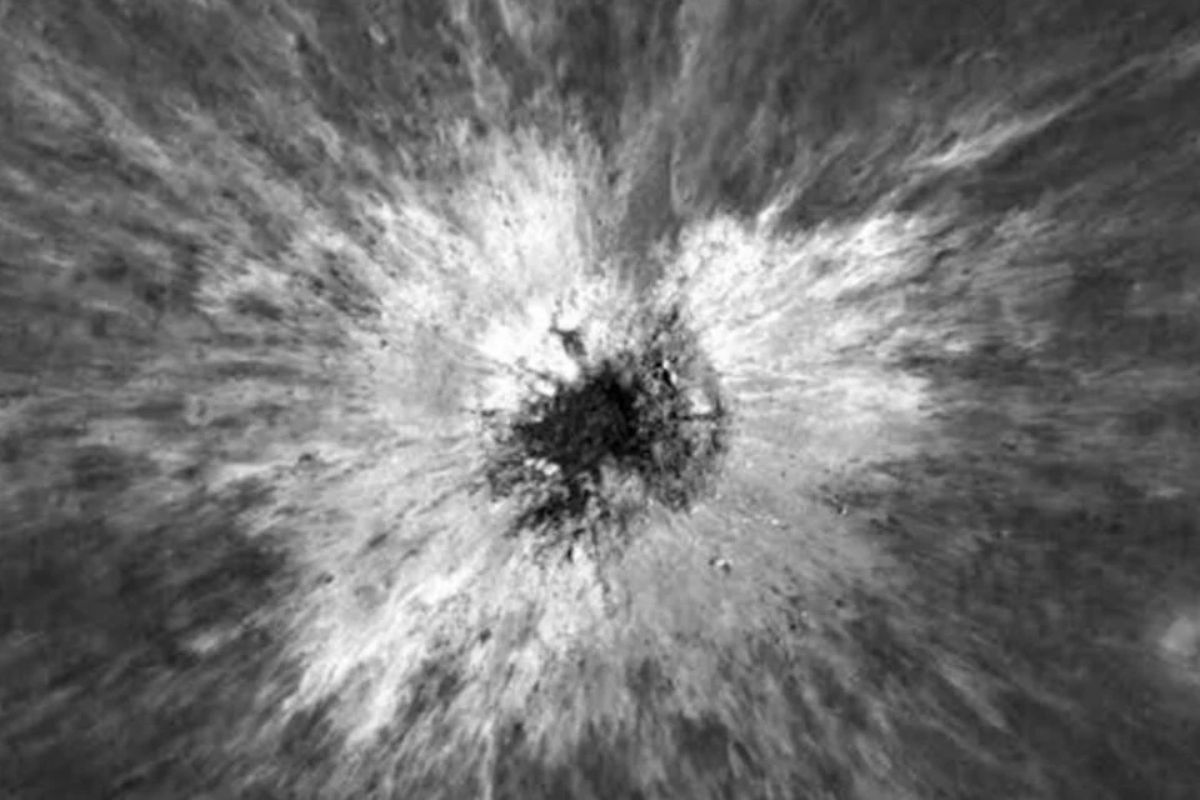

The scar on the Moon appeared after a collision at the end of spring 2024 and left a 43-meter-deep crater, with rocks and darkened material that may have melted and solidified in seconds.
The scar on the Moon identified by scientists reveals the recent trace of a rare impact on the lunar surface, formed at the end of spring 2024 and detected by comparing before and after images captured by NASA’s Lunar Reconnaissance Orbiter, the LRO.
The finding draws attention because the Moon is constantly hit by space rocks, but such recent evidence is uncommon, as craters do not “erase” with wind or water on the lunar surface, and most known marks are millions or even billions of years old.
How the scar on the Moon was discovered in LRO images
The team behind the discovery observed clear changes in images taken before and after the event, which allowed them to confirm the recent formation of the crater. The record is a rare and valuable case for better understanding how craters form not only on the Moon but on other bodies in the Solar System.
-
Tesla injected an additional $250 million into the German factory, doubled the battery cell target, and opened its own production line for startups.

-
No more TV stuck on the wall: Samsung The Freestyle+, the new projector with over 400 lumens projects on walls, floors, and ceilings, bringing cinema to any corner of the house.

-
A Japanese governor single-handedly stalled the construction of the world’s fastest train for nine years, and only now has he agreed to allow a tunnel excavated at a depth of 1,400 meters.
-
Almost 1 billion euros, two gigafactories, and a million-dollar public investment, Chinese company aims to turn Spanish city into Europe’s new battery hub.



The results were presented at the 57th Lunar and Planetary Sciences Meeting in March, reinforcing the role of continuous monitoring as a tool to capture events that, in practice, usually happen without any visible warning from Earth.
A record crater in 17 years of mission
The newly identified crater measures about 225 meters wide and, according to researchers, is the largest impact crater formed during the 17 years of the LRO mission. The previous record in the mission was a crater of 70 meters, discovered in 2013 also by comparing images of the same location.
The event is described as extremely rare, with an estimated occurrence of once every 139 years for an impact of this scale, which helps explain why new craters this large are almost never seen in “recent” time.
Depth, shape, and rocks thrown by the impact

Besides the width, the structure impresses with its shape. The crater is about 43 meters deep and has been described as a funnel with steep walls. Around it, large blocks of rock ejected by the collision appear, with the largest reaching about 13 meters.
This debris distribution is a central piece for reconstructing the dynamics of the impact, as it helps estimate the direction, intensity, and consequence of the impact.
The trail left by the debris trail
By analyzing the direction of the ejected material, the team was able to observe the direction of the trail and estimate where the object came from. The space rock may have arrived from the southeast, with enough speed to penetrate the surface and spread debris northward.
The trail acts like a map of the impact, transforming the crater into a physical record of trajectory and energy released.
Dark material and possible “glass” formed by heat
Inside the crater, researchers noted an unusually dark material, described as resembling glassy-looking rocks. The hypothesis is that part of the material was melted by the heat of the impact and solidified almost immediately, a sign of how much energy was released during the event.
When the impact is strong enough to alter the lunar soil in an instant, it leaves chemical and visual clues, and this helps to understand crater formation more accurately.
What the LRO has learned about impact frequency
The LRO has been orbiting the Moon for 17 years, mapping the surface in detail to support future missions. During this time, the probe has identified hundreds of newly formed craters, and the dataset suggests that the Moon may be getting hit twice as often as previously thought.
In 2014, the LRO itself survived the impact of a small meteoroid while capturing images of the lunar surface, reinforcing that the environment is active even without an atmosphere.
Before this discovery, images from the LRO also identified a crater of 22 meters seen in November 2025, which may have formed sometime between December 2009 and December 2012, showing how comparing records over time continues to reveal new marks.
What surprises you more about this 2024 impact, the size of the crater or the rarity of an event of this magnitude?