Portuguese
  Spanish


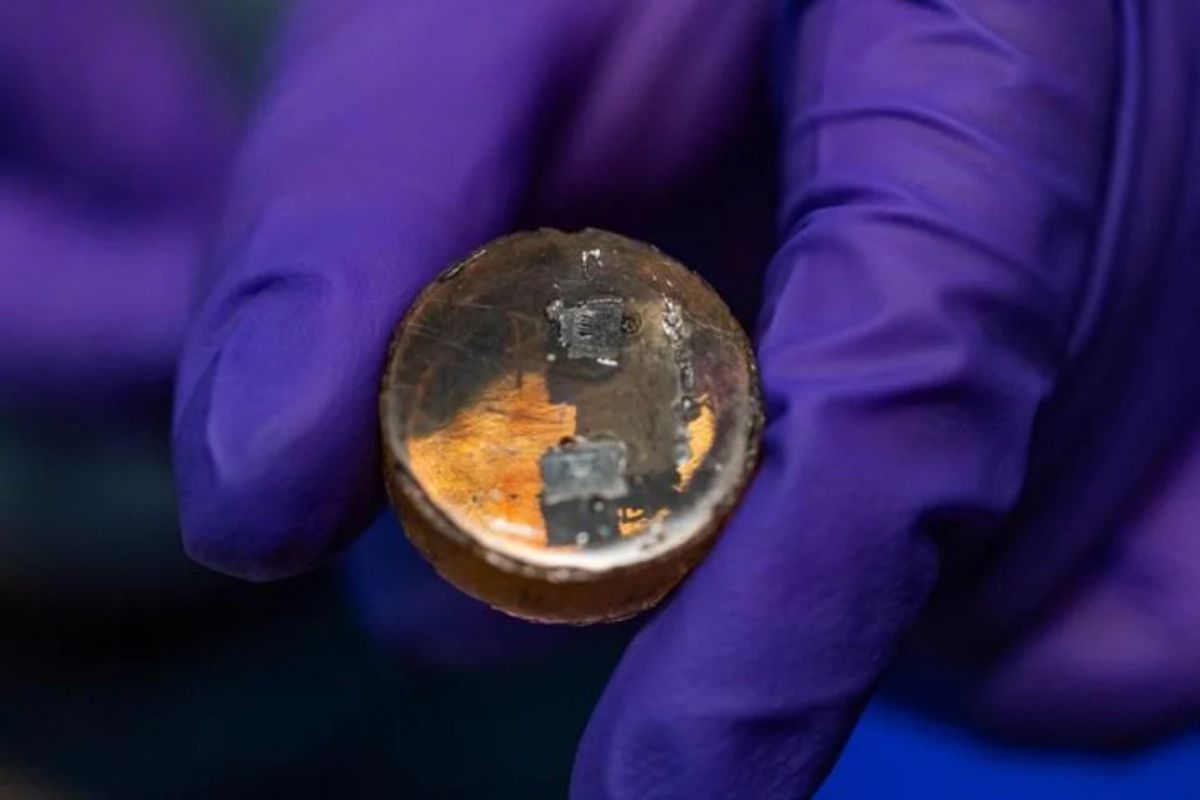


Experiment under high pressure with the Indarch meteorite recreated conditions of Mercury and showed that sulfur assumes functions of oxygen, weakens structures, and prolongs magmatic activity
A meteorite that fell in Azerbaijan in 1891 became the key piece for researchers to bring Mercury into the laboratory. The team from Rice University realized that the composition of the Indarch meteorite resembled that of the planet and decided to “cook” a replica of mercurian rocks under high pressure and high temperature.
The result was a strong clue as to why Mercury has a crust poor in iron and rich in sulfur: in the absence of sufficient iron to “hold” the sulfur, it begins to form bonds with other elements that, on Earth, would normally bond with oxygen.
Why a meteorite was the best alternative to study Mercury
On planets like Venus and Mars, it is more common to use what is already known about Earth as a reference. On Mercury, this fails because the planet has a very different chemical environment, with a crust poor in iron and rich in sulfur.
-
Tesla injected an additional $250 million into the German factory, doubled the battery cell target, and opened its own production line for startups.

-
No more TV stuck on the wall: Samsung The Freestyle+, the new projector with over 400 lumens projects on walls, floors, and ceilings, bringing cinema to any corner of the house.

-
A Japanese governor single-handedly stalled the construction of the world’s fastest train for nine years, and only now has he agreed to allow a tunnel excavated at a depth of 1,400 meters.
-
Almost 1 billion euros, two gigafactories, and a million-dollar public investment, Chinese company aims to turn Spanish city into Europe’s new battery hub.


Moreover, Mercury is a difficult target. The proximity to the Sun and the lack of atmosphere cause temperatures to vary from very high extremes to very low.
And there is little direct material to interpret: only three missions have been sent specifically to study Mercury, which limits readings and increases uncertainty.
In this context, the Indarch meteorite served as a “shortcut.” By using a material with chemistry similar to that of the planet, scientists can test hypotheses without relying on samples collected from Mercurian soil.
The “recipe” of Mercury rock in the laboratory

The study began with a detailed analysis of the chemical composition of Indarch, focusing on how that material would react under temperature and pressure conditions compatible with Mercury.
Then, the researchers mixed the chemical ingredients in a small glass vial.
This vial was “cooked” in a high-pressure and high-temperature chamber, creating a kind of rocky glass that serves as a replica of Mercury’s rocks.
The logic was to use temperature, pressure, and chemistry constraints derived from observations and spacecraft models to recreate the planet’s environment, even without direct samples.
What sulfur does when Mercury lacks sufficient iron
On iron-rich planets like Earth and Mars, sulfur tends to bond with iron. However, Mercury has a notable lack of this element on its surface. With less iron available, sulfur seeks “new bonding partners.”
According to the study’s description, it begins to bond with important elements that form rocks, such as magnesium and calcium. On Earth, these elements typically bond with oxygen, creating more stable silicate structures.
When sulfur takes on this role instead of oxygen, the structures become weaker and start to melt at lower temperatures, which alters how magma forms and evolves.
Why this may keep Mercury melting for longer
The most relevant point of the result is that by facilitating melting at lower temperatures, sulfur-dominated chemistry may prolong the generation of melting and magmatic activity on the planet.
In other words, it is not just a curiosity about chemical bonds. It is a mechanism that may help explain why Mercury’s internal evolution has followed a different path, sustaining magma processes longer than would be expected with Earth-like chemistry.
A new way to understand planets without forcing “Earth logic”
The authors present the experiment as a way to study Mercury on its own terms, rather than imposing Earth-based assumptions.
The idea is to use planet-specific chemistry, pressure, and temperature to reconstruct how the interior and surface may have evolved.
The study also reinforces that planetary formation can follow very different paths depending on which elements dominate the bonding and stability of rocks, and that sulfur can be as decisive on Mercury as oxygen is in Earth’s geological history.
Do you think this type of laboratory experiment is the best way to understand Mercury, or is there still a need for a mission capable of bringing back real samples from the planet?