Portuguese
  Spanish


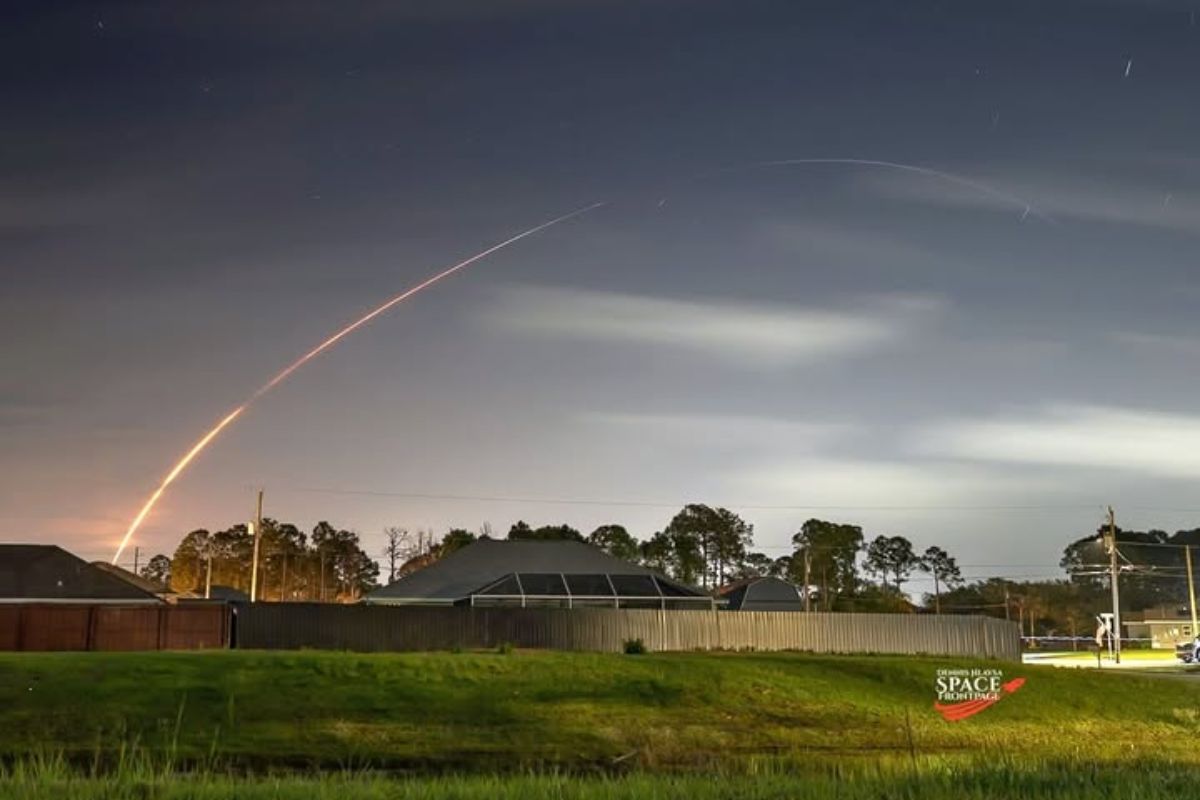

The Starlink constellation surpassed the mark of one thousand satellites sent into orbit in just the first three and a half months of 2026, consolidating SpaceX as the most aggressive space operation in history and raising debates about the future of global connectivity and the growing dominance of a single company in space.
SpaceX reached a milestone on Tuesday (14) that translates into numbers the industrial scale of its Starlink program: the one thousandth satellite launched in 2026. The Starlink 10-24 mission took off at 6:33 AM (Brasília time) from Cape Canaveral, Florida, carrying 29 broadband satellites aboard a Falcon 9 rocket. With this shipment, the total for the year reached 1,002 units in low Earth orbit.
The number is impressive not only for its volume but also for its speed. It has been just over a hundred days since the beginning of January, which equates to an average of nearly eight Starlink satellites placed in space every 24 hours. No other private company, government agency, or space power maintains a pace even close. The cadence transforms what was once an extraordinary event, an orbital launch, into an almost daily routine.
37 dedicated missions in less than four months

According to Futuro Astronomo, Tuesday’s flight was the 37th launch exclusively dedicated to the Starlink constellation in 2026. To put it into perspective, this means that SpaceX has conducted nearly ten missions per month focused solely on supplying its satellite internet network.
-
Three teenagers transform cut cardboard into Japanese origami-style packaging that promises to retire styrofoam and bubble wrap, win a $12,500 prize, and target giants like Amazon, FedEx, and Home Depot after a robot motor arrived broken.

-
The large jar blender has a rival: Oster Ultra Power bets on 1,000 W, six stainless steel blades, and two portable cups with leak-proof lids.

-
Tesla injected an additional $250 million into the German factory, doubled the battery cell target, and opened its own production line for startups.

-
No more TV stuck on the wall: Samsung The Freestyle+, the new projector with over 400 lumens projects on walls, floors, and ceilings, bringing cinema to any corner of the house.




Other commercial, scientific, and governmental payloads are still counted separately.
Each mission carries between 23 and 29 satellites of the V2 Mini version, designed to operate in low orbit and provide broadband connectivity with reduced latency.
The sum of these regular shipments has made the Starlink constellation surpass 10,191 operational satellites, out of a total of 10,209 currently in orbit, according to data from KeepTrack. This number represents about 65% of all active satellites around the Earth, a dominance that no other operator comes close to matching.
The Falcon 9 and the logic of reusability
The centerpiece of this mechanism is the Falcon 9 rocket, which has become the most launched orbital vehicle in history.
In this Tuesday’s mission, SpaceX used booster number B1080, which completed its 26th flight. This is the same first stage that has participated in crewed missions such as Axiom 2 and Axiom 3, as well as the resupply mission CRS-30.
About eight and a half minutes after liftoff, B1080 successfully landed on the drone ship Just Read the Instructions, positioned in the Atlantic Ocean.
This was the 598th landing of a Falcon 9 booster since SpaceX began practicing orbital landings. The systematic reuse of boosters is what allows the company to keep costs low enough to sustain this launch frequency. Without it, the numbers simply wouldn’t add up.
What a thousand Starlink satellites in a hundred days mean in practice
The milestone of a thousand satellites in less than four months is not just a demonstration of logistical capability. It signals that SpaceX operates at a level of production and launch that has transformed access to space into an assembly line.
While competitors like Amazon, with its Kuiper project, are still trying to get their first hundreds of satellites into orbit, Starlink is already functioning as a global network with over 10 million subscribers in about 150 countries.
If the current pace continues until December, the company could surpass 3,500 Starlink satellites launched just in 2026, a volume that raises serious questions about orbital sustainability.
Recent data shows that nine Starlink satellites are expected to re-enter the atmosphere between April 14 and 16, and tracking analyses indicate relevant probabilities of approaching debris from old missions. Managing this increasing traffic is a challenge that accompanies each new record.
The competitive context: who is trying to keep up
No direct competitor operates on the same scale. Amazon launched its first satellites from the Kuiper Project in partnership with ULA, using Atlas 5 rockets, but is still in the early stages of deploying the constellation.
OneWeb, now part of the Eutelsat group, has about 600 satellites, a number that SpaceX surpasses in launches in less than three months.
On the government side, China maintains ambitious programs for low Earth orbit constellations, but none of them come close to Starlink’s monthly cadence.
The difference is not just in the technology of the satellites, but in the complete ecosystem: mass production, reusable rockets with dozens of flights per unit, and launch infrastructure capable of operating multiple times a week from multiple bases.
Starlink in 2026: commercial expansion and controversies
In addition to technical expansion, Starlink has significantly increased its commercial presence in recent months. The network has made agreements with airlines such as Southwest Airlines, Gulf Air, and Air Canada, and is already operating on cruise ships and cargo vessels of major maritime operators.
In February 2026, the service received licenses to operate in Vietnam, a market with the potential for up to 600,000 terminals.
But the expansion did not come without controversy. Journalistic investigations revealed the extensive use of Starlink terminals by digital fraud centers in Southeast Asia, leading SpaceX to deactivate access for at least 2,500 devices in Myanmar.
The installation of a terminal in the White House complex also raised questions about conflicts of interest, given Elon Musk’s political involvement. These tensions illustrate how the scale of Starlink places it at the center of debates that go far beyond space technology.
What Lies Ahead
With Starship, SpaceX’s next-generation rocket, advancing in tests, the expectation is that the payload capacity per mission will increase dramatically, allowing for the launch of larger and more powerful Starlink satellites in even larger batches.
The company’s long-term goal envisions up to 34,400 satellites in the constellation, a number that would completely redefine the map of global telecommunications infrastructure.
For now, what the numbers from this Tuesday confirm is that SpaceX has transformed orbital launches into an industrial-scale operation.
One thousand Starlink satellites in just over a hundred days is not a one-time record. It is the new normal for a company that treats space as a production line.
And you, what do you think about this launch pace? Is Starlink’s dominance in space positive for global connectivity or does it pose a risk due to concentration in a single company? Leave your opinion in the comments.