






 Portuguese
  Spanish
  3 min of reading
  20 comments


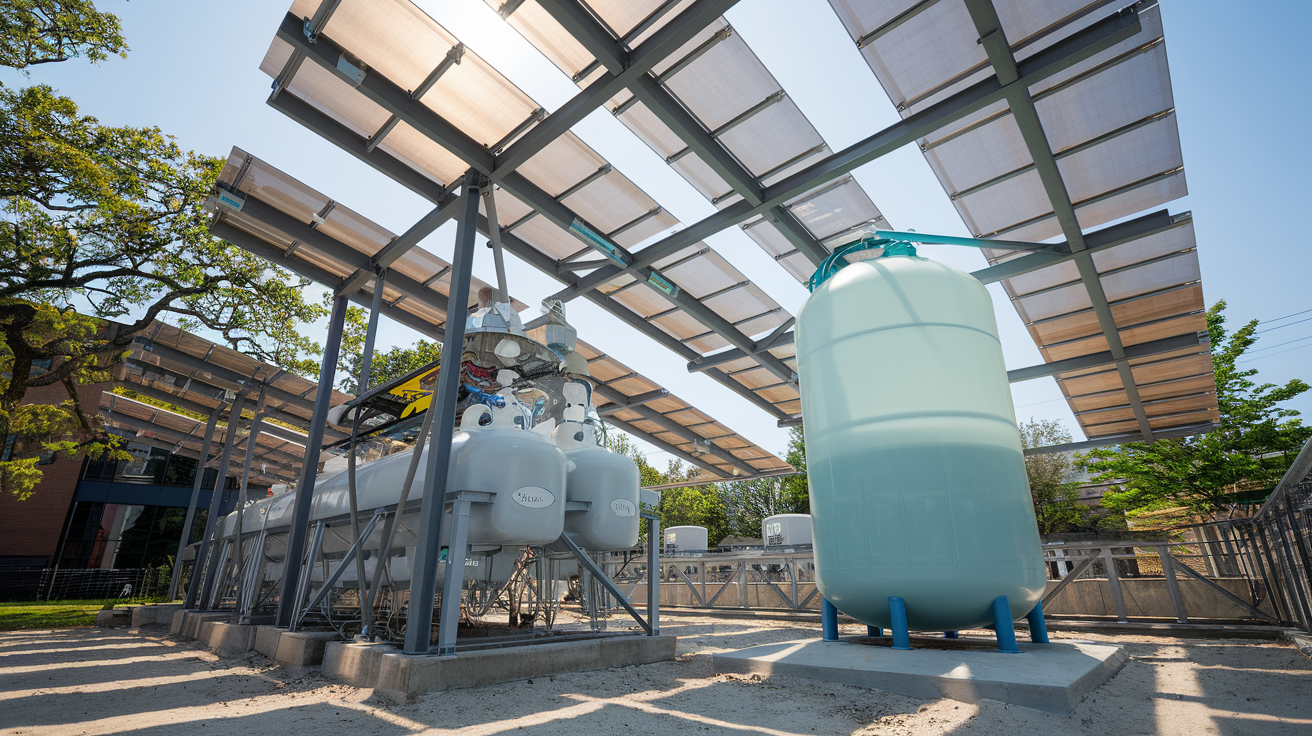


New MIT Technology Promises to Revolutionize Access to Drinking Water! Discover How the Desalinator, Capable of Purifying 5,000 Liters Per Day, Can Transform the Lives of Millions.
Engineers from the Massachusetts Institute of Technology (MIT) spent six months in Alamogordo, a city in New Mexico, USA, known for being the test site of the first atomic bomb in 1945, developing a new MIT technology. The goal was to operate an automated system that could revolutionize the world. It is a technology that desalinates 5,000 liters of groundwater using solar energy.
The Impact of the New MIT Technology
The result of the desalinator was a technology that desalinates 5,000 liters of drinking water per day, a volume sufficient to supply a community of 3,000 people. In the coming months, the team plans to launch a company based on the technology used.
To understand the importance of MIT’s creation, it is necessary to understand the significance of exploring groundwater and the existing methods of utilizing clean energy in a desalinator.
-
Helicopter Drops 180 Tons of Sand and Gravel on Swedish River to Revive Ecosystem Damaged by Decades of Exploitation

-
Brazilian Company Launches Retro Smartphone with 48 MP Camera, T9 Keyboard, and Privacy Features for Social Media-Free Use

-
Self-Taught Chinese Farmer Builds 5-Ton Submarine from Scrap, Launches It in Anhui River
-
Invisible Induction Technology Enables Wireless Power for Blenders, Coffee Makers, and Air Fryers, Reducing Countertop Cables





Brackish water is water that mixes fresh and saltwater and is not suitable for human consumption. In addition to being present in some seas, it is generally found in environments such as mangroves, estuaries, and lagoons.
However, the tests for the technology that desalinates 5,000 liters per day were conducted in a region far from the coastal shoreline. In Alamogordo, the brackish water being explored was underground.
Understand How the New Solar-Powered Desalinator Works
The novelty in the new technology that desalinates 5,000 liters of water is that it respects the rhythm of the sun, optimizing production. As sunlight increases and decreases throughout the day, the device can automatically adjust to speed up or slow down the desalination process. It can even detect if a passing cloud has covered the sun and react quickly.
A conventional desalinator uses constant energy and battery storage to compensate for variations in solar energy throughout the day. In the new MIT technology, researchers managed to eliminate the need for batteries, reducing the system’s response time: it updates the desalinator rate 3 to 5 times per second.
It works like this: when the sky opens up, the panels are generating more energy than the system is using at that moment.
Thus, the controller of the new technology that desalinates 5,000 liters of water instructs the system to increase pumping, pushing more brackish water through the electrodialysis stacks (responsible for desalination, effectively). At the same time, part of the solar energy is already diverted to increase the electric current supplied to the stack, so it can remove more salt from the water.
New MIT Technology Utilizes Over 94% of Clean Energy
The faster the reaction time, the less battery will be used. Researchers see brackish groundwater as having great potential to supply inland communities where access to seawater and energy is limited.
The technology that desalinates 5,000 liters of water would be a low-cost alternative powered by renewable sources.
An article published in the journal Nature Water highlights that, throughout the testing period, the prototype developed by the engineering team operated for six months under various solar conditions, utilizing over 94% of the clean energy from solar panels. Now, the challenge for the new MIT technology is to scale up the system in hopes of serving larger communities or even entire municipalities.





Bom dia
Ótima notícia!!
Parabéns aos pesquisadores do MIT
No entanto, acredito que tem uma informação que não é cabível: “ 5000 litros suficiente para uma população de 3.000 pessoas”
UMA SOLUÇÃO PARA ACABAR COM A DESERTIFICAÇÃO DO PLANETA , JÁ QUE AS PLACAS POLARES ESTÃO DERRETENDO.
Esqueceram de um método mais simples.
-> Pelo processo de Galdino Santana de Limas, a água salgada é submetida a micro-organismos que ficam em pedaços de bambu. Eles fazem a dessalinização em cerca de 25 minutos. A água foi testada e ficou comprovado que é potável.