






 Portuguese
  Spanish
  4 min of reading
  1 comment


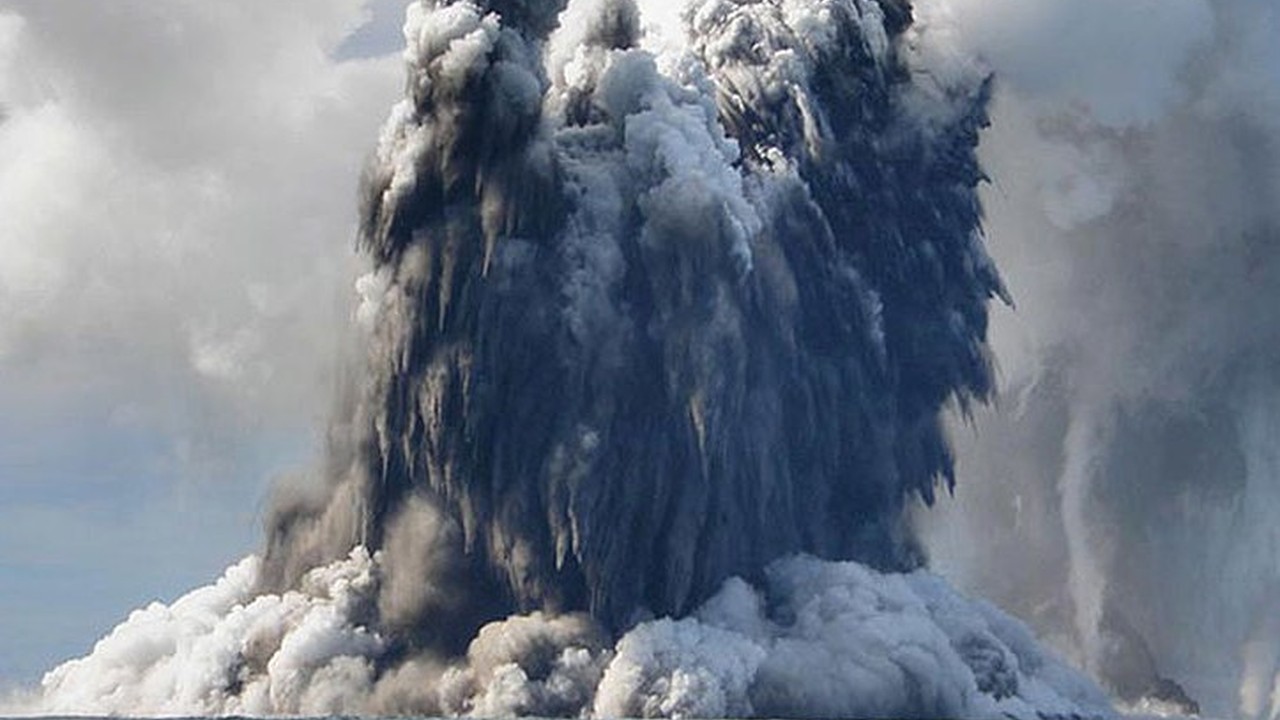

Since the beginning of May, a volcano hidden beneath the waters of the Bismarck Sea, north of Papua New Guinea, has erupted and started to launch columns of steam nearly three kilometers high, in a spectacle that scientists are following with a question in the air, could a new island be emerging from the ocean right before our eyes.
The first signs did not come from a visible explosion, they came from tremors. Around May 8th, seismographs began to detect a swarm of small earthquakes in an underwater formation called Titan Ridge, in the southwestern Pacific. Shortly after, NASA satellites captured from space what the instruments were already indicating, white plumes rising from the sea surface, a clear sign that a volcano was awakening below.
The column of steam and ash reached about three thousand meters in height, emerging from nowhere in the middle of the blue. And with it came a detail that makes the scene even more hypnotic, the water around filled with pumice stone, that volcanic rock so full of air bubbles that it floats. Large patches of this stone began to spread across the surface, forming temporary islands that the current carries away.
How a volcano can raise an island
Here is the part that truly fascinates me. Most of the planet’s volcanoes are not on land, they are on the seabed, in a submarine ridge that circles the globe. Almost all of them raise their mountains silently, hidden under hundreds of meters of water. But when one is shallow enough and ejects sufficient material, the mound of rock and ash can grow until it breaks the surface. This is exactly how volcanic islands are born, from the patient accumulation of eruption upon eruption.
-
Space technology used to search for water on Mars is now hunting for invisible leaks under the streets of São Paulo, using satellites, AI, and chlorine signals to help Sabesp recover up to 6.7 billion liters of water.

-
Japan sends ship to extract mud rich in rare earths at nearly 6,000 meters deep in the Pacific, attempts to lift 350 tons per day from the seabed, and transforms sediments near Minamitori Island into a strategic weapon to reduce dependence on China.
-
Venus Aerospace promises a rotating detonation hypersonic engine that takes the Stargazer to Mach 9 and crosses oceans in 1 hour, but the flight that made history barely surpassed the speed of sound.

-
Brazilian student creates a cheap formula that makes plants grow up to 90% faster and wins an award in a global scientific competition.




This is how places like Iceland and many Pacific islands emerged. What is happening now in Papua is potentially the first chapter of such a story, in real-time. If the volcano remains active and piles up enough material above the waterline, we could literally watch a new piece of geography emerge from the sea, something that most maps take millennia to record.

The stone that floats and tells the story
The pumice stone spreading through the water is not just a spectacle, it is a valuable scientific clue. It forms when gas-filled lava cools quickly upon contact with water, trapping bubbles within the rock. Analyzing this stone tells researchers the type of magma coming from below, the violence of the eruption, and even the depth at which everything is happening. It’s as if the volcano sends samples of itself floating to the surface.
These stone rafts also have a curious ecological role. As they travel across the ocean, carried for months by currents, they serve as a ride for small marine organisms, which cling to them and cross vast distances. I confess I find it poetic, a volcano that destroys at birth already spreads life across the sea while still erupting.

Watching without being able to get close
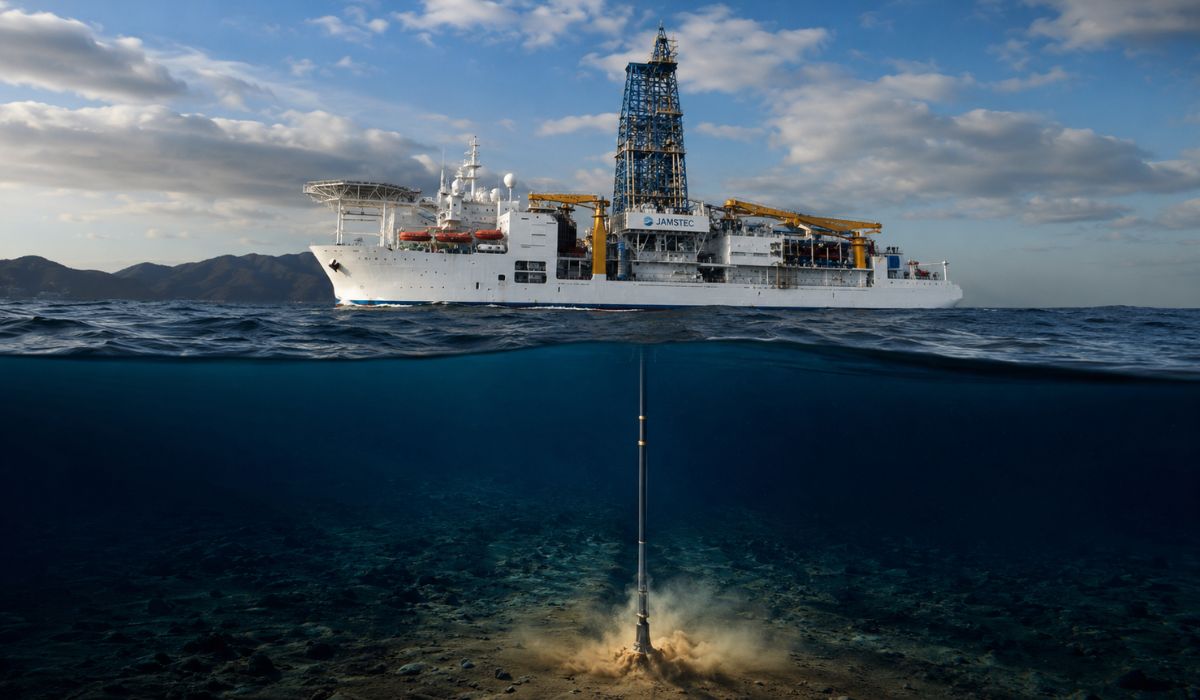
Studying an underwater volcano in eruption is one of the greatest challenges in geology, because the stage is underwater and in full activity. No one dives in the middle of the eruption. Science has to use what it can, satellites that see the plume from above, seismographs that hear the tremors, and ships that cautiously approach to collect pumice stone and measure the water temperature. It’s a distant vigilance, made of indirect clues.
This monitoring is not just curiosity. Underwater eruptions can affect navigation, change the local water chemistry, and in extreme cases, generate waves. Closely following what happens in Titan Ridge helps to better understand a process that has shaped the planet for billions of years and that almost always goes unnoticed because it is hidden at the bottom of the sea.
It’s no coincidence that this is happening right there. Papua New Guinea is nestled in the Ring of Fire of the Pacific, the horseshoe-shaped belt where the plates that form the Earth’s crust collide and where most of the planet’s volcanoes and earthquakes are concentrated. It’s one of the most geologically active regions that exist, a place where the Earth is constantly reshaping itself, on the surface and especially at the bottom of the sea. Those who live there coexist with this ground restlessness as part of the landscape, and scientists keep the area under constant surveillance precisely because of this intensity.

A piece of planet under construction
I imagine the feeling of those on the monitoring ships, looking at that steam column and knowing they might be witnessing the exact moment when the Earth creates a new piece of itself. We tend to think of maps as something fixed, but they are photographs of a planet that never stops reorganizing itself.
What will remain of this eruption, whether a permanent island or just another underwater mound, still depends on the coming days and weeks. In any case, the episode is a powerful reminder that the forces that shaped every continent remain active, bubbling right there, just below the sea surface and almost always out of our sight.
Would you like to see, in real-time, a new island emerging from the ocean, or does that give you more fear than enchantment?




Images in this article are misleading in that these are not the Bismarck Sea Titan Ridge location. This new activity is not near other land and many of these photos show nearby land. You ought to properly identify when and where those photos were taken because this is not the new activity. Make it clear and don’t mislead.