






 Portuguese
  Spanish
  4 min of reading
  0 comments


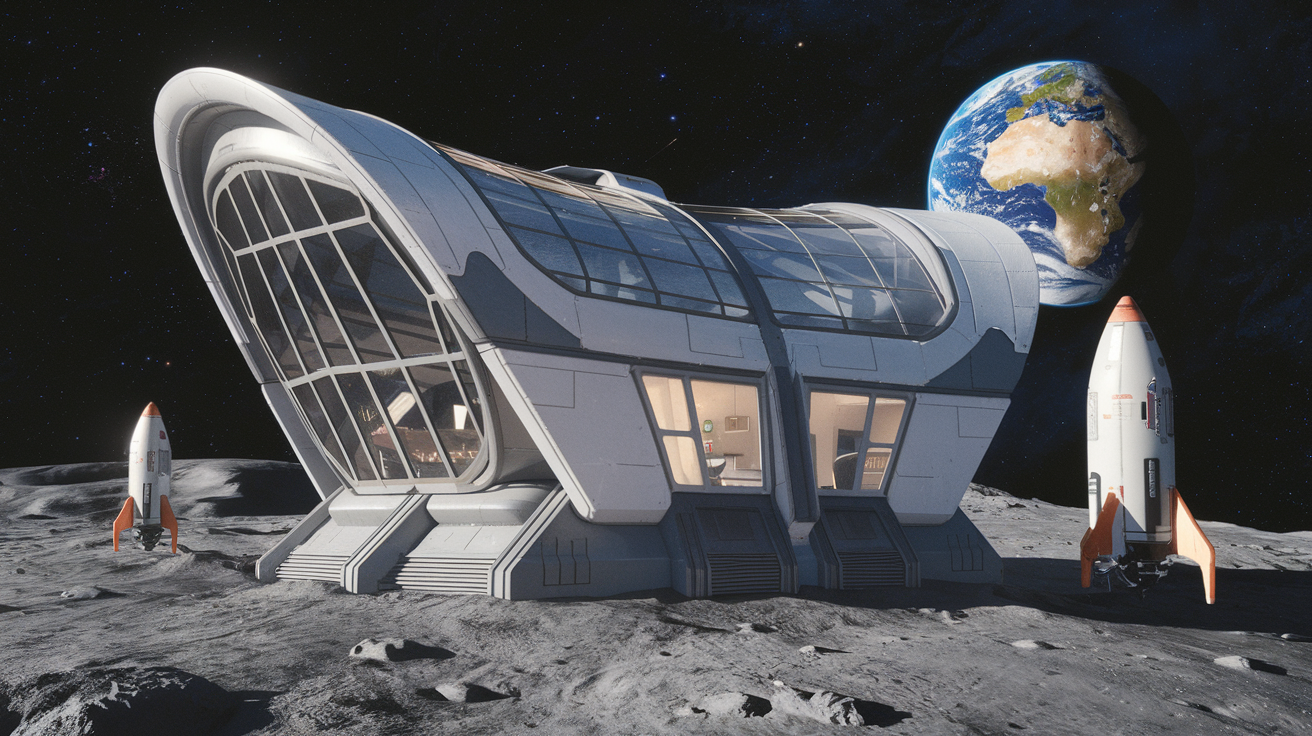
With Innovative Technology and Partnership with Icon, NASA Plans to Create Housing on the Moon for Future Space Missions. The Dream of Living in Space is Closer Than Ever!
Have you ever thought about living on the Moon? It may seem like science fiction, but NASA is turning this dream into reality with a bold project. The American space agency has forged a contract with Icon, a Texas-based company specializing in 3D printing, to develop robots capable of building houses printed on the Moon. That’s right: lunar housing, made directly from the soil of our natural satellite, is on the radar for future space missions.
What is the Olympus Project?
It is all part of the Olympus Project, an initiative by NASA that aims to literally prepare the ground for continuous human life in space. The agreement with Icon, signed in 2020 and valued at US$ 60 million, focuses primarily on developing robots that can print structures directly on the lunar surface.
But don’t think it will just be a “Ctrl+P” in space! The idea is to use lunar rocks as raw material to create the structures, which eliminates the need to transport tons of materials from Earth to the Moon. Thus, in addition to being efficient, the technology is sustainable and optimized for the harsh conditions of the lunar environment.
-
Goodbye traditional laundry: Roborock launches washer and dryer with super hydrolysis, microbubbles, 99.99% sterilization, low-temperature drying, automatic detergent, app control, and cycles to remove stains, odors, mites, and bacteria from clothes.

-
It is now possible to generate energy without batteries: new flexible material transforms body heat into electricity and paves the way for more efficient, autonomous, and comfortable wearable devices, with the potential to revolutionize personal electronics in the coming years.

-
Leaving the charger plugged in without a phone consumes energy or is it a myth? Experts call the phenomenon “phantom consumption” and warn that dozens of devices on standby can add up on the bill over the year.
-
It accompanies Earth, but it is not a moon: Chinese probe reaches Kamo’oalewa and begins an unprecedented mission to investigate where the strange asteroid came from, what its internal structure is like, and whether its origin is linked to an ancient collision that launched fragments of the lunar surface into space.



Houses, Platforms, and Even Roads on the Moon
Icon is not new to this type of innovation. The company was responsible for Mars Dune Alpha, a simulated Martian habitat that NASA used in the 2023 CHAPEA mission. In this experiment, astronauts tested what life would be like on Mars, simulating everyday tasks in an environment designed with the same technology that now promises to revolutionize lunar construction.
In the case of the Moon, Icon intends to go beyond houses. The company plans to build landing platforms, roads, and even pressurized buildings, which will be crucial for longer and more ambitious missions. These elements are vital for the success of the Artemis program, which aims to establish a permanent human presence on the satellite. If all goes well, what is being done on the Moon can also be replicated on Mars.
Why is This Important?
According to Niki Werkheiser from NASA, exploring new worlds requires the development of innovative technologies adapted to the unique conditions of these environments. It is not just a matter of scientific curiosity; these technologies have the potential to open doors to even more ambitious missions and, who knows, a future where living off Earth is as common as taking a plane today.
The creation of printed houses on the Moon is not just about living. These constructions will be essential for the survival of astronauts, providing shelter against cosmic radiation, extreme temperatures, and micrometeorites. It is literally about building security in space.
The Impact of the Project
The contract with Icon marks an important step in the modern space race. While countries and private companies compete to see who will leave their mark on the Moon next, NASA stands out with a practical and visionary approach. Creating habitable structures beyond Earth is no longer a distant concept; it is a real necessity for the advancement of space exploration.
NASA reinforces that this type of technology goes beyond the Moon. With the lessons learned from the Olympus Project, it will be possible to apply the same principles to building habitats on Mars and even on other celestial bodies. Just imagine: in a few decades, you might be neighbors with a Martian — or at least with another Earthling who decided to live on the Moon or Mars.
When is This Going to Happen?
Although the contract with Icon was signed in 2020, the development of these technologies is still ongoing. The Artemis mission, which will serve as a starting point for continuous human presence on the Moon, is already in progress. The expectation is that these constructions will begin to take shape in the coming decades, bringing the dream of living on the Moon closer to reality.
NASA has not released a specific date for when we will see the first printed houses on the Moon, but advancements in the Artemis program indicate that this could happen sooner than we think. The success of projects like Mars Dune Alpha proves that Icon has the know-how to tackle the technical and scientific challenges of this endeavor.
A Small Step for Construction, a Giant Leap for Humanity
The concept of printed houses on the Moon may seem like something out of a science fiction movie, but it reflects how far technology has come. The partnership between NASA and Icon is more than just an engineering project; it is a promise that humanity is ready to expand its horizons and explore new homes beyond Earth.
Whether you are a space enthusiast or someone who just dreams of the possibility of looking at Earth from a lunar window, one thing is certain: the future of space exploration has never seemed so promising — and so habitable.


-

1 person reacted to this.