






 Portuguese
  Spanish


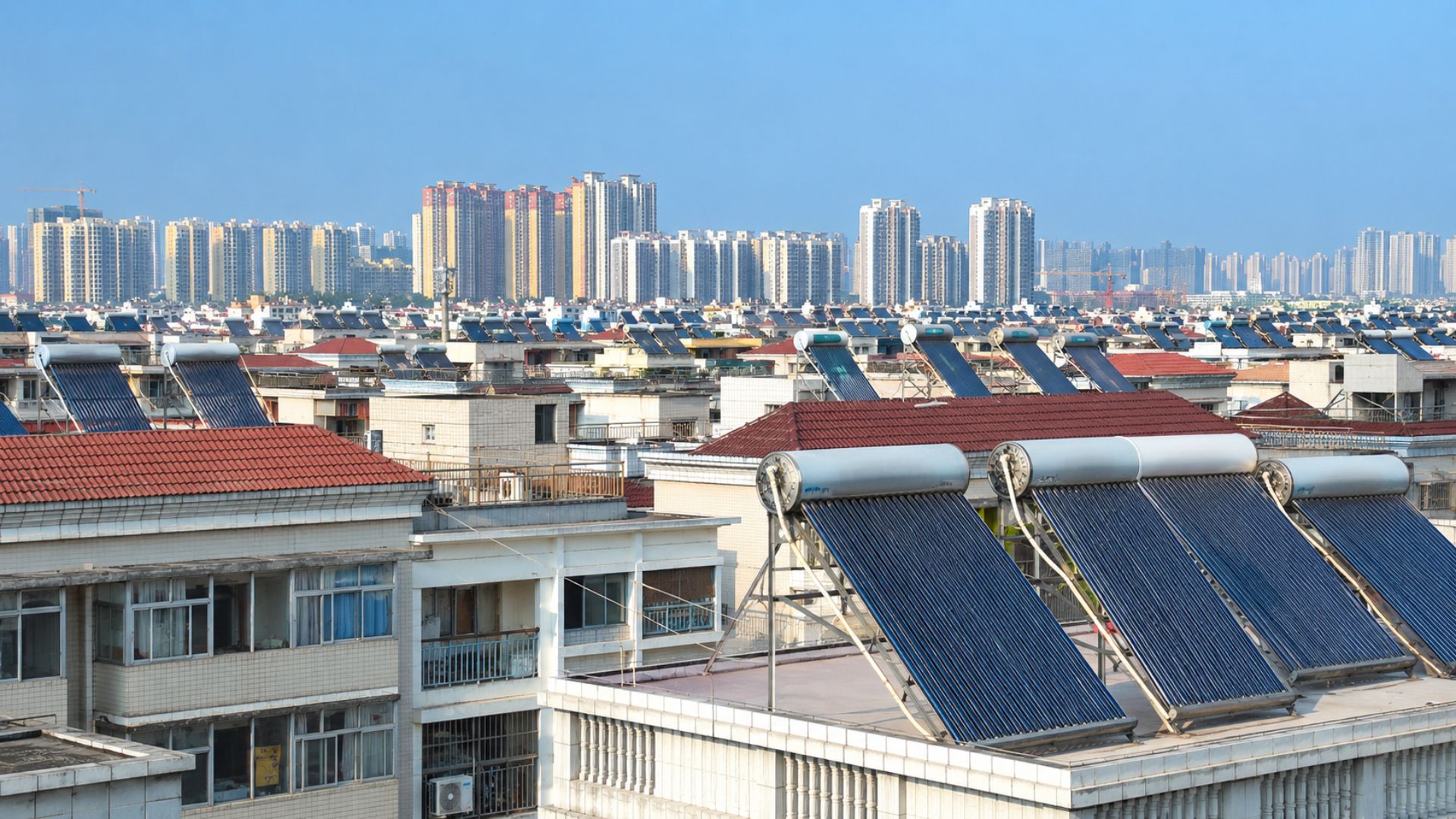


There is no pump, wiring, or monthly bill: the water rises on its own due to the temperature difference. Patented at Tsinghua in 1985, the technology placed China with about 70% of the world’s solar thermal capacity. In the USA, it is not prohibited, but certification and labor make the price jump from a few hundred to thousands of dollars.
More than 85 million homes in China heat water almost for free using vacuum glass tubes, a cheap, durable technology with no moving parts that was invented at a Chinese university. The same system, however, encounters certification requirements and building codes in the United States that significantly increase installation costs, even though, contrary to popular belief, it is not prohibited in the country.
The principle behind vacuum glass tubes is as simple as it is ingenious. Each tube is, in practice, a glass cylinder inside another, with the air removed from the space between them, creating a vacuum that acts as a thermal insulator, the same principle as a thermos. Sunlight passes through the outer glass and heats the water in the inner tube, which naturally rises to a tank without needing a pump, electricity, or any moving parts.
How the vacuum tube solar heater works

Since there is no air between the two glass walls, heat does not escape by conduction or convection, only by radiation, which is a slow process. Therefore, the inner tube can reach very high temperatures while the outer tube remains cool to the touch, even on harsh winter days, something that the old flat plate collectors cannot do with the same efficiency.
-
Few people know, but the smallest city in Rio holds a tunnel that was once the largest in the world, covering only 95.35 km², housing a railway work of 2,233 meters, and is also known for the historic title of the 4th best climate in the world.

-
A ‘hanging’ road in SP with viaducts over 80 meters, 11 tunnels, 20 suspension bridges, and pillars fixed at a depth of 40 meters has been challenging the Serra do Mar for almost 50 years and still impresses engineers.
-
Few people know the ingredient that can make strawberry plants produce larger and healthier fruits with just 1 spoonful per plant, thanks to the gradual release of phosphorus and calcium that strengthen roots, stimulate flowering, and increase vigor.
-
23-year-old worker dies after being ‘pulled’ by machine at packaging factory during production line maintenance; accident involved an industrial extruder, mobilized forensic investigation, and left the victim without a chance for rescue.


The circulation of water occurs through a physical phenomenon called thermosiphon. Cold water stays at the bottom of the tubes, is heated by the sun, becomes less dense, and rises to the storage tank, while the colder water from the tank descends to take its place. This cycle repeats throughout the day, driven only by the density difference between hot and cold water, without any electrical energy consumption and without motors that could break.
A genuinely Chinese invention
The history of this technology began with a problem. In the 1970s, China was industrializing, and millions of rural families needed hot water, but there was no gas infrastructure or reliable electrical network in the countryside. The government bet on the sun, and in 1979, Tsinghua University in Beijing assembled a solar energy research team with the mission of creating a cheap and easy-to-operate system.
The major breakthrough came in 1983 when researchers developed a special coating capable of absorbing more than 93% of solar radiation and emitting very little heat back, applied inside a vacuum glass tube. The patent was registered in 1985. It is worth noting that although China initially imported flat plate technology, the design of vacuum tubes was a native innovation developed on Chinese soil, not a copy of Western solutions.
From a shed to the Solar Valley


The mass adoption of the technology had a decisive name: Huang Ming, an engineer from the oil sector who became interested in solar energy and founded the Himin Solar Energy Group in Dezhou, Shandong province. Starting with almost no capital, he heavily invested in advertising on state TV and transformed the company into a world leader in the sector, helping to popularize heaters among hundreds of millions of Chinese people.
The success was so great that Dezhou became known as the Solar Valley, an industrial zone entirely dedicated to solar thermal energy. Huang Ming even received the Right Livelihood Award in 2011, a prize known as the alternative Nobel, for his work in bringing solar energy to millions of homes. For a one-time cost of about 1,500 yuan, equivalent to something between 190 and 300 dollars, families could have hot water without a monthly bill or complex maintenance.
The power of numbers in China
The data shows the scale of this silent revolution. By 2014, China had installed more than 85 million solar water heating systems, the vast majority using vacuum glass tubes. The country accounted for about 70% of the world’s solar water heating capacity, with Chinese companies holding most of the technology patents.
The system has proven efficient in a wide variety of conditions, from hot coastal regions to icy areas, including high-altitude locations like Tibet. Studies conducted by universities, including in Australia and Hong Kong, have confirmed that vacuum tubes reliably deliver heated water even in cold or cloudy climates, precisely because the vacuum insulation prevents heat loss to the external environment.
The weakness of glass and the limit in big cities
Despite the advantages, the technology has an important weak point: the glass can break. In rural areas, with low-rise houses, a cracked tube is just a minor inconvenience, resolved by replacing a cheap part. But in tall buildings in big cities, a broken tube can fall and become a safety hazard on sidewalks, in addition to making maintenance much more difficult.
For this reason, starting in the 2000s, several Chinese cities began to restrict the installation of these heaters in tall buildings, and the market started to shrink as the population moved to apartments. After all, the system depends on a tank positioned above the tubes, on the roof, space that, in residential towers, belongs to the building’s administration, not each resident. It’s a case where it wasn’t physics that changed, but the architecture of the cities.
The knot in the United States: expensive, not prohibited
This is where the point that often causes the most confusion comes in. There is a notion that these heaters are banned in the United States due to an alleged industry conspiracy, but this is not true. What exists is a certification process, known as OG-300, and building code requirements, such as mixing valves and installation by a licensed professional, which significantly increase the system’s cost. It’s bureaucracy and cost, not a ban.
So much so that there are duly certified systems available for sale in the American market, and Chinese manufacturers list the United States, Canada, Germany, and Brazil among their markets. The practical effect, however, is that equipment that would cost a few hundred dollars ends up costing thousands once certification, specialized labor, and licenses are added. The technology is legal and works, but the sum of requirements reduces its competitiveness compared to traditional gas and electric heaters.
Why the rest of the world adopts it
In several countries, vacuum tube solar heaters are simply a common household appliance, without the regulatory burden that increases the solution’s cost in some markets. In Greece, a large part of homes use solar thermal systems; in Israel, Turkey, and other countries, they are seen on the rooftops of practically all cities, often encouraged or required by law in new constructions.
The contrast is interesting for Brazil, which appears among the markets of these manufacturers and has enormous solar potential. Here, solar water heating is already used in homes and condominiums, mainly to reduce electricity bills, and it tends to grow with the search for energy efficiency. The technology shows how a simple and low-cost solution can have a real impact on family economies and reduce energy consumption.
The vacuum glass tubes are a fascinating example of how a simple, cheap, and efficient technology can transform the daily lives of millions of people, as happened in China. Far from conspiracy theories, what the comparison between countries reveals is the weight that rules, costs, and urban architecture have on the adoption of an innovation. In the end, the physics of the sun heating the water remains valid anywhere in the world, but the path to the roof depends on each local reality.
And you, were you already familiar with these vacuum glass tube solar heaters or have you used any solar heating system at home? Do you believe that Brazil should further encourage this type of technology to lower energy bills? Leave your comment, share your experience with solar energy, and share the article with those interested in innovation, sustainability, and household economy.





Great ,can I buy one in my country, Kenya