Portuguese
  Spanish


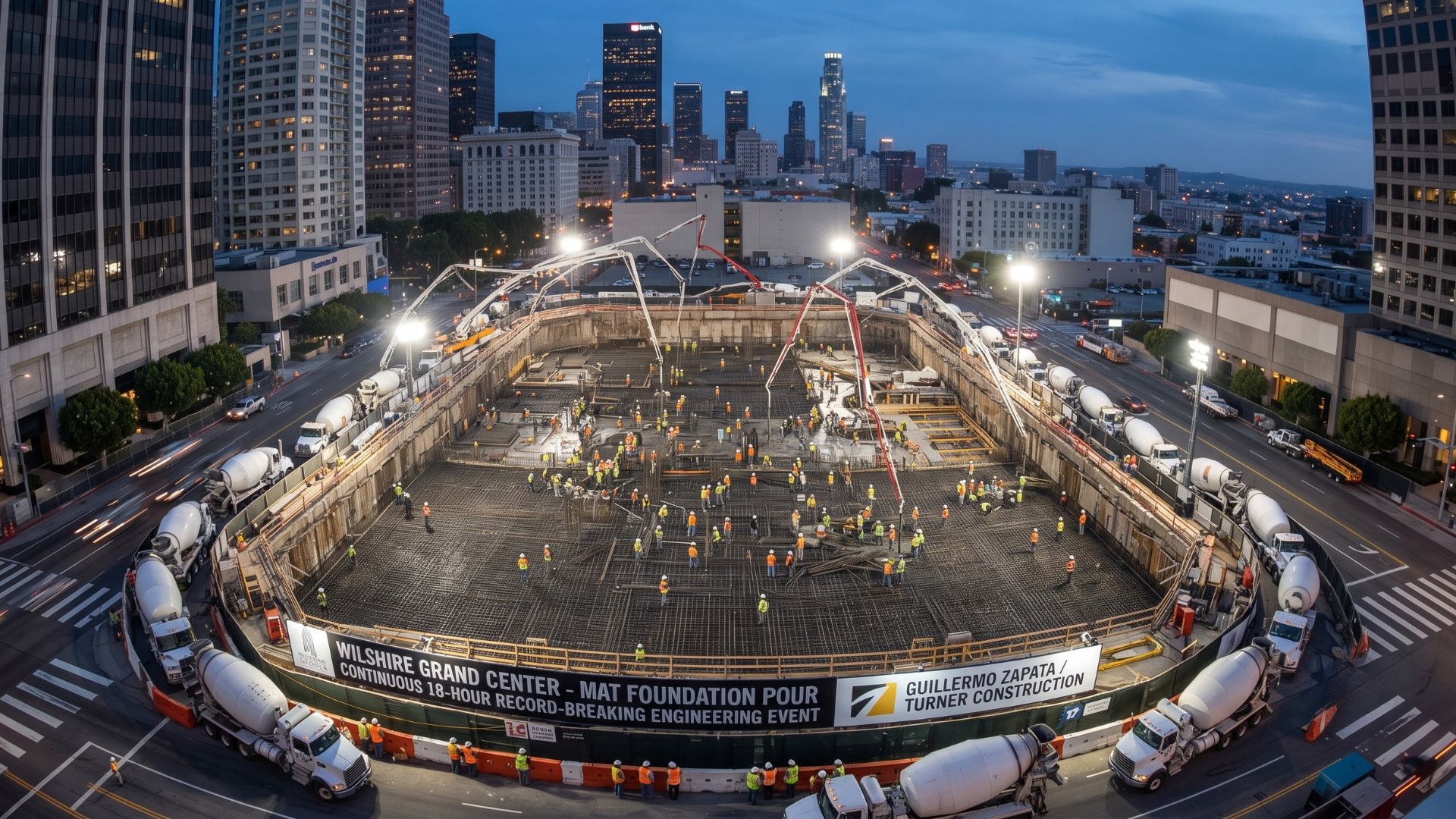

The construction of the Wilshire Grand Center mobilized more than 2,100 trucks in a continuous concrete pour that entered the Guinness World Records and marked American engineering.
In February 2014, downtown Los Angeles was the stage for one of the largest concrete pouring operations ever conducted. To build the foundation of the Wilshire Grand Center, engineers organized a task force that mobilized more than 2,100 concrete mixer trucks, pouring approximately 16,200 cubic meters of concrete in a single continuous pour. The operation entered the Guinness World Records as the largest continuous concrete pour in the world at that time, surpassing the previous record set during the construction of the Venetian hotel in Las Vegas.
The Wilshire Grand Center would later become the tallest building on the west coast of the United States, with a height of 335.3 meters and 73 floors, making the foundation one of the most critical stages of the entire project.
More than 16 thousand cubic meters of concrete were poured in a single stage
The foundation of the building required a massive concrete slab capable of distributing the weight of the tower over the rock formation known as the Fernando Formation.
-
The man who started in construction with his own house founded a company in 1957, went through a banking crisis in 1987, and ended up connected to 16,500 houses in Houston.

-
Builders challenged experts, erected a 16-story building using only reinforced concrete when the known limit was six floors, and proved that skyscrapers would never be the same again.
-
Up to 60 concrete mixer trucks pour 380 m³ of concrete onto the “big slab” of Niemeyer’s first work in Amazonas, in a decisive stage of the construction of the monumental oca that will mark the Parque Encontro das Águas in Manaus.

-
Alert in Santa Catarina: the Anita Garibaldi Bridge on BR-101 is completely closed in both directions due to “structural risk,” and drivers are diverted to a 20 km/h detour that promises kilometer-long queues until July 20.




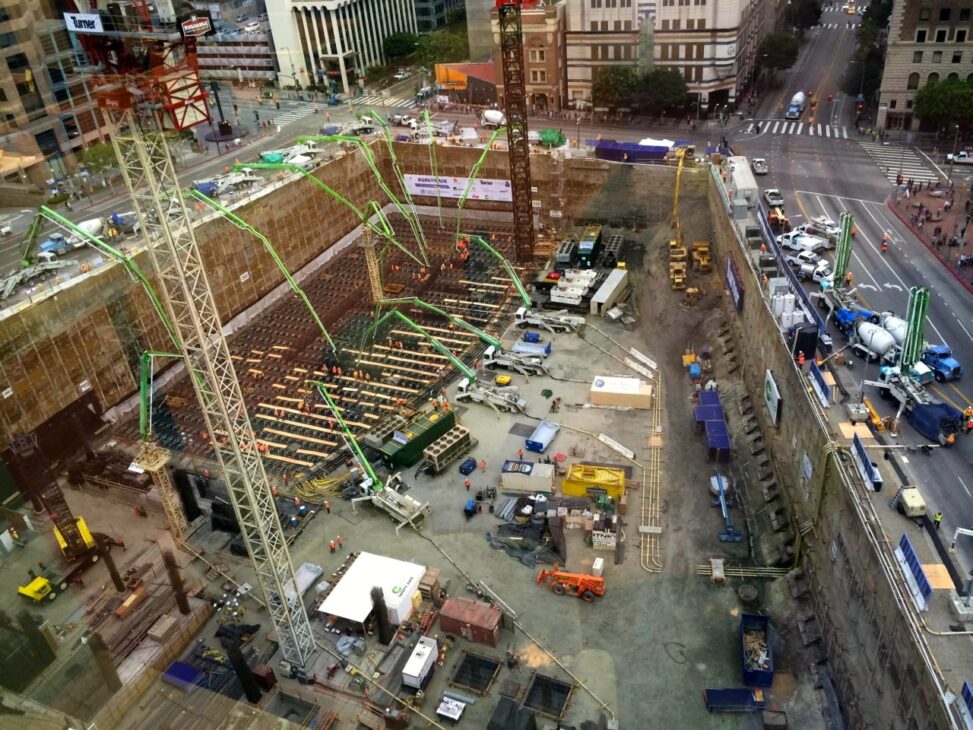
The Conco Companies
According to the Los Angeles Times, approximately 16,200 m³ of concrete were used, equivalent to about 82 million pounds (approximately 37 thousand tons), poured continuously to form a base about 5.5 meters thick.
To avoid cold joints, which can compromise structural integrity, the entire foundation had to be executed without interruptions.
More than 2,100 trucks participated in the operation
Logistics was one of the biggest challenges of the project. According to The Guardian, approximately 2,120 concrete mixer trucks made successive trips to the construction site to maintain a constant flow of concrete throughout the operation.


According to the company The Conco Companies, responsible for the concreting, about 227 trucks remained in continuous operation, making between 10 and 14 trips each, totaling approximately 2,100 concrete deliveries throughout the pour.
Eighteen pumps worked simultaneously
It was not enough just to transport the concrete. According to The Conco Companies, 18 concrete boom pumps were strategically positioned around the excavation to distribute the material evenly throughout the foundation.
The coordination between trucks, concrete plants, pump operators, and engineering teams needed to function continuously so that no sector of the foundation suffered interruptions during the pour.
Operation lasted about 20 hours and broke world record
Although many reports mention approximately 18 hours of concreting, the official record of the Guinness World Records considers an operation of about 20 hours, from the start to the completion of the continuous pour.
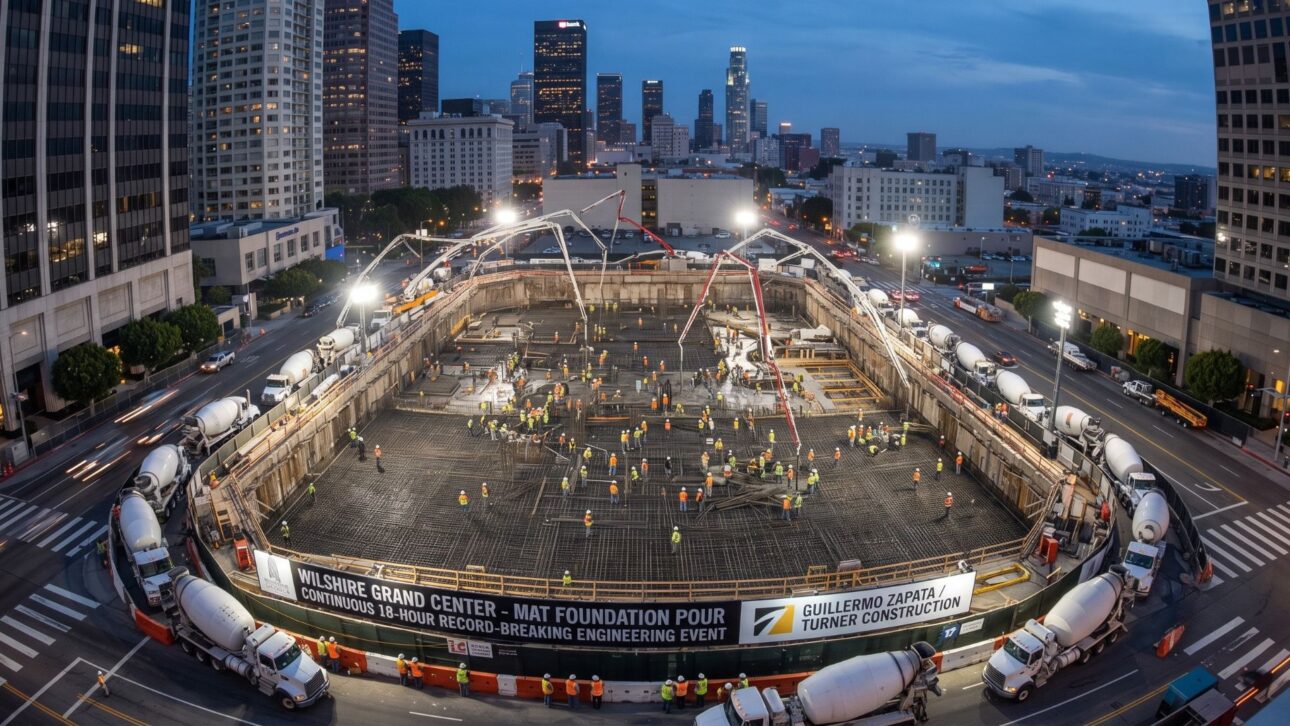
The result was enough to surpass the previous record, set in 1999 during the construction of The Venetian, in Las Vegas.
At the time, experts classified the operation as one of the largest demonstrations of logistics ever carried out in North American civil construction.
Foundation needed to support one of the tallest buildings in the United States
All this structure would serve as the base for an extremely demanding building from a structural point of view. The Wilshire Grand Center reached 335.3 meters in height and became the tallest building in Los Angeles and the west coast of the United States when it was inaugurated in 2017.

According to the Los Angeles Times, the massive foundation was designed to withstand not only the enormous weight of the tower but also the forces generated by earthquakes, as Los Angeles is located in a region of high seismic activity.
Seismic engineering required an exceptionally robust foundation
The foundation was designed to work in conjunction with a gigantic reinforced concrete structural core. As explained by Wired magazine, the building uses thick structural walls, advanced bracing systems, and devices capable of dissipating energy during earthquakes.
The enormous foundation slab plays an essential role in this setup, distributing loads and increasing the stability of the tower in the face of intense seismic movements.
The concreting of the Wilshire Grand Center is still remembered as one of the most complex operations ever executed in civil construction.

The success of the logistics, involving thousands of truck trips, dozens of concrete pumps, and thousands of tons of material poured without interruption, made the project a milestone of modern engineering and an example frequently cited in studies on large structural concrete pours.