






 Portuguese
  Spanish
  3 min of reading
  0 comments



With Record Exports of 3.48 Million Vehicles in 2025, China Bets on Giant Car Carrier Trucks That Revolutionize Automotive Transport and Challenge the Limits of Global Logistics
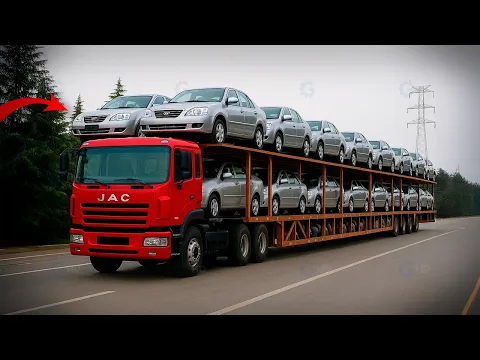
The presence of Chinese vehicles in the global market continues to expand rapidly, driven by increasingly bold logistics. In the first half of 2025, China exported 3.48 million cars, an 18% increase compared to the same period the previous year. To handle this record volume, the country began using giant car carrier trucks, capable of transporting up to 30 vehicles per trip — more than double the capacity of the standard models used in Brazil.
This demand led Chinese manufacturers to invest in colossal car carrier trucks.
These vehicles can transport up to 30 cars or utility vehicles at once, more than double the capacity of the models used in Brazilian territory.
-
Survivor of 1966 SS Daniel J. Morrell Shipwreck in Lake Huron Recounts 38-Hour Ordeal in Extreme Cold

-
The Greatest Hoax in World Cup History? The Film That Denied Brazil’s 1958 Victory and Exposed How Fake Evidence Can Seem Convincing on TV
-
Fake South Korean Online Stores Offer Shopping Thrill Without Spending Money or Receiving Products
-
The War of Jenkins’ Ear: How a Severed Ear Sparked One of the 18th Century’s Most Unusual Conflicts



Efficiency and Emissions Savings
In comparison, a standard car carrier truck in Brazil typically carries 11 cars. Therefore, the Chinese model has become a more efficient and cost-effective alternative.
Besides reducing logistical costs, it also decreases pollutant emissions, as a single truck can transport what two Brazilian trucks would carry.
This efficiency, however, comes with challenges. The extreme size of these carriers requires special care, particularly regarding road safety.

Giants on Wheels Measuring 32 Meters
According to industry information, Chinese car carrier trucks can reach up to 32 meters in length, with a width of 3.2 meters and a height of 4.5 meters.
For comparison, the largest Brazilian trucks measure about 23 meters in length and 2.6 meters in width, although they can be slightly taller, reaching 4.9 meters.
These proportions have raised concerns among traffic specialists, who have questioned the safety of allowing these vehicles on the country’s highways.
Government Wants to Reduce Vehicle Sizes
In light of the criticisms, the Chinese government is considering limiting the dimensions of car carrier trucks. The new rules aim to restrict the length to 22 meters and the width to 2.6 meters.
If approved, the carriers would resemble those used in Brazil, with a capacity of about 11 vehicles per trip.
Resistance from Transport Companies
Even so, the approximately 30,000 vehicle transport companies in China resist the idea of reducing the size of their fleets.
The main concern is the increase in operational costs, which could more than double.
In the current configuration, the trucks allow for transporting cars side by side on two levels, accommodating different types of models — hatchbacks, sedans, SUVs, and utilities.
In some cases, it is possible to carry up to 24 smaller vehicles, which represents a significant logistical advantage.
Additionally, these giants feature a special axle system that helps better distribute the weight of the load and ensures stability, even with maximum loads.
With information from Estadão.





-

-

-

-

22 people reacted to this.