






 Portuguese
  Spanish
  5 min of reading
  0 comments


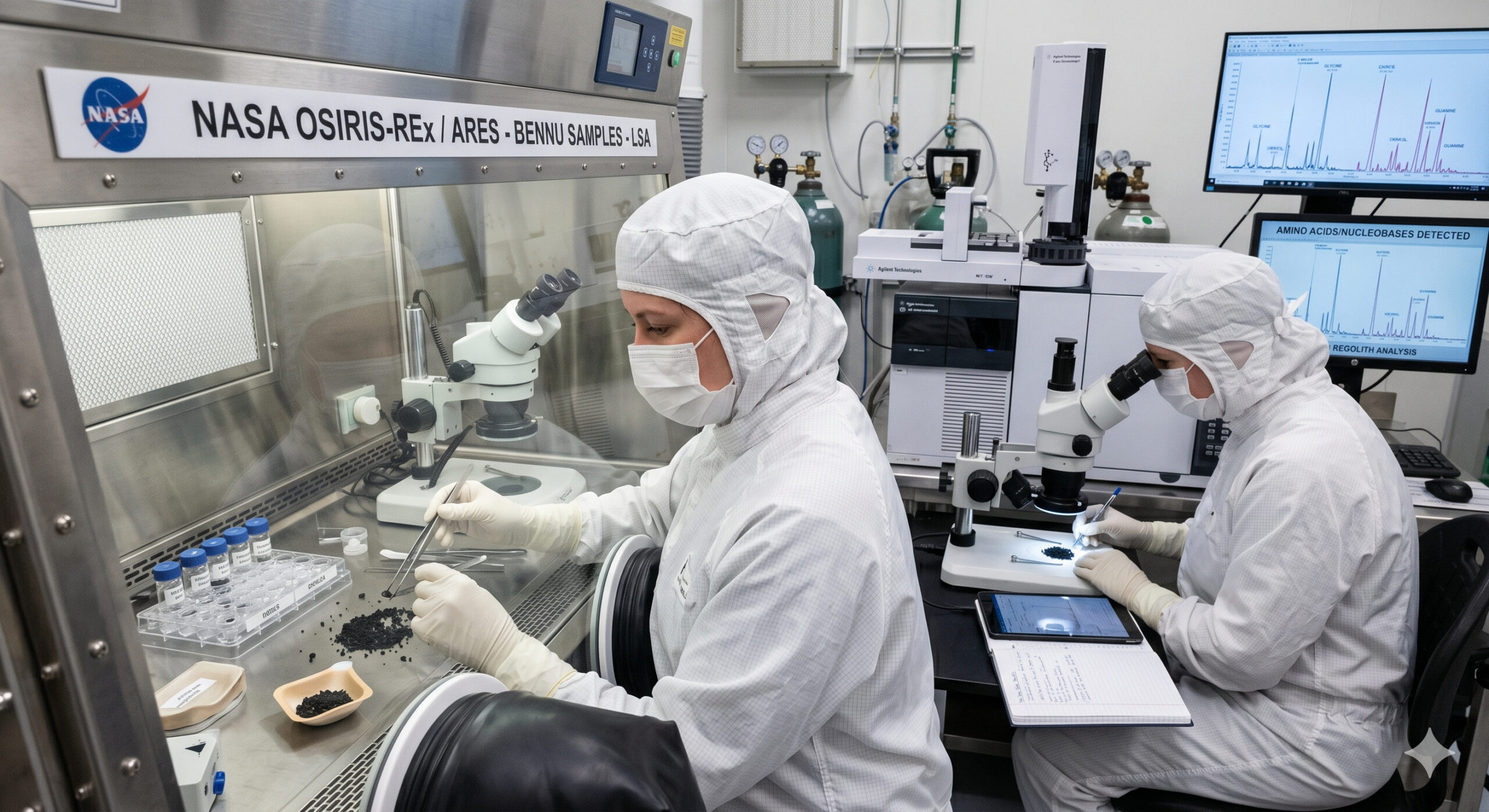
Samples from asteroid Bennu reveal amino acids and nucleobases, supporting the hypothesis that the ingredients of life were already circulating in the primitive Solar System.
In 2025, NASA announced, on January 29, 2025, the first complete results of the analyses of the samples brought back by the OSIRIS-REx mission from asteroid Bennu, a celestial body about 4.5 billion years old and preserved since the early days of the Solar System. The material had been collected directly from the surface of the asteroid in 2020 and returned to Earth in 2023, and has since been studied in specialized laboratories.
According to the official NASA statement published on January 29, 2025 and the Reuters report from the same day, scientists identified in the samples 14 of the 20 amino acids used by life on Earth to form proteins, as well as all five nucleobases present in DNA and RNA: adenine, guanine, cytosine, thymine, and uracil. The central data is straightforward: fundamental compounds for the chemistry of life already existed in celestial bodies formed even before the emergence of Earth, reinforcing the hypothesis that asteroids may have helped distribute these ingredients throughout the primitive Solar System.
Asteroid Bennu preserves primitive material from the beginning of the Solar System
Bennu is classified as a carbonaceous asteroid, rich in organic compounds and minerals formed in environments with the presence of water in the past.
-
A doctor from Minas Gerais warns that sleeping with the fan pointed at the body all night is not as harmless as you think; it dries out the respiratory tract, causes mucus buildup, spreads dust mites, and can even irritate the cornea of the eyes.

-
Ecuadorian volcano at 6,268 meters is more than 2,000 meters closer to space than Everest, which is 8,848 meters, because the Earth is wider at the equator.
-
Public school students in the hinterlands of Maranhão create a bioinsecticide with neem and castor to protect corn crops, transform rural waste into biogas and biofertilizer, and bring sustainable technology to producers at ExpoSertão.

-
Ötzi, the 5,300-year-old mummy found in the Alps, reveals a still active microbiome, and the Iceman’s yeast points to an energy-saving fermentation.


Having remained relatively unchanged since its formation, it serves as a kind of chemical archive of the early Solar System.

The OSIRIS-REx mission was specifically designed to collect material that had not been altered by terrestrial processes, ensuring a more accurate analysis of the original composition.
This makes Bennu one of the most valuable sources ever studied to understand the origin of the chemical elements that enable life.
Amino acids and nucleobases found are fundamental components of biology
The amino acids identified in the samples are molecules that form proteins, essential for nearly all biological processes.
The nucleobases — adenine, thymine, cytosine, guanine, and uracil — are the building blocks that make up DNA and RNA, responsible for the storage and transmission of genetic information.
The simultaneous presence of these two sets of molecules in an asteroid reinforces a hypothesis that has been discussed for decades in the scientific community.
The hypothesis that the ingredients of life did not originate exclusively on Earth, but may have been brought by celestial bodies.
Evidence reinforces the theory that asteroids helped to “seed” primitive Earth
One of the main interpretations of the data is that asteroids like Bennu may have played an important role in the origin of life on Earth.
During the period known as the late heavy bombardment, billions of years ago, Earth was struck by numerous asteroids and comets.
These impacts may have:
- Transported water
- Introduced organic compounds
- Provided raw materials for complex chemical reactions
The discovery of organic molecules on Bennu strengthens the idea that Earth received some of the necessary ingredients for life from space.
However, it is important to highlight that this does not mean that life itself came from space, but rather that its basic components may have been delivered in this way.
Samples were collected directly from the asteroid and brought to Earth
The OSIRIS-REx mission marked a significant advancement in space exploration.
Launched in 2016, the spacecraft arrived at Bennu in 2018 and conducted the collection in 2020, using a robotic arm to capture material from the surface.
The capsule containing the samples returned to Earth in September 2023, landing in the state of Utah, in the United States.
The direct collection eliminates many of the uncertainties present in studies based on meteorites, which can undergo changes while passing through the Earth’s atmosphere. This increases the reliability of the obtained data.
Presence of water in Bennu’s past is suggested by found minerals
In addition to organic molecules, the analyses also indicated the presence of minerals formed in aqueous environments. This suggests that the original body from which Bennu originated may have had contact with liquid water at some point.
The combination of water and organic compounds is considered one of the essential factors for the emergence of life, which makes this discovery even more relevant.
Discovery does not prove existence of life outside Earth
Despite the scientific impact, it is crucial to clarify that the presence of amino acids and nucleobases does not mean that life exists or has existed on Bennu. These molecules are ingredients, not living organisms.
The discovery reinforces favorable chemical conditions for life, but does not confirm its existence outside Earth. This point is essential to maintain scientific accuracy and avoid misinterpretations.
Research opens new possibilities for studies on the origin of life
The results obtained from Bennu expand the field of study on the origin of life, allowing new investigations in areas such as:
- Prebiotic chemistry
- Formation of complex molecules in space
- Interaction between water and organic compounds
The analysis of these samples should continue for years, as only a small fraction of the material has been studied so far.
OSIRIS-REx mission redefines asteroid exploration standards
In addition to scientific discoveries, the mission also establishes a new standard for space exploration. The ability to collect and bring back intact samples from an asteroid paves the way for future similar missions.
This allows for more detailed studies than those based solely on remote observations. The discoveries on Bennu also influence the search for life outside Earth.
If the basic ingredients of life are common in asteroids, this increases the likelihood that similar conditions exist elsewhere in the universe.
This expands the scope of exploration to moons, planets, and other celestial bodies that may have received similar material.





Be the first to react!