Portuguese
  Spanish


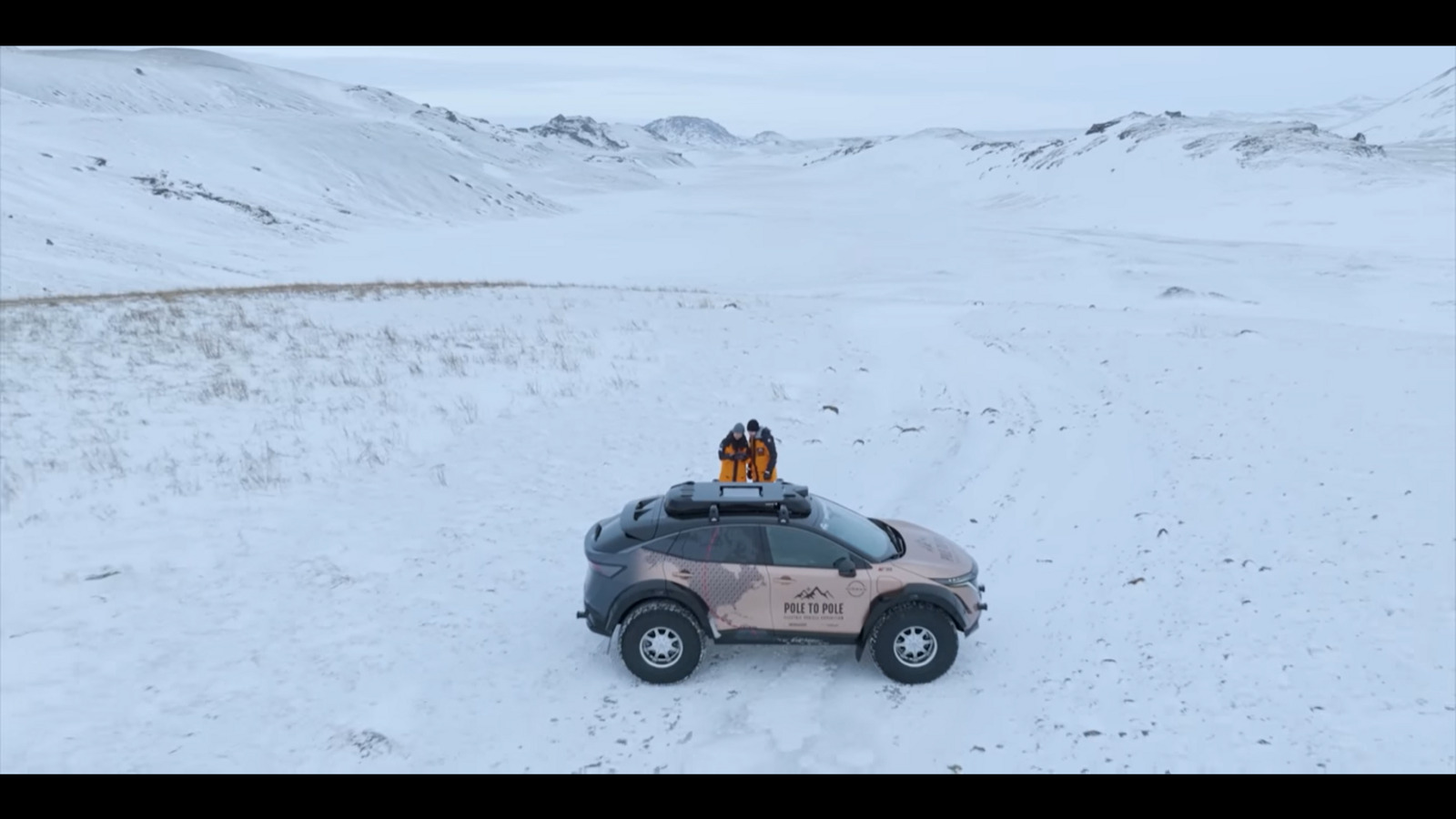

British couple traveled 33,800 kilometers in an electric Nissan Ariya, crossed 14 countries from the Magnetic North Pole to the South Pole, and demonstrated the vehicle’s endurance in ice, snow, roads, and long distances
Chris and Julie Ramsey traveled 33,800 kilometers in an electric car, crossed 14 countries, and reached the South Pole on December 15, 2023, completing the first electric vehicle expedition between the Magnetic North Pole and Antarctica.


The historic feat in an electric car
The journey began in March, about nine months before arrival. The couple set off from the closest possible point to the Magnetic North Pole and ended on the frozen snow of the South Pole, next to the metallic globe-shaped statue.
No car had completed this route before. The feat gained significance for being accomplished in an electric Nissan Ariya. Julie told the Washington Post that they could have failed at any moment.
-
Driver Crosses 100-Year-Old Railway Bridge Over Uruguay River, Encounters Rural Couple Preserving Traditional Farming Methods

-
Rural Producer Returns to Brazilian Farmland, Builds Family Agricultural Business with Children’s Support and Industry Backing
-
Goiás Couple Boosts Artisan Cheese Production from 25 to 70 Kilos Daily with Technical Support, Transforming Family Life in Rural Brazil
-
13-Year-Old Discovers Ancient Roman Ring Near Mount Carmel, Now Set for Display in Jerusalem




The mission had a clear and straightforward goal: to demonstrate the capability of electric vehicles in extreme conditions and over very long distances. For the couple, the trip showed that these models can go far.

A nearly standard Nissan Ariya faced ice and snow
The vehicle used was a standard Nissan Ariya. The main changes were made with Arctic Trucks, which reinforced the body and installed giant 39-inch tires to tackle ice and snow.
The battery and propulsion system remained intact. In practice, the car continued to function as a regular electric vehicle, requiring regular stops for recharging.
Chris, a coffee enthusiast, also added power for an espresso machine. They used a gas generator and sometimes a solar generator.
Six years of preparation and 14 countries on the route
The adventure required six years of planning, development, training, and support. Despite the difficulty, Chris and Julie already had experience in long journeys.
They had completed the Mongol Rally, a 16,000-kilometer trip from the United Kingdom to Mongolia, using a Nissan Leaf. Chris also held a Guinness World Records title since 2018.
In that year, he covered 285 kilometers on an electric bicycle over 12 hours, achieving the record for the longest distance in that period. The new attempt, however, was on a much larger scale.
At the start of the expedition, temperatures reached -45°C as the couple drove over ice and hidden snowbanks. They camped in tents next to the car or inside it when the wind was strong.

Upon reaching the Canadian continent, the couple relied on charging stations and outlets offered by locals. Still, they reported that many stations were faulty and that providers needed improvement.
The challenge of keeping the battery charged accompanied the epic journey. Before heading through South America, Chris and Julie mapped sections where the range might be insufficient.
They worked with Enel X to install 20 charging stations in Chile, Peru, Ecuador, and Colombia.
During the journey south, the only time they needed to leave the car was to take a ferry to Colombia and bypass the Darién, on the border between Panama and Colombia.
From South America to the South Pole
Afterward, the couple traveled through tree-lined roads and through Cali, Colombia, and Lima, Peru.
Along the way, they met generous people passionate about cars. Some offered services to take care of the Nissan, while others wanted to hear more about the mission.
The final stage began in November when they arrived in Antarctica. They disembarked in Punta Arenas, at the southern tip of Chile, and prepared to fly to the icy continent.
In Antarctica, they reunited with the Arctic Trucks support team and traveled another 1,100 kilometers to the final destination. The Nissan arrived covered in snow and ice.
Chris told Top Gear that being at the South Pole felt unreal after so many years of planning. He stated that he always trusted the Nissan Ariya, although the experience was more difficult than he imagined.
Sune Tamm, operations director of Arctic Trucks, told the Washington Post that they did something no one dreamed was possible, not even in a fossil fuel vehicle.
On social media, the couple celebrated the arrival. For Chris, after the stress faced, other drivers can relax seeing what an electric car managed to do.
With information from Guinness.