Portuguese
  Spanish


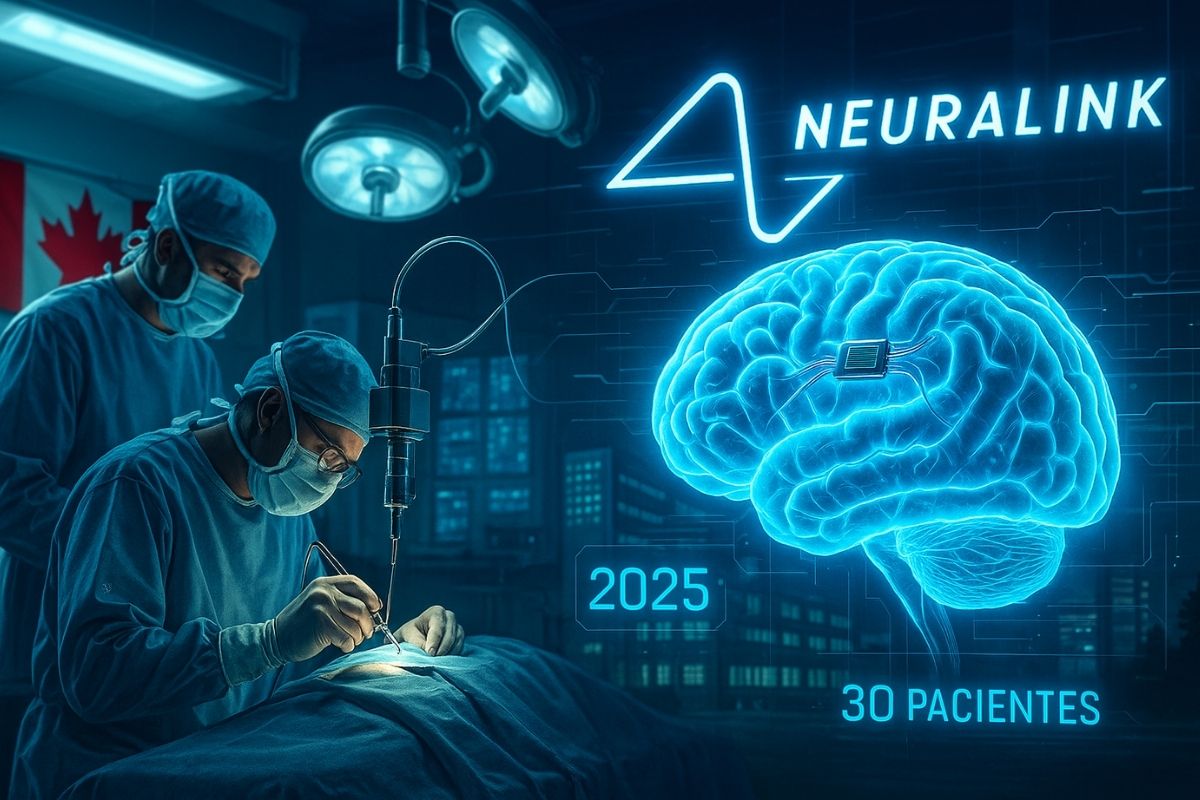

Elon Musk’s Company Performed Two Surgeries in Toronto and Expands International Clinical Study; Goal is to Test the Device on Up to 30 Volunteers with Paralysis
Neuralink has taken a decisive step towards global expansion. According to confirmed information, the company performed the first brain implants outside the United States, in two surgeries at the University Health Network (UHN), in Toronto, Canada, on August 27 and September 3, 2025. The procedures are part of the clinical study C Prime, which aims to reach up to 30 patients by the end of the year.
The initial focus of the project is on people with severe cervical injuries, for whom the device can represent a leap in autonomy and dignity, allowing them to control computers, send messages, and even interact with electronic devices solely using their minds.
Who Are the Patients and How Does the Implant Work
Neuralink selects volunteers with severe paralysis for this phase of testing.
-
One of the most devastating El Niños in modern history did not only bring heat: amidst droughts, destroyed crops, and lack of supplies, 50 million people died across three continents, and scientists see in this past a brutal warning for a hotter planet.

-
EcoFlow’s Portable Fridge Offers 43 Hours Off-Grid, Reaches -25°C, App-Controlled, Solar-Powered for Camping and RV Adventures
-
Vietnamese Inventor Overcomes Debt and Develops Agricultural Robot Sold in 15 Countries
-
3,000 Sheep Maintain 900 MW Solar Farm Transforming Texas Fields into Energy for Data Centers



The device is a wireless implant that reads electrical signals from the brain and translates them into digital commands.
To do this, it uses artificial intelligence capable of learning specific patterns of each individual, increasing the accuracy of neural reading.
In practice, patients can move a cursor, operate connected devices, and even manipulate robotic prosthetics.
Experts point out that this stage has the potential to transform the lives of people with severe motor limitations, restoring control over basic everyday tasks.
How Far Has Neuralink Advanced in the Clinical Field
Before Canada, Neuralink had already performed implants in the United States and the United Kingdom, establishing itself as the company making the most progress in multicenter studies with brain-computer interfaces.
The study C Prime is considered essential to validate the safety of the implant and the performance of the surgical robot that performs the insertion of the neural wires.
According to the company, the data collected by 2025 will be used to demonstrate not only efficacy in digital control but also to pave the way for new applications.
Such as restoration of speech in stroke victims, partial recovery of vision in the blind, and initial research on memory and cognition.
Where Is the Most Immediate Technological Impact
The difference of Neuralink is combining surgical robotics and artificial intelligence in a standardized implantation process.
This ensures that surgeries are faster, safer, and scalable.
The use of AI allows the adaptation of neural decoding “to each brain’s way,” something that increases the clinical success rate.
Canada is now the third country to integrate clinical testing, reinforcing the internationalization strategy.
For analysts, the choice of a reference hospital like UHN shows that the company seeks to establish scientific credibility in rigorous medical research environments.
Why This Advancement Is Both Concerning and Exciting


For advocates, the technology is a milestone for patients with paralysis, offering a new form of independence and social inclusion.
Critics raise ethical questions about safety, privacy of neural data, and unequal access to technology.
The fact that Neuralink is expanding beyond the U.S. shows that testing is maturing, but it also increases pressure on global regulations.
The scenario points to an unprecedented race: brain implants have moved from the realm of promises and are now in real operation, with dates, locations, and identified volunteers.
If the clinical results are positive, Neuralink could lead not only in the medical field but also in a new industry of brain-machine interfaces.
Do you believe that Neuralink will really revolutionize the lives of people with paralysis, or is it still too early to trust this technology? Share your opinion in the comments — we want to hear your thoughts.