Portuguese
  Spanish


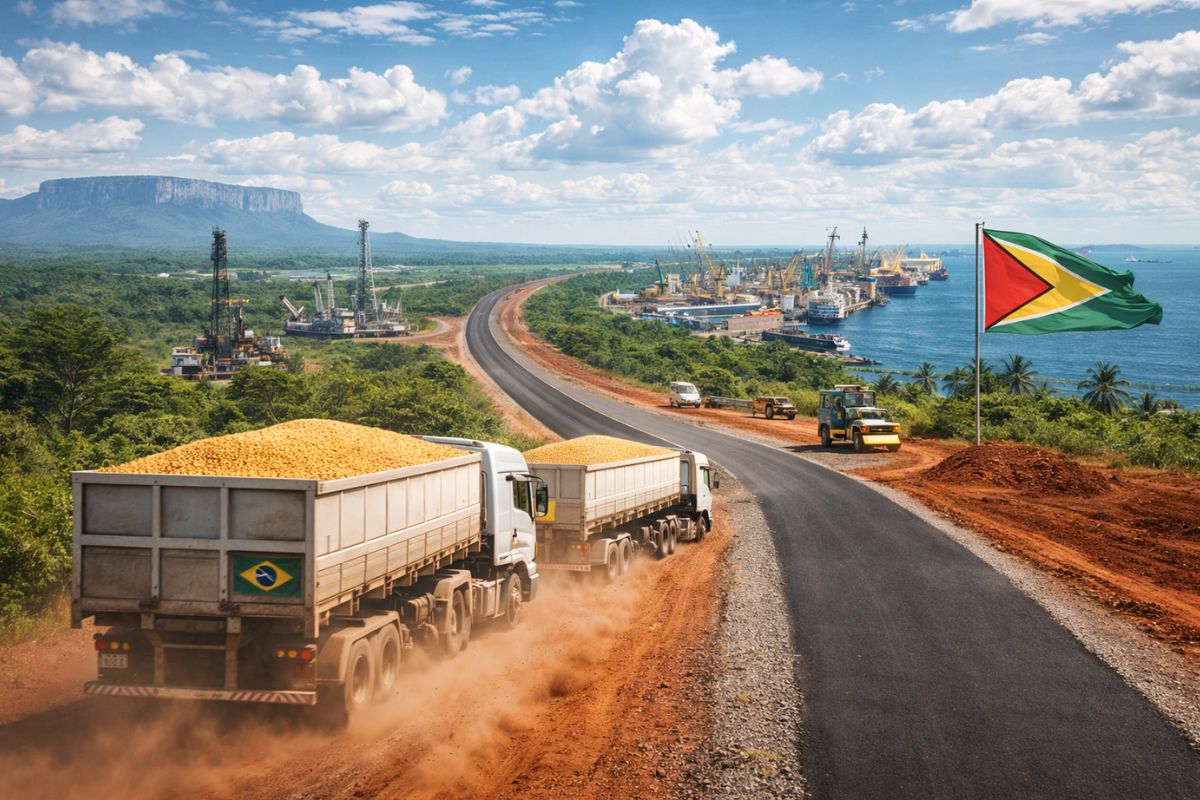

Halfway on a dirt road, the Soy Route of Roraima depends on the paving promised by Guyana by 2030 to reach the port regularly.
The soy route that could connect Roraima to a port in Guyana has gained attention because it addresses a well-known pain for those producing far from the major corridors: high freight costs, long journeys, and the fear that logistics will turn into a “will it or won’t it” right at harvest time. When a shorter alternative emerges, the first reaction is hope. The second is skepticism, because not every route on paper becomes a practical route.
And this is where the detail that dictates the pace of this story comes in: half of the journey is still on dirt. This changes everything. A dirt road can work at one time and become a bottleneck at another; it might even be passable today and turn into a choke point tomorrow. So, the soy route becomes a promise with a big asterisk underneath.
Why the soy route has entered the radar now

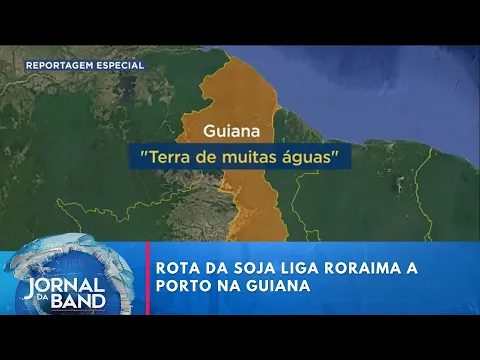
Roraima is at the top of the map, and therefore, any path that promises to shorten the journey to a port draws attention. The soy route enters this conversation as a possible more direct corridor, capable of reducing some of the burden of longer routes.
-
Labor shortage reaches the truck drivers’ area: Brazil is already facing a deficit of 120,000 drivers, 65.1% of transport companies feel the impacts, and Mercedes-Benz strengthens training in the face of the new generation of technological trucks.

-
An important sector in Brazil is suffering from a labor shortage, requiring the qualification of 14 million workers by 2027, leading companies to invest R$ 5 million to train professionals and address the technical deficit.
-
With a record production of nearly 3 million barrels per day, Petrobras resumes importing diesel in July, highlighting the bottleneck in Brazilian refining.

-
Micron invested $9.3 billion in a factory in Hiroshima to produce the memory that powers the brain of global artificial intelligence.



However, what really matters is not just distance. It’s predictability. When transport becomes a lottery, the margin disappears without warning. And that’s why the market looks at a new route thinking less about “shortcut” and more about “can we trust it?”.
Half the way is still dirt and that defines the real risk
When it is said that half of the journey is still on dirt, it is not a small detail. It defines whether the soy route will be a solid exit or just a path that works on good days.
Dirt roads tend to increase the risk of delays, raise maintenance costs, and create bottlenecks at critical points. And there is a problem that doesn’t show up in the picture: when the flow increases, the bad stretch usually worsens faster. If it doesn’t have consistent traffic, the corridor doesn’t consolidate, and the market treats it as a gamble, not as a foundation.
Guyana became richer with oil and promises to pave by 2030
On the Guiana side, the piece that could change the game appears: the country has become rich with oil and talks about paving the stretch by 2030. For the soybean route, this is not an “improvement.” It’s a game changer.
Paving is what transforms a route that works part of the year into a corridor that works all year round. Without pavement, the route remains vulnerable to interruptions and cost variations that leave producers and buyers insecure.
What logistics teaches when a route truly changes the life of a country
When a transportation infrastructure moves from improvisation to a system, the impact is not small; it is a change of reality. In an example of a modern railway built to connect a port to a capital, a journey that often took more than a day was completed in about 4 hours after operations began. This affects supply, reduces delays, and changes how companies, producers, and commerce operate.
The lesson is simple: when transportation ceases to be an obstacle, costs decrease, planning improves, and risks diminish. This is what a paved and predictable soybean route can deliver if it truly becomes a reliable corridor.
What to observe before betting on the soybean route

Before treating this soybean route as a ready-made solution, there are some points that will determine whether it will take off or remain in the “almost”:
The actual paving schedule by 2030 and what moves from speech to work
The most critical stretches of the land part and how they behave when the flow increases
The capacity of the port and the fluidity of access, so the bottleneck doesn’t just change places
The consistency over time, because a route only becomes a route when it can be relied upon
What could change for Roraima if the soybean route truly works
If the soybean route gains regularity, the main change is the security of planning. It’s not just “going faster”; it’s reducing the invisible cost of uncertainty. With a reliable corridor, more negotiation options arise, improving freedom of choice and reducing dependence on a single path.
But if half of the route remains unpaved for a long time, the route tends to oscillate between promise and bottleneck, and the market will continue to price that risk.
And now I would like to ask you in a very simple way: do you think this soybean route has a chance of becoming a reliable path before 2030, or does it still seem like a good idea that will take a long time to truly work?