Portuguese
  Spanish


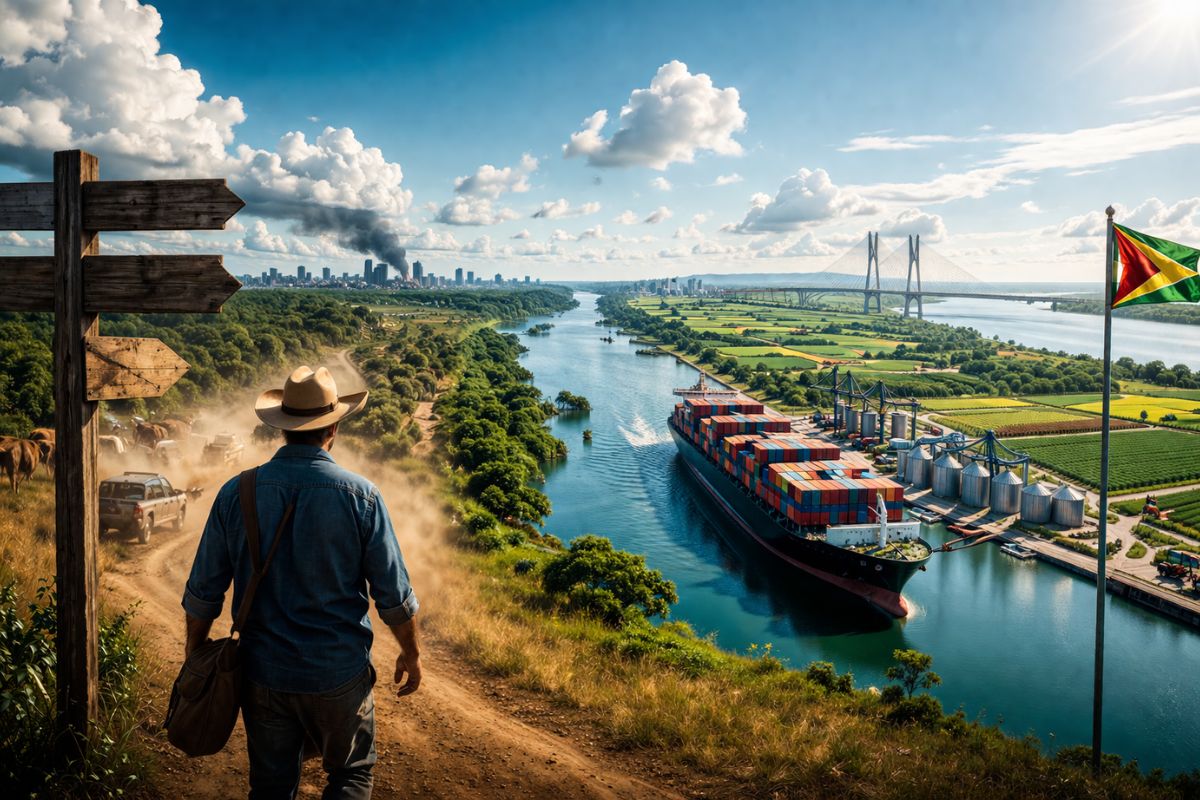

With high interest rates and legal uncertainty in Brazil, farmers point to the neighboring country as a refuge for offering land grants, tax incentives, a port, a waterway on their own farm, and the bridge that is missing to close the integration.
The high interest rates and lack of predictability have begun to weigh on the fields in Roraima, and producers have been seeking alternatives outside Brazil to plant and harvest with fewer obstacles. In the view presented in the report, when the debate gets lost in smaller disputes, organized crime benefits and those who produce become more exposed to risks and uncertainties.
On the other side of the border, Guyana appears as a contrast: there are reports of land grants, tax exemptions and reduced tax collection, in addition to investment in infrastructure that changes the logistical game, with examples of farms where the harvest leaves the field and arrives at the loading terminal within the property itself, using a waterway, port, and a shorter route towards Asia.
What is pushing producers out of Roraima
The combination of high interest rates and legal uncertainty is described as a direct brake on the ability to produce, invest, and expand. When the cost of money rises and the rules seem unstable, the producer loses momentum to finance inputs, machinery, and infrastructure, and begins to seek an environment where the numbers add up with less risk.
-
While NATO secured more than $10 billion in missiles and space surveillance at a single forum, Brazil still spends 1.1% of its GDP on defense and is stalling its own anti-aircraft system.

-
Corn ethanol attracts R$ 23 billion in 21 new plants and prepares for a nearly 50% jump in Brazilian production by 2027, even with high interest rates.
-
A newly opened terminal in the middle of the Amazon has begun transporting soy and corn through Amapá, eyeing the queue of ships that is congesting the ports in the South.
-
Tesla injected an additional $250 million into the German factory, doubled the battery cell target, and opened its own production line for startups.


In this scenario, the central criticism is that instability opens the door to a dangerous side effect: a feeling of institutional abandonment, while issues of security and predictability remain unanswered at the pace expected by those in the field.
Why Guyana became a refuge for those who want to plant and harvest
The attraction does not appear only as a specific economic advantage, but as a package. The report highlights respectful treatment, with the government acting as a partner and without “difficulty” in enabling productive work. What stands out here for those fleeing high interest rates is land grants and incentives to accelerate the start of production.
It is also noted that more than 80% of Guyana’s territory is preserved, while the country combines preservation with productive expansion and infrastructure, reinforcing the narrative that the agricultural project is “starting off on the right foot.”
From the field directly to shipping: terminal on the farm and waterway in use
One of the strongest points is the example of logistics within the agricultural operation itself: the grain harvest goes directly from the field to a shipping terminal within the farm, cited as a reference for pioneering.
Meanwhile, the structure already uses waterway by local river, instead of relying solely on road transport. In the comparison made, Brazil still appears to be discussing studies to use large rivers, while the Guianese operation has already incorporated the waterway in practice, reducing steps, time, and cost, something that becomes even more significant in times of high interest rates.
Port in Georgetown and the shortest route to Asia


The report mentions the port in the capital Georgetown as a key piece for the flow of goods. The logistical argument is straightforward: a route leaving from Boa Vista can reduce travel time to the Panama Canal, through which the grains head towards Asia.
In the presented reading, this creates a competitive advantage because it shortens the path and tends to reduce the total cost of export, especially when high interest rates make any inefficiency more expensive.
The missing bridge and the race to complete integration
To close the corridor, there is still a pending bridge pointed out as the last step to complete the integration of Roraima with Guyana. On the Brazilian side, it is mentioned that the highway is ready. On the Guianese side, the Transamazonian of the neighboring country appears with 200 km paved.
The construction on the other side is described as being valued at around US$ 1 billion, led by a contractor, with the expectation of consolidating the flow of production and trade. With high interest rates, this type of infrastructure stops being a detail and becomes decisive.
Security also plays a role in the decision
The account reinforces that it is not just about the economy. Security and stability enter the calculation, both in the Guianese and Brazilian environments, because predictability does not depend only on taxes or credit, but also on being able to operate without surprises.
When the producer feels that the scenario becomes more unstable, high interest rates and legal insecurity stop being separate problems and start to function as a push to seek another place where the risk seems lower.
With high interest rates and legal uncertainty, do you think Brazil is at real risk of losing producers to neighboring countries, or is this still a sporadic movement?