






 Portuguese
  Spanish


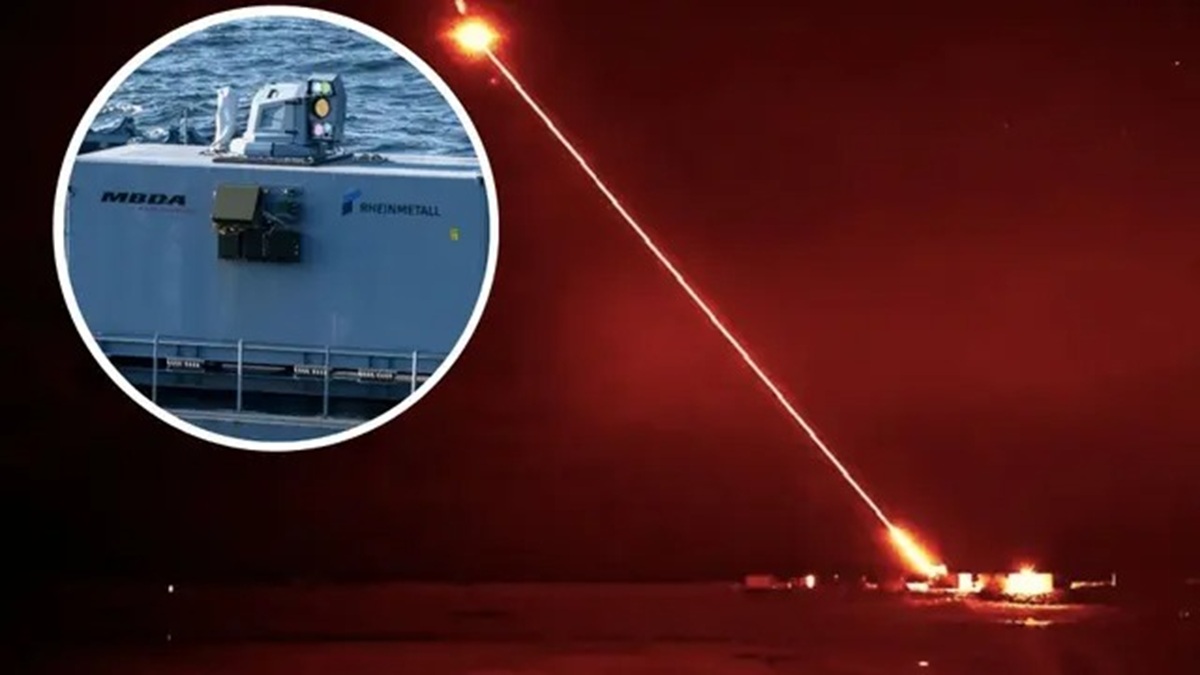
Rheinmetall And MBDA Delivered To The German Navy A High-Power Laser Weapon System, Successfully Tested At Sea And Designed To Destroy Drones, Fast Boats, And Guided Missiles.
Rheinmetall and MBDA delivered to Germany a laser weapon demonstrator of approximately 20 kilowatts, designed to neutralize enemy drones and other lightweight targets. The prototype has already undergone over 100 firing tests under real operational conditions, and the expectation is that it will enter operation starting in 2029.
The companies emphasize that the system can complement conventional guided missiles because it offers a more economical and precise option to counter small and fast threats.
Delivery, Integration, And Testing At Sea And On Land
The demonstrator arrived at the Laser Competence Center of the Weapons and Munitions Technical Center (WTD 91) in Meppen for a new phase of testing. The companies stated that the system successfully completed a year-long testing phase at sea, aboard the frigate SACHSEN, demonstrating the robustness of the container and the performance of the beam under real maritime conditions.
-
U.S. National Park Deploys Robotic Birds Near Wyoming Airport to Protect Endangered Species: Dancing and Sound-Emitting Replicas Aim to Lure Real Birds to a 100-Acre Restored Area Away from Runways After 32 Aircraft-Related Deaths

-
Russia and India Lift 320-Ton Pressure Vessel into Kudankulam Nuclear Plant Reactor, Advancing Project That Has Already Prevented 112 Million Tons of CO2 Emissions

-
Brazilian Student Wins Global Science Fair in the U.S. with Sound Wave Method to Alter Alzheimer’s-Linked Genes
-
Bosch Unveils Revolutionary 2.3 kg Hub Motor for E-Bikes with 45 Nm Torque and 400 Watts Power, Eliminating Resistance Above 25 km/h in Historic Shift for German Manufacturer


With the support of WTD 91, the container with the laser is now also operating in additional land-based drone defense tests, expanding the validation of the system in different operational scenarios.
MBDA was responsible for target detection and tracking, the control console, and linking the demonstrator to the command and control system.
Rheinmetall took over the aiming system, beam guidance, the demonstrator container, integration and electrical systems on the deck of the frigate SACHSEN, and the high-power laser source, including its peripherals.
This arrangement highlights a technical partnership that, according to the statement, showcases the companies’ expertise in optics and sensor technology.
Current Capabilities And Expansion Possibilities
The demonstrator currently operates with about 20 kilowatts, an adequate power level to neutralize small unmanned aerial vehicles and lightweight surface targets.
The companies emphasized that the system architecture was designed to be scalable, so future versions could exceed 100 kilowatts to confront larger threats. Exclusive technologies, “designed and manufactured in Germany,” ensure accurate target detection and tracking, based on years of development in optics and sensors.
The companies also stated that the weapon could be equipped with enhanced capabilities, allowing, if necessary, the destruction of guided supersonic missiles and rockets, as well as mortar and artillery projectiles.
Thus, the laser weapon system can offer new possibilities for counter-operations against non-cooperative targets, as it neutralizes swarms of drones and other small targets with precision and effectiveness.
An operational laser system would act as a complement to guns and guided missiles, especially in defense against swarms of drones, fast boats, and, at close range, guided missiles.
The combination of advanced detection, integrated control, and a high-energy beam aims to provide an additional layer of defense, more economical to use and quick to respond.
The delivery of the demonstrator represents, according to the statement, an important step towards the commercial and operational availability of a future laser system for the Navy, paving the way for a new generation of directed energy-based defenses.





Be the first to react!