






 Portuguese
  Spanish
  3 min of reading
  0 comments


German University Develops Bioconcrete That Transforms Human Waste Into Low-Carbon Construction Material
Researchers at the University of Stuttgart are leading an innovative initiative that uses human urine and bacteria to create a more eco-friendly type of concrete. The method, called microbial biomineralization, promises to significantly reduce emissions in the construction industry, one of the most polluting sectors in the world.
Bioconcrete with Urine: A Creative Solution for Sustainable Construction
The construction sector, historically reliant on cement, is about to undergo a radical change. Scientists at the University of Stuttgart in Germany have developed a new approach to producing concrete from the biomineralization of organic waste, specifically urine. The technique is part of the SimBioZe project and combines sand, urea, and bacteria that promote the formation of calcium carbonate, resulting in a solid material similar to natural sandstone.
According to Interesting Engineering, the concrete produced with urine achieved a compressive strength above 50 MPa, surpassing traditional materials used in bioconstructions. With artificial urine, the performance was 20 MPa, and with human urine, it was 5 MPa. Scientists are refining the methodology to achieve ideal levels between 30 and 40 MPa, which are considered suitable for buildings up to three stories.
-
Common land turns into 4 compact townhouses with two parking spaces, suites, skylights, and free space at the back for expansion, a solution that tries to tackle the high price of lots and keep affordable housing in the Minha Casa Minha Vida program outside expensive gated communities in Blumenau.

-
A Japanese carpenter took five months to build a house by hand with screwless joints, knot-free cedar, and a finish that a 40-year veteran American contractor said he had never seen anything like anywhere in the world.

-
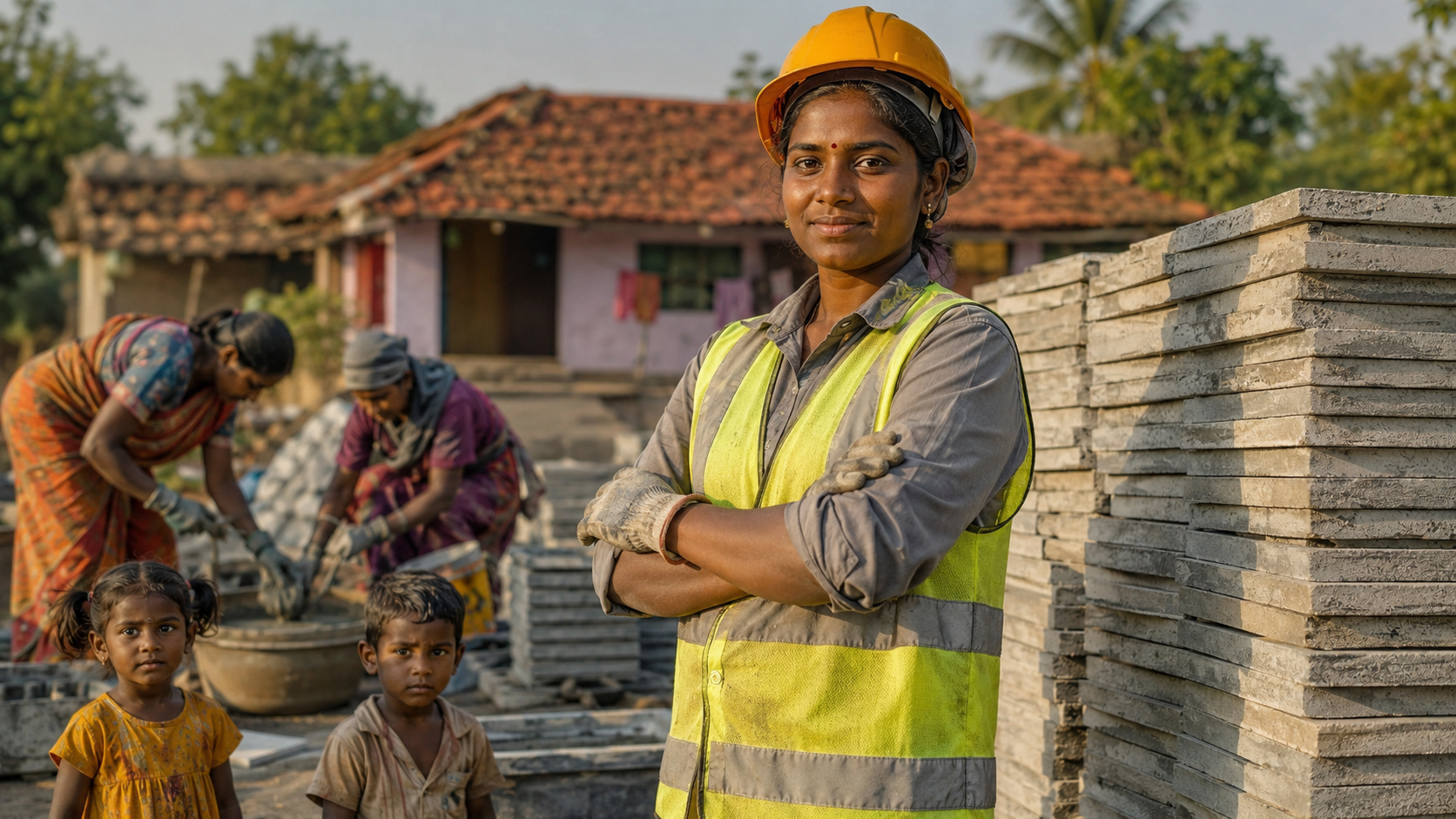
Mother of two who couldn’t leave her village in India takes a 20-day masonry course, starts a company with other women, receives a large production order, and changes her financial situation.

-
Giant project connecting Salvador to Ilha de Itaparica advances in Bahia with authorization for the land phase, linear support platform in Vera Cruz, investment over R$ 10 billion, 12.4 km of extension over the sea, and a structure ten times larger than the Ponte de Guaratuba.



Project Invests in Circularity to Minimize Construction Impacts
More than just a laboratory innovation, the German project proposes a sustainable value chain that links sewage, concrete production, and fertilizer generation. The process not only consumes less energy compared to conventional cement but also emits reduced volumes of greenhouse gases. The idea is to close the urban waste cycle, transforming an environmental issue into a construction solution.
As reported by Interesting Engineering, urine can be collected in public places with high foot traffic, such as airports, and sent to specialized facilities for processing. The University of Stuttgart already plans to build a pilot plant at Stuttgart Airport, where it will be possible to test the practical application of bioconcrete on a large scale.
Innovation Could Redefine Sustainability Standards in Construction
The German initiative joins a growing movement of universities and research institutes seeking cleaner and more efficient methods to meet the global demand for construction. Biomineralization had been previously explored by other institutions, but the use of urine as the main agent is a bold advancement. With financial support for a new phase of testing, the SimBioZe project aims to enhance production stability and increase bacterial activity in industrial processes.
The use of bacteria to transform waste into solid materials is not new, but the union of biotechnology and construction opens up new ways to think about the future of cities. The initiative from the University of Stuttgart reinforces how science can be applied in practice to rethink production models and reduce the environmental impacts of critical sectors.




Be the first to react!