






 Portuguese
  Spanish


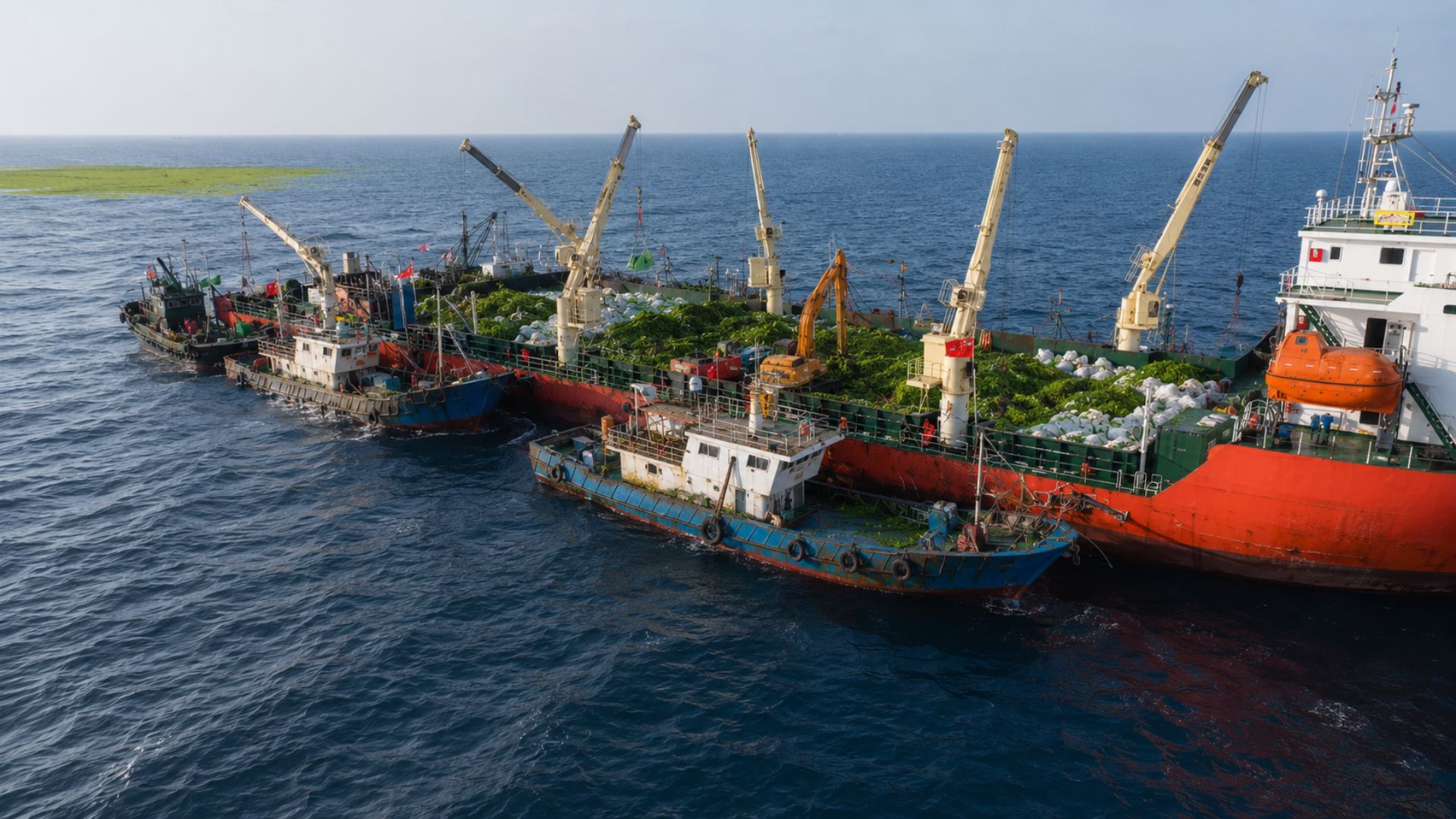


What once represented a recurring environmental disaster on China’s coasts now supplies crops in dozens of nations with marine-derived organic fertilizer, according to CGTN, the result of over 50 patents developed to harvest, dry, and process algae directly from the ocean on an industrial scale.
Every summer, a thick green tide takes over extensive stretches of the Chinese coast. Tons of sea lettuce accumulate on the sand, suffocating marine ecosystems and generating millions in cleanup costs for local governments. For decades, this phenomenon was treated exclusively as a catastrophe – a problem with no apparent solution that repeated itself with the punctuality of a biological clock. Until Chinese laboratories decided to look at that discarded biomass and see in it the raw material for a fertilizer capable of revolutionizing agriculture on a global scale.
The result of this shift in perspective is already crossing borders. The biological fertilizer derived from sea lettuce is now commercialized in over 60 countries and regions, supported by a portfolio of more than 50 national patents covering everything from specialized harvesting vessels to proprietary drying and dehydration systems. China has converted marine waste into exportable agricultural technology, and the world has started to pay attention.
The green invasion that paralyzed the Chinese coast

Every year, as temperatures rise, ocean currents carry colossal volumes of sea lettuce to China’s east coast. The algae reproduce with impressive speed in nutrient-rich waters, forming green carpets that cover kilometers of beach and block the sunlight necessary for the survival of other marine species. The impact on coastal ecosystems is severe: fish, crustaceans, and underwater plants lose habitat, and the biological balance of the region deteriorates each season.
-
Low-Demand Brazilian Beef Offal Gains Popularity Abroad: Indonesia Purchases $19.5 Million, Boosting Revenue and Reducing Waste

-
Soy Expansion in Former Brazilian Savanna Sparks Water and Land Conflicts in Major Agricultural Frontier
-
Mexican Pest Threatens U.S. Cattle Herds at Historic Lows, Potentially Boosting Brazilian Beef Exports as Burger Prices Soar

-
Avocado Boom for European and U.S. Markets Fuels Water Crisis in Drought-Stricken Chilean Region




For coastal communities, the scenario is equally dramatic. The decomposition of sea lettuce within hours of leaving the water releases intense odors and attracts pests, transforming tourist areas into zones of repulsion. Municipal governments must mobilize fleets of trucks and hundreds of workers to collect the material before the sanitary situation worsens. The logistical cost of this operation, repeated year after year, consumed budgets without generating any return until science posed a different question: what if that algae wasn’t waste?
From marine waste to high-tech fertilizer

The answer came from research centers that identified a significant concentration of beneficial nutrients for the soil in the composition of sea lettuce. Rich in nitrogen, potassium, and essential microelements, the material had ideal characteristics for the formulation of a biological fertilizer, provided it could be processed on an industrial scale before natural decomposition rendered it useless. The technical challenge was as great as the economic opportunity.
Pioneering companies had to develop the entire production chain practically from scratch. Special harvesting vessels were designed to efficiently remove the algae from the sea, dehydration systems were created to eliminate the high water and sand content present in the fresh material, and processing lines were adapted to transform the biomass into granulated or liquid fertilizer ready for application. More than 50 national patents now protect these technologies, consolidating an innovation ecosystem that was literally born out of adversity.
The use of naturally occurring sea lettuce on beaches instead of dedicated cultivation represents a double advantage. Fertilizer production costs fall significantly because the raw material is abundant and free, while environmental pressure decreases, as collection removes precisely the excess biomass that harmed coastal ecosystems. It’s a model where solving the environmental problem feeds the production chain, and vice versa.
More vibrant soil, more robust harvests


Inside laboratories, comparative tests reveal visible differences between soils treated with sea lettuce fertilizer and those receiving conventional products. Soil enriched with the marine compound shows a looser and more aerated texture, creating superior conditions for root development and the activity of beneficial microorganisms. This structural improvement of the soil is not just a laboratory finding; farmers in different regions of China confirm the transformation in the field.

In the Pindu area, for example, rural producers report that the soil, previously extremely hard and compacted after years of intensive agriculture, regained softness and porosity after consecutive seasons with the marine fertilizer. This physical change translates into healthier plants, better water absorption, and potentially more productive harvests without the need to increase the dosage of chemical inputs. For farmers facing the progressive depletion of their lands, the product represents a concrete alternative for regeneration.
A rapidly expanding global market
The Chinese biological fertilizer derived from seaweed already reaches buyers in over 60 countries and regions, demonstrating that the demand for sustainable agricultural solutions knows no borders. Large-scale export has transformed what was a local coastal problem into an international value chain, generating foreign exchange and positioning China as a benchmark in biotechnology applied to green agriculture.
Domestically, the sector is also growing vigorously. China currently has over 4,500 companies dedicated to the production of biostimulants and biological fertilizers. Researchers point out that the segment is undergoing an accelerated transition towards more precise and environmentally responsible agricultural technologies, with the stated goal of increasing the country’s grain production while reducing the ecological footprint of rural activity. New products and formulations are under continuous development in laboratories, including next-generation biostimulants aimed at improving soil conditions in degraded regions.
What sea lettuce teaches about innovation
The trajectory of this invasive algae offers a lesson that transcends agriculture. Recurring environmental problems can hide extraordinary economic opportunities when science is encouraged to investigate beyond the obvious. China has not eliminated the annual sea lettuce invasion; the natural phenomenon continues to occur, but it has found a way to absorb the excess biomass into a productive chain that generates employment, technology, and quality fertilizer for the world.
The model raises relevant questions for other countries facing similar challenges with algae proliferation, sargassum accumulation, or coastal imbalances. If tons of marine organic matter can turn into patented and exportable fertilizer, how many other environmental “pests” are just waiting for the right question to become solutions?
And what do you think about this transformation? Do you believe Brazil could adopt similar strategies with algae or other natural residues to produce biological fertilizer? Leave your comment and share your opinion – this debate needs diverse voices.




Brilliant article, well done China!!