






 Portuguese
  Spanish
  9 min of reading
  1 comment


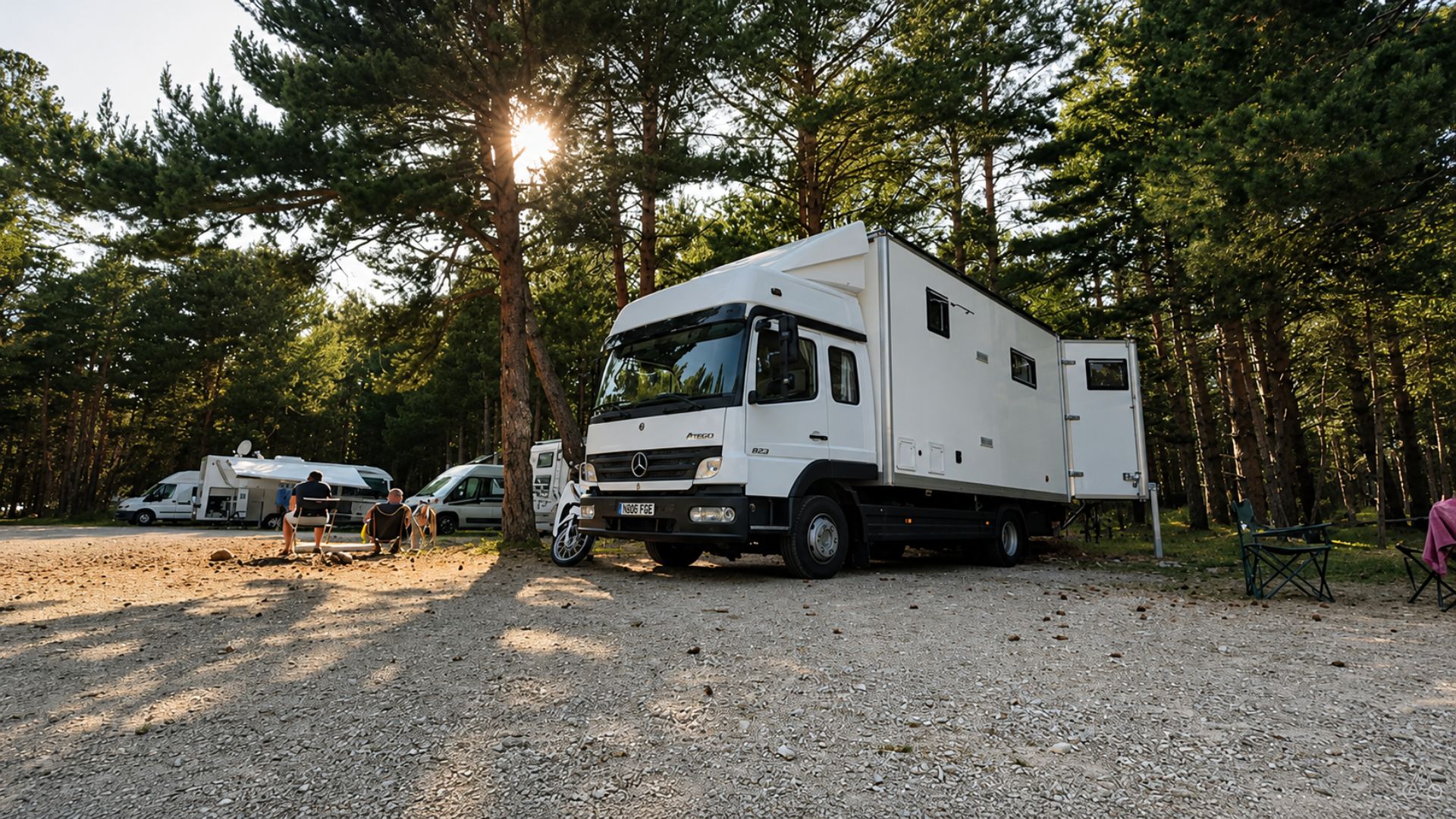


Óscar and Blanca bought a 2006 Mercedes Atego 2 for 17 thousand euros and converted the vehicle into a house on wheels with 700 liters of potable water, 300 liters for gray water, five solar panels totaling 2,000 W, six 100-ampere lithium batteries each, and an extra 3.6 kWh portable battery.
The combination of automotive engineering and compact architecture has gained a new curious example in Spain. Óscar and Blanca documented on video the transformation of a 2006 Mercedes Atego 2 truck into a house on wheels fully equipped, with a robust hydraulic system, energy autonomy, and even a custom lift bed.
The conversion took about a year and a half and was done at the Vancraft workshop in Tarragona. The result is a vehicle capable of living practically independent of the public grid, with 700 liters of potable water stored in food-grade stainless steel tanks, two thousand watts in solar panels on the roof, and a suspended bed that goes up and down with the occupants still lying on it.
The choice of truck and the first scares

The process began long before the renovation itself. The couple took seven months to find a second-hand vehicle in good condition and not too old, a timeframe that shows the care needed in any project of this type.
-
Hidden beneath icy waters between Alaska and Siberia, a 160 km underwater canyon plunges 2,600 meters and transforms the Bering Sea into a corridor of life.

-
A hospital janitor who also washed cars to make a living has just impressed Brazil by achieving the impossible dream of becoming a doctor at 26 years old and shouting to the world that the janitor has won.
-
Two billionaires spend $67 million just to avoid having a neighbor and block a $285 million mega mansion, with 4,645 m², bowling alley, car museum, and waterfront area in Florida.

-
David Camacho, the 10-year-old Mexican child prodigy with an IQ of 162, higher than Einstein’s, underwent astronaut training at NASA, speaks four languages, and created an app to help children deal with emotions after the bullying he experienced.




The final choice was a Mercedes Atego 2 manufactured in 2006. The truck had only one previous owner and 147 thousand kilometers driven, a low value for a vehicle of this category, with the particularity that it had never left Madrid, as it was only used for local moves and stored in a warehouse.
After the mechanical inspection confirmed the good condition of the chassis and cabin, the couple closed the deal for 17 thousand euros. Still on the way to Barcelona, however, a tire blew out and the truck was stranded on the shoulder, a premonition that the transformation would not be free of unforeseen events.
A week later, with all tires and brake pads replaced, the vehicle finally arrived at the conversion workshop. From that moment, the true journey of reconstruction began, which would involve everything from welding sheets to installing electrical systems comparable to those of a traditional Brazilian residence.
The secret of the 40-centimeter false floor

The body of the Mercedes Atego is 5.40 meters long, 2.60 meters high, and 2.50 meters wide. To fit everything the couple wanted, from a double bed and a single bed to a garage for a motorcycle and bicycles, a decisive architectural trick was needed.
The solution came with a false floor raised by 40 centimeters. This galvanized iron structure serves as a lower layer where water tanks, electrical installations, heating ducts, and other systems that would occupy useful space inside the house on wheels are hidden, leaving the main living area free for furniture and circulation.
Even with this elevation, there is still more than 2 meters of internal height for the couple to move around inside the vehicle. This means that the storage gain does not compromise vertical comfort during their stay in the vehicle, a balance difficult to achieve in conventional motorhomes.
The engineering of this false floor required specialized welding. Therefore, the choice of Vancraft as the workshop was crucial, as the team combined knowledge of carpentry, electricity, electromechanics, gas plumbing, sheet metal work, and welding in a single location, a rarity in the specialized sector for professional motorhome conversions in Europe.
The stainless steel tanks and the water system


The water tanks were custom-designed to fit under the chassis. The sheets used are 316 stainless steel, a grade suitable for the food industry, as the stored water serves for both hygiene and for drinking and cooking.
The capacity is impressive compared to common motorhomes. The fresh water tank stores 700 liters and the grey water tank holds 300 liters, autonomy that allows for prolonged stays in locations without available infrastructure for replenishment.
Each tank was welded with an internal baffle to prevent instability during truck movement. This technical detail, common in boats, prevents the weight of displaced water from swaying the vehicle on curves, improving stability when driving on roads with many changes of direction.
The system also features three ultraviolet lamps to eliminate microorganisms, reverse osmosis return, automatic inlet valve, overflows, and a button-activated external outlet. The chosen piping was from the John Guest brand, known for withstanding high temperatures and offering leak-free installation, a standard used in international luxury boats and vehicles.
Electrical autonomy with solar panels and lithium batteries
The energy aspect followed the same level of care as the hydraulic system. Five solar panels totaling 2,000 W were installed on the vehicle’s roof, fixed on a custom-made galvanized iron support and anchored to the structural beams of the bodywork.
These panels power a battery bank installed inside the motorhome itself. There are six lithium batteries, each with a capacity of 100 amperes, a setup that ensures electricity for daily use without needing to connect the vehicle to the public grid during long travel periods.
To complement the system, there is also a 3,000 W inverter-charger that powers the air conditioning and other 220-volt appliances, an MPPT regulator, a remote monitoring unit, two 100-amp boosters for charging via the alternator while driving, and two 24 to 12-volt converters.
As an additional redundancy, the couple also brought an Ecoflow Delta Pro portable power station, with 3.6 kWh capacity and up to 4,500 W output in XBoost mode. The battery can be charged via the electrical grid, solar panels, or the alternator, ensuring electricity even on cloudy days or after intense use of the air conditioning by the couple.
The kitchen, automotive LPG, and heating
The kitchen was planned considering the practical operation of the vehicle in motion. Instead of a traditional gas cylinder, the couple chose a 60-liter automotive LPG tank, installed externally with its own filling valve and inspection cover.
The consumption calculation is interesting for those interested in the model. A full tank offers autonomy for more than a year of cooking, as the gas is used only for this function and consumption remains low in the daily routine of the traveling couple.
The main countertop was made of Neolit, a sintered stone material similar to Silestone, but with greater resistance to extreme temperatures and ultraviolet rays. The choice adds a bit more weight to the vehicle, but offers durability incompatible with natural wood countertops, which require constant maintenance and warp easily.
For hot water, the system uses a 9-liter boiler with electric and diesel heating. The clever detail lies in the hot air outlet device, which passes through the middle of the water tank and heats the environment without additional energy consumption, utilizing the heat already generated for other functions inside the motorhome.
The lift bed invented by the workshop
Perhaps the most original item of the project is the couple’s bed. As the Mercedes Atego’s bodywork is compact, the team had to design a structure that would descend from the ceiling when needed, a model known in European motorhomes as a lift bed.
The novelty came from the couple’s requirement. The bed had to descend with both of them still lying on it, a possibility that does not exist in the conventional motorhome market, so Vancraft’s lead engineer, Chavi, had to develop the piece specifically for the project.
The structure operates with an industrial geared motor and automotive belts that wind and unwind when going up or down. Special supports were welded to the roof beam and the false floor’s iron structure, creating an anchorage capable of supporting the couple’s weight even with the vehicle parked on uneven terrain.
The result is a system that allows one occupant to wake up before the other and descend with the bed without needing to wake their partner. This type of detail transforms the experience of living in a motorhome, eliminating common inconveniences in small motorhomes where any movement wakes up the person sleeping next to you.
The lifting platform that became a private terrace
Another element that gained an unexpected function was the truck’s rear lifting platform. Some people suggested that the couple remove this equipment during the conversion, claiming it would no longer be useful in the vehicle’s new role.
The decision was exactly the opposite. The couple kept the platform and transformed it into a private terrace, with tropical IP wood flooring that withstands constant exposure to the elements and gives a welcoming look to the outdoor space of the home on wheels.
The workshop also built a custom side table made of galvanized iron tubes, with two supports at each corner to ensure stability. The structure is fixed to guides with stops that can withstand up to 300 kilograms, enough capacity to accommodate a dining table, chairs, and even hammocks for outdoor relaxation.
The result is a space that brings the vehicle to life, especially in summer. The platform becomes a meeting point for meals, beers with friends, and naps in hanging hammocks, transforming what was originally cargo equipment into an essential part of the experience of living in a home on wheels.
Security, air conditioning, and washing machine
Even with so many integrated systems, the couple did not give up on installing a washing machine inside the vehicle. The chosen location was next to the lithium batteries, a decision that raised concerns due to the risk of water leakage onto the electrical system.
The solution came with robust waterproofing. The gap between the machine and the batteries was sealed with fiberglass and waterproofing paint, in a layer tested with water filling, a test performed by the team itself before releasing the space for actual use.
The air conditioning also underwent a change during the project. The original model installed did not convince the couple, and it was replaced by a 220 V residential unit, common in Brazilian homes, fixed to an external structure specially welded to receive the condensing unit.
To complete the safe operation of the home on wheels, security cameras were installed at each external corner of the truck, plus an internal camera, an alarm connected to the doors, and volumetric sensors. This system allows the couple to monitor the vehicle remotely when they go out for walks and leave their dog Coti alone inside the structure.
What stands out most in the final result
After a year and a half of continuous work, the Mercedes Atego truck became a home on wheels with a professional finish. The walls were covered with 5-millimeter white laminated plywood, the ceiling received pine paneling with walnut-colored varnish, and the floor gained vinyl tiles in a parquet pattern.
The interior lighting combines tracks with directional spots, R16 luminaires above the table, and LEDs on the office shelves. Approximately 600 meters of electrical cables were used in the complete installation, a number that shows the complexity of the system developed for this specific home on wheels.
The office dining table was made of solid wood, and the couple opted to make it convertible and extendable. For daily meals, it accommodates two people, but can be expanded to host up to six guests and even transform into a double bed for occasional guests who decide to sleep in the vehicle.
The final choice of every detail reveals a clear philosophy of living with little in terms of space, but with much in terms of quality. Every centimeter of the Mercedes Atego was designed to combine total mobility with residential comfort, a model that has gained traction among European couples who decide to exchange fixed homes for permanent adventure on wheels.
And you, would you face this nomadic routine inside a home on wheels mounted on a Mercedes truck, with 700 liters of water, 2,000 W solar panels, and a custom lifting bed?
Tell us in the comments if you would trust living with 1,000 liters of water stored in stainless steel tanks under the chassis, if you like the idea of a private terrace on a rear lifting platform, and which item from this project you would like to have in your own future conversion. The discussion helps understand if Brazilians are ready to embrace life on wheels as a real alternative to traditional housing in large urban centers.





Great build,enjoy