Portuguese
  Spanish


You’ve Never Seen This Before: The Subway Enters One Side of a Building and Exits the Other… with Residents Watching Everything
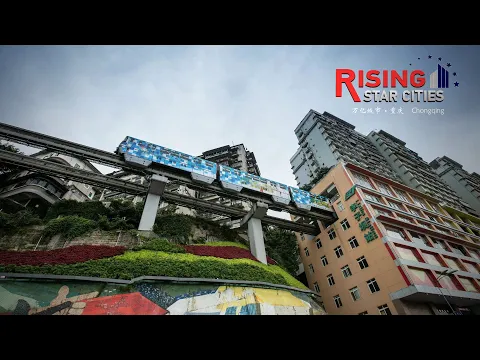
In southwest China, there is a city where the subway seems to have come straight out of a science fiction script. In Chongqing, the urban railway network not only connects neighborhoods but also defies gravity, crossing buildings and reaching depths no other system of its kind has achieved. It is an unprecedented urban engineering feat in a metropolis of over 31 million inhabitants that knows no plans — only slopes, declines, and vertical structures. Chongqing’s public transportation system has already broken several world records and is about to set new ones.
A Terrain Where Building Tracks Seemed Impossible
The idea of creating a subway in Chongqing has been around since the 1940s, but it has repeatedly been discarded for a simple reason: the city’s brutal geography. Located in a mountainous region and cut by deep rivers, Chongqing’s topography resembles an “urban roller coaster,” with elevations varying up to 250 meters within a few kilometers.
During the 1970s and 1980s, while cities like Beijing and Shanghai inaugurated their conventional subways, Chongqing remained without a viable solution. This changed in the late 1980s when a technical group began studying alternatives. The answer came after international research missions: monorails.
-
Seen from space, an astronaut captures in Canada a geometric carpet of crops drawn over the backdrop of a ghost lake that disappeared 12,000 years ago, was once larger than all the Great Lakes combined, and left a scar of fertile mud that still sustains agriculture.

-
Billionaire says the most valuable skill will help overcome job elimination caused by AI, following Bill Gates’ fears

-
A Dutchman created a ‘box’ that makes trees grow in the desert almost without water and without irrigation: the invention has already brought seedlings to dozens of countries and achieves up to 90% survival where common planting did not exceed 10%.

-
Abandoned warehouse hid a giant collection of rare computers, with over 2,000 artifacts from the 1930s to the 1980s.





Why a Monorail and Not a Traditional Subway?
The monorail, unlike conventional tracks, is lighter, consumes less energy, and can navigate tight curves and climb steep slopes — ideal for a rugged terrain like that of Chongqing. Additionally, the implementation cost was significantly lower: about US$ 100 million per kilometer, compared to US$ 200 million for a traditional underground subway, according to Chinese technical reports.
The Line That Goes Through a Building and Operates Without Bothering Residents
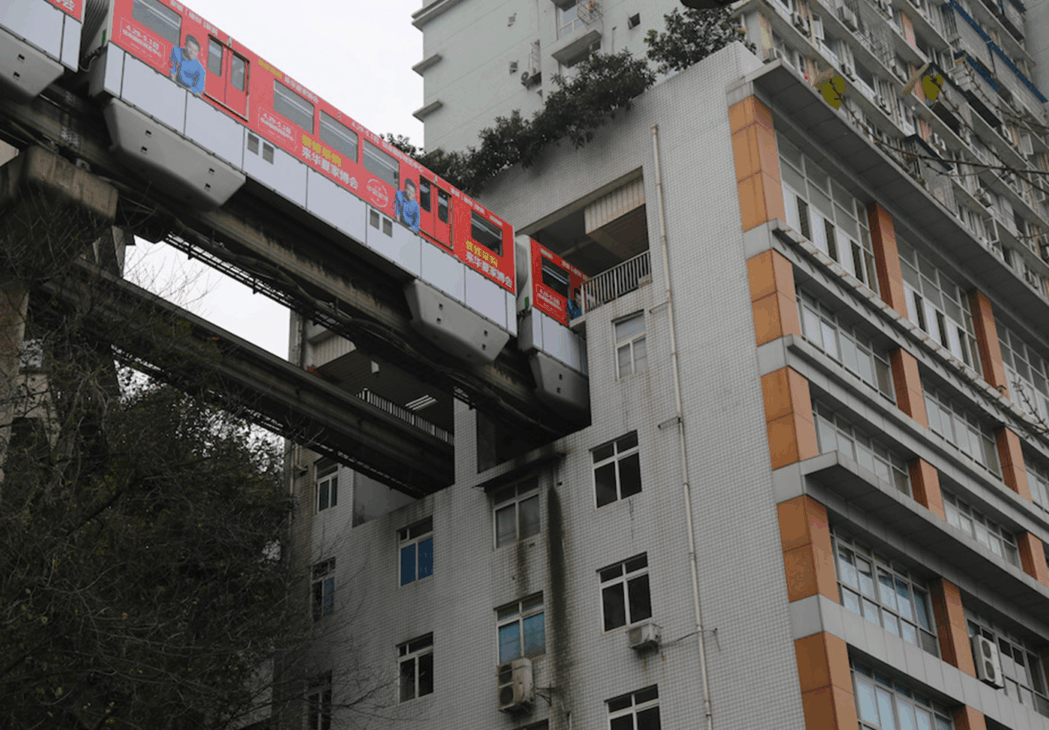
In 2005, Line 2 was inaugurated, the first section of Chongqing’s subway, primarily composed of elevated tracks. One of its most iconic passages cuts through a residential building on the 8th and 9th floors. The project was developed in partnership with the building’s contractor, who implemented a soundproofing and structural isolation system using columns encapsulated in concrete cylinders. The sound of the train inside the building does not exceed 60 decibels — equivalent to the noise of a dishwasher.
The Deepest Station on the Planet is Here
If passing through buildings is already impressive, descending to Hongyancun Station is a unique experience. At a depth of 116 meters, it is officially the deepest subway station in the world, as confirmed by China Daily. There are eight escalators that can take up to ten minutes to reach the track level. Those who prefer the elevator arrive at the bottom in about 53 seconds — but be prepared for your ears to pop, like on an airplane flight.
A Network Full of Records and Innovation
The Chongqing metro system does not stop there. Among its most notable achievements are:
- Line 3: it is the longest monorail in the world, at 56 km, and also the busiest, with over 250 million trips per year, according to CRRC.
- Egongyan Bridge: the longest suspension bridge exclusively for the subway in the world, at 1.6 km.
- Caijia Bridge: a railway bridge 100 meters high over the Jialing River, creating the visual effect of a “train in the clouds.”
- Hualongqiao Station: one of the highest stations in the world, at 48 meters above ground.
Aggressive Expansion and New Technologies
Currently, Chongqing has 12 lines in operation and about 561 km of tracks, making it the sixth largest metro system in the world by length. According to the municipal plan, by 2035, the number of lines is expected to reach 23.
The city inaugurated, at the end of 2023, Line 18, with 29 km, and in January 2025, the suburban line Bitong, with 37.5 km, will be in operation. This information is available on the official Chongqing Rail Transit portal.
Another important innovation was the launch of China’s first autonomous monorail with cross seating, connecting terminals of Chongqing International Airport. The model, manufactured by CRRC, is a milestone in automated transportation.
Urban and Environmental Impact
In 2021 alone, Chongqing’s metro transported over 1.1 billion passengers, with peaks of up to 4 million per day. This not only alleviated traffic on the streets but also boosted the regional economy. In 2024, contracts with railway infrastructure companies exceeded 4.2 billion yuan (about R$ 3 billion), according to the Xinhua agency.
Moreover, a new electric transmission line between Xinjiang and Chongqing brought over 36 billion kWh of energy, half from renewable sources, contributing to a reduction of 16 million tons of CO₂ per year.
A Future Promising More Milestones
The outlook for Chongqing’s metro remains promising. The next decade is expected to witness the inauguration of even deeper underground lines, faster monorails, and structures interconnected with new urban hubs.
Did you enjoy the story of this Chinese megaproject? Comment below and share the article with others who also love engineering, urban planning, and smart transportation!