Portuguese
  Spanish



13.3 km tunnel in the Himalayas brings water to 122 thousand hectares in Nepal and promises to transform dry region into agricultural hub.
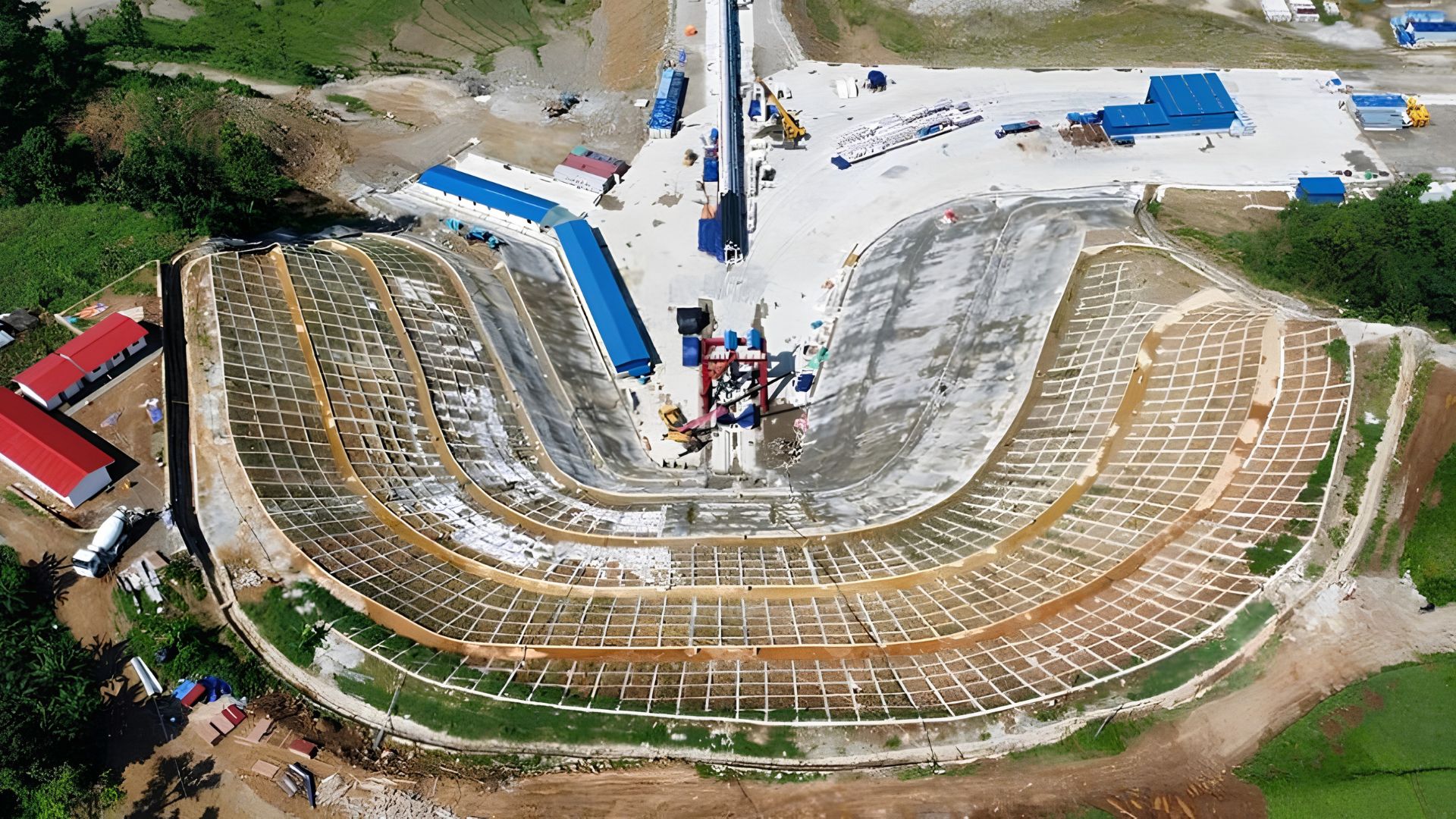
In 2024, Nepal reached a milestone in one of the most strategic underground works of its recent infrastructure: the excavation of the Sunkoshi Marin Diversion Multipurpose Project tunnel, a 13.3-kilometer structure opened under the Himalayas to transfer water from the Sunkoshi River to the Marin River, a tributary of the Bagmati. According to Tunnel Online, in a report published in the 05/2024 edition, the 6.4-meter diameter Robbins Double Shield TBM broke through the final section on May 8, 2024, after traversing complex geological conditions and completing drilling 11 months ahead of schedule.
The central objective of the project is direct and strategic: to bring water to the Bagmati irrigation system and allow the irrigation of 122 thousand hectares in the districts of Rautahat, Dhanusha, Mahottari, Sarlahi, and Bara, in Terai, a vital agricultural region in southern Nepal and historically vulnerable to drought. The Kathmandu Post reported on May 9, 2024 that the project also includes a 31.07 MW power plant, leveraging the elevation difference between the basins to transform a water intervention into an integrated system of water, energy, and food production on a national scale.
13.3 km tunnel crosses mountains to connect two basins and redistribute water in Nepal
The Sunkoshi Marin Diversion Project is a classic example of inter-basin water transfer. The logic behind the work is simple on paper, but extremely complex in execution: to take water from a region where it is abundant and bring it to another where it is scarce.
-
Prefabricated Home Assembled in Days Offers Cleaner, More Efficient Construction with Factory-Made Panels, Requires Technical Design to Prevent Moisture Issues

-
Single Mother Working Three Jobs Receives 111 m² 3D-Printed Home with Concrete Walls Built in 12 Hours, Featuring 3 Bedrooms, 2 Bathrooms, and a Printer for Replacement Parts

-
Simple Technique to Restore Rusty Metal Window Grilles Gains Attention for Revitalizing Old Structures Without Full Replacement

-
Couple Transforms Suffolk’s Last 1891 Windmill into Luxurious Four-Story Home with Zinc Observation Room in England





In Nepal’s case, the Sunkoshi River has significant flow, while areas of Terai face prolonged periods of drought that limit agricultural production. To resolve this difference, engineers designed a tunnel that crosses the mountain range, allowing water to flow from one side to the other.
This transfer does not rely on continuous pumping, which reduces operational costs and makes the system more efficient over time.
Project completed ahead of schedule and shows advancement in tunnel engineering in extreme regions
One of the most impressive aspects of the project is its completion time. According to industry records, the tunnel was completed approximately 11 months ahead of schedule, despite being built in one of the most challenging regions on the planet. The Himalayas present complex geological conditions, including unstable rocks, high underground pressure, and the risk of infiltrations.
The excavation was carried out with TBM (Tunnel Boring Machine) machines, giant equipment that slowly advances underground, cutting rock and installing support structures simultaneously.

This type of technology is fundamental for projects of this scale, as it allows for greater precision and safety in environments where traditional methods would be unfeasible.
System can irrigate 122 thousand hectares and change agricultural production of an entire region
The most direct impact of the project is on agriculture. With the water transfer, Nepal gains the capacity to irrigate approximately 122 thousand hectares of agricultural land that previously depended exclusively on seasonal rainfall. This reduces the vulnerability of production to drought periods and allows for greater predictability in cultivation.
Continuous irrigation also enables crop diversification and increased productivity, as farmers no longer depend on unpredictable climatic cycles.

In practice, the tunnel can transform a vulnerable region into a more stable agricultural hub, with a direct impact on the country’s food security.
Project also utilizes elevation difference to generate energy and increase system efficiency
In addition to irrigation, the Sunkoshi Marin also incorporates power generation. The elevation difference between the two basins allows for the installation of a hydroelectric system with an estimated capacity between 28 MW and 31 MW, according to the project’s technical data. This means that the transferred water not only irrigates crops but also generates electricity.
This combination of functions is one of the most efficient aspects of the project. The same infrastructure solves two problems simultaneously: lack of water and need for energy.
The choice of water destination is not random. The Terai is one of Nepal’s most important agricultural regions, responsible for a large part of the country’s food production. However, it is also an area vulnerable to climatic variations, with drought periods that compromise harvests.
Without adequate irrigation, production becomes limited and unstable. With the new system, the expectation is to reduce this dependency and increase the region’s resilience to extreme climatic events.
Invisible tunnel shows how large-scale projects can operate without altering the visible landscape
Unlike giant dams or open canals, the Sunkoshi Marin is an almost invisible infrastructure. Much of the system is buried, operating silently beneath the surface. This reduces visual impact and avoids massive population displacements, common in large surface projects.
This type of work represents a new generation of infrastructure, where the impact is felt in the economy and supply, but not necessarily visible in the landscape.
Nepal, due to its mountainous geography, has a large availability of water in some regions and scarcity in others. Projects like Sunkoshi Marin emerge as a solution to balance this distribution.
The logic is similar to other large global water transfer projects, but with additional challenges related to altitude, geology, and access.
Engineering in mountainous regions requires specific solutions and a high technical level
Building a tunnel of this magnitude in the Himalayas is not just a matter of scale. The region presents challenges such as:
- high geological pressure,
- variation in rock types,
- seismic risk,
- logistical difficulty.
Overcoming these barriers requires detailed planning, advanced equipment, and highly specialized teams. The success of the project indicates significant technical advancement in execution capability in extreme environments.
Water infrastructure becomes a central element in food and energy security
The Sunkoshi Marin case shows a global trend: water is becoming one of the planet’s most strategic resources.

Projects that ensure access, distribution, and efficient use of water have a direct impact not only on agriculture but also on energy and economic stability.
Tunnel can become a model for other countries with water imbalance between regions
The solution applied in Nepal can serve as a reference for other countries facing similar problems.
Regions with excess water in one area and scarcity in another can adopt underground transfer systems as an alternative to large dams or open canals.
Now the direct question remains: if invisible tunnels can already cross mountains to redistribute water and transform entire regions, how many other projects of this type are still being planned to address global water scarcity without most people even noticing?