






 Portuguese
  Spanish


USA will pump 2.1 million cubic yards of sand in New Jersey in 2026 to contain erosion and protect cities.
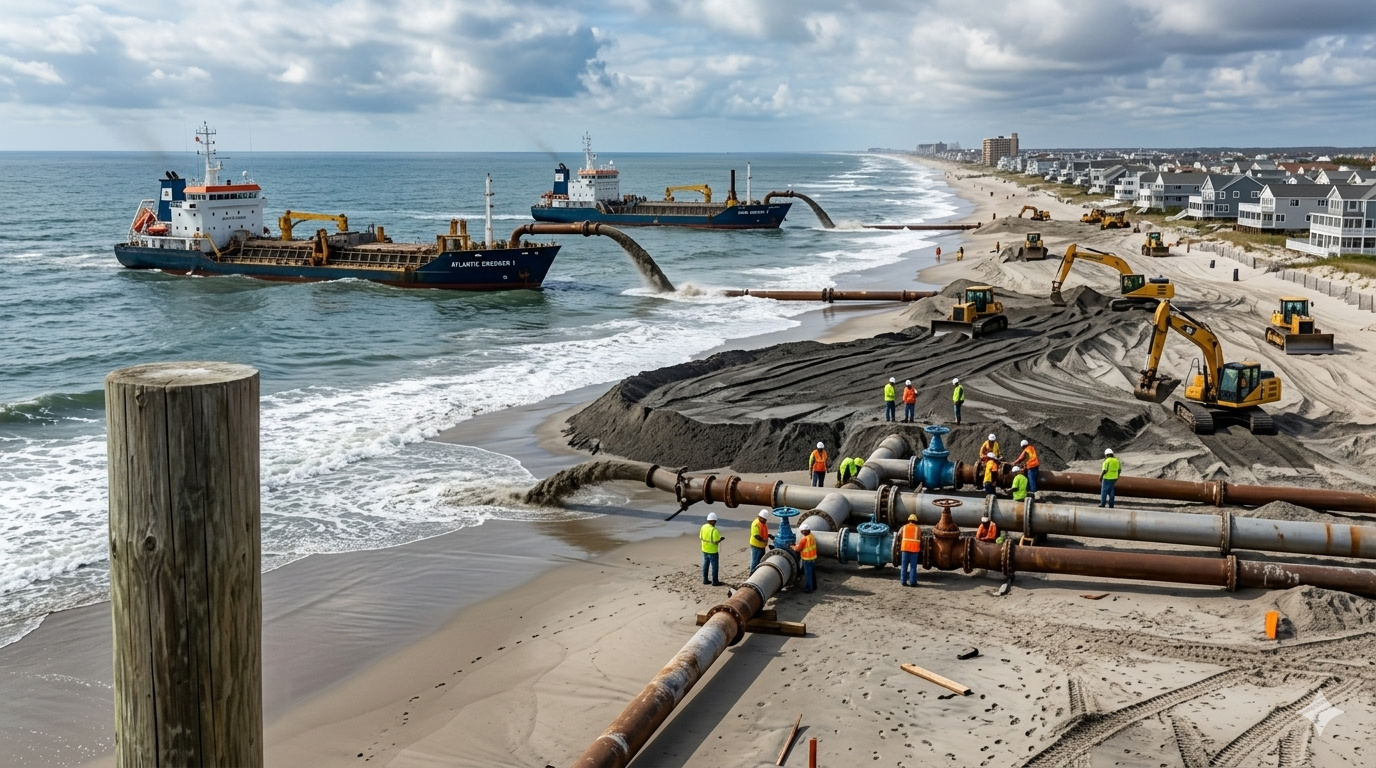
In 2025, the United States initiated a new phase of one of the most recurring coastal defense strategies in the Atlantic: replenishing entire beaches with sand taken from the seabed. According to an update published by the U.S. Army Corps of Engineers on December 13, 2024, the project Manasquan Inlet to Barnegat Inlet, in Northern Ocean County, New Jersey, plans to dredge and deposit 2.1 million cubic yards of sand, equivalent to approximately 1.6 million cubic meters, in vulnerable stretches of the coastline between Seaside Heights, Toms River, Lavallette, Bay Head, Point Pleasant Beach, Mantoloking, and Brick Township.
The operation, contracted for $73.5 million with the Great Lakes Dredge & Dock Company, is not just a beach maintenance project. The U.S. Army Corps of Engineers itself reports that the sand will be taken from three approved offshore areas in the Atlantic Ocean, pumped to the coast, and shaped into an engineering model designed to reduce damage caused by coastal storms. In practice, the United States is rebuilding a natural defense barrier with sand, expanding eroded beaches, repairing dunes, access points, sand fences, and coastal vegetation in one of the most exposed regions of New Jersey’s coastline.
Project plans pumping of 2.1 million cubic yards of sand along the coast
The plan involves removing large volumes of sand from the ocean floor using specialized dredges, which transport the material to the coast and pump it directly onto the beaches.
-
In the World’s Most Densely Populated Desert, Families Dig Funnel-Shaped Underground Cisterns to Capture Rare Rainfall and Store Drinking Water for Up to Eight Months

-
Smart Glass Revolutionizes Privacy: Touch-Activated Opacity Transforms Windows into Connected Home Features with App and Voice Control

-
Young Innovators from Brazil Turn Discarded Plastic into Eco-Friendly Bricks Using Coconut Fiber, Offering a Sustainable Alternative for Construction
-
Brazilian Scientists Among Team Proposing to Turn Ocean Depths into Giant Gravity Battery Using Cargo Ships and Subsea Cranes




This process allows for the reconstruction of entire stretches of coastline that have been eroded over time. The 2.1 million cubic yards represent a massive volume, enough to raise and widen the sand strip over several kilometers in length.
This new layer acts as a buffer zone between the sea and urban areas.
Beach nourishment is used as a natural barrier against storms and sea advancement
The technique used is known as “beach nourishment.” Instead of building walls or dikes, the strategy is to reinforce the beach itself so that it absorbs the energy of the waves.
When storms hit the coast, the sand is displaced and redistributed, dissipating the force of impact before it reaches urban structures.


This type of solution is considered more adaptive, as it works with natural processes instead of trying to block them completely.
Project of $73.5 million protects densely populated cities in New Jersey
The Ocean County region is not an isolated area. It houses coastal communities with homes, businesses, roads, and critical infrastructure.

Without intervention, erosion could reduce the width of the beaches to the point of leaving these areas directly exposed to the sea.
The investment of $73.5 million reflects the economic and strategic value of the region, where damage caused by storms could result in losses far exceeding the cost of the project.
Operation starts between May and July 2026 and may last several months
The project’s schedule follows the operational standard of the Army Corps. The mobilization of equipment and the start of pumping should occur between the end of spring and the beginning of summer in the northern hemisphere, usually between May and July.
The execution does not happen at a single moment. It extends over months, depending on weather conditions, tide, and logistics.
This type of work requires a controlled operational window, as it involves offshore activities and direct impact on the coastline.
Sand is removed from specific areas of the seabed to avoid environmental impacts
The choice of where to remove the sand is not random. Dredging is done in previously studied areas to ensure that the material has suitable characteristics and that the removal does not cause significant environmental damage.
This process involves analyses of grain size, impact on marine ecosystems, and ocean floor stability.
Modern coastal engineering tries to balance protection and environmental impact, although this is a point of constant debate.
Coastal erosion in the USA has been advancing for decades and requires periodic interventions
The New Jersey coastline, like other regions of the United States, faces continuous erosion.

Factors such as:
- more intense storms,
- sea level rise,
- changes in ocean currents
contribute to the gradual loss of sand.
Therefore, projects like this are not isolated events. They are part of a continuous maintenance cycle, in which sand needs to be replenished periodically.
Hurricanes and storms accelerate sand loss and increase risk for cities
Extreme events are one of the main drivers of these interventions. Storms like Hurricane Sandy in 2012 showed the devastating impact the sea can have on urban areas.
Storm waves can remove large volumes of sand in a few hours, leaving cities exposed. Beach nourishment acts as the first line of defense, reducing the impact of these occurrences.
Historically, coastal defense was done with rigid structures, such as concrete walls and breakwaters. However, these solutions can cause side effects, such as intensified erosion in neighboring areas.
The current approach prioritizes more flexible solutions, such as sand replenishment. The idea is to create a system that can adapt to the behavior of the sea, rather than trying to contain it in a fixed manner.
Sand becomes a strategic resource in coastal engineering projects
One of the most interesting points is the role of sand. The material, which seems abundant, becomes a strategic resource when used on a large scale.
Moving millions of cubic meters requires planning, logistics, and significant investment. Sand ceases to be just a natural element and becomes part of a planned infrastructure.
Sea level rise and the increase in the intensity of extreme weather events put more pressure on coastal regions.
This makes interventions like New Jersey’s increasingly common. Several countries are already adopting similar strategies to protect cities and infrastructure.
Coastal engineering enters a new phase of continuous adaptation
The United States project shows a paradigm shift. Coastal defense is no longer a permanent solution and becomes a continuous process of adaptation.
Instead of building a definitive structure, countries are starting to manage the coastline over time. This approach recognizes that the coastline is dynamic and requires constant interventions.
Now the question that remains is direct: if even countries with billions of dollars are moving millions of tons of sand every year to contain the advance of the sea, to what extent will this strategy be sufficient in the face of an ocean that continues to rise and reshape the coastline on a global scale?





Be the first to react!