Portuguese
  Spanish


Understand How A Climate Supercomputer Capable Of Processing Trillions Of Data Works And Why The Energy Consumption Of The ECMWF Supercomputer Is Equal To That Of An Entire City. Understand The Challenges And The Importance Of This Technology To Accurately Predict The Climate
Meteorological supercomputers are responsible for making it possible to predict the weather days, weeks, and even months in advance. However, the cost of this accuracy goes far beyond financial figures: these giant machines consume energy comparable to that of entire cities. Some of the leading climate forecasting centers in the world, like the ECMWF (European Centre For Medium-Range Weather Forecasts) and the Fugaku supercomputer in Japan, demand between 5 and 30 megawatts (MW) of electrical energy, enough to power tens of thousands of homes simultaneously.
Today you will understand how these supercomputers work, why they consume so much energy, and what the importance of this power is for keeping society informed and safe in the face of extreme weather events.
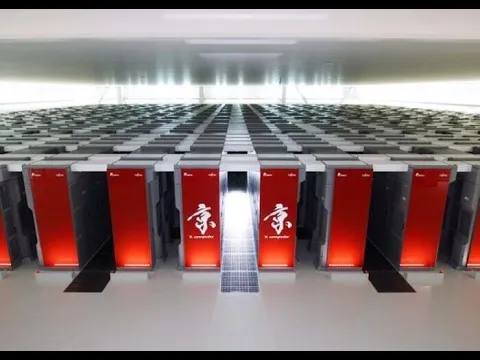

After All, How Much Does A Supercomputer Consume?
The energy consumption of a supercomputer is one of the most critical factors in its operation. The supercomputers used in weather forecasting, such as the ECMWF supercomputer and Fugaku, are among the most powerful and energy-hungry on the planet.
-
Engineers Develop Fridge-Sized Machine to Produce 95-Octane Synthetic Fuel from Air and Water, Aiming to Sustain Combustion Engines Without Oil

-
Two-Armed Robot Uses AI to Reassemble Destroyed Pompeii Frescoes, Solving an “Impossible” Puzzle
-
New Law in Brazil Requires Breaks for Type 1 Diabetes Management at Work, School, and Public Exams

-
Scientists Confirm “Greening” of Antarctica: Ice on the World’s Coldest Continent Turns Green as Mosses Multiply Over Tenfold in Four Decades


To give you an idea, Fugaku, installed at the RIKEN Institute in Kobe, Japan, consumes about 30 MW, equivalent to the residential energy consumption of a city with 30,000 to 50,000 inhabitants.
Meanwhile, the new system from ECMWF, built in Bologna, Italy, is capable of consuming up to 10 MW, according to an official report from the European institution. These figures help us visualize how much a supercomputer consumes during continuous operation with high calculation demand.
These numbers are compatible with the cooling, storage, and data processing systems that operate 24 hours a day, 7 days a week. Efficiency is an essential factor in maintaining functionality and avoiding failures, and this is costly in terms of electricity.
How Does A Climate Supercomputer Work?
The supercomputer that predicts the weather works with advanced mathematical models based on atmospheric physics, oceanography, and real-time data. Every minute, thousands of data points are collected by satellites, weather stations, ocean buoys, and remote sensors. This data feeds extremely complex numerical models that can only be processed by high-performance machines.
These models simulate the Earth’s atmosphere in layers, with resolutions reaching a few kilometers of precision. The goal is to predict not only temperature and rainfall but also extreme events such as cyclones, heat waves, floods, and snowstorms. Additionally, these predictions directly impact sectors such as agriculture, transportation, energy, and public safety.
Supercomputers like those at ECMWF or NOAA (National Oceanic and Atmospheric Administration of the USA) perform trillions of calculations per second, ensuring reliable predictions with several days’ lead time. This is a clear example of how a climate supercomputer works and its impact on daily life.
Why Do Meteorological Supercomputers Consume So Much Energy?
The high energy consumption of climate supercomputers is due to three main factors:
- Massive Data Processing: A meteorological supercomputer needs to handle petabytes of information daily, performing extremely complex mathematical operations.
- Cooling System: To avoid overheating, these systems require sophisticated thermal infrastructure, including liquid cooling and industrial fans.
- Continuous Operation: The work of these computers is constant and critical, requiring 24/7 operation.
Moreover, each time there is a push for greater accuracy and spatial resolution in predictions, the necessary calculations increase exponentially, leading to greater energy demand. Therefore, the question “how much does a supercomputer consume” is more than mere curiosity: it is a technical and environmental challenge that grows as technology advances.
Real Examples: ECMWF And Fugaku At The Top Of Climate Forecasting
The ECMWF supercomputer is one of the main examples of using computational power in meteorology. Headquartered in Europe with a new data center in Bologna, the system can process forecasts with a 9 km resolution and a range of up to 15 days.
Its computational power exceeds 20 petaflops, operating with cutting-edge technology and supporting large volumes of data.
Fugaku, developed in partnership by RIKEN and Fujitsu, has even reached the top spot on the list of the most powerful supercomputers in the world. Its use in meteorology includes modeling natural disasters, such as earthquakes and tsunamis, as well as analyzing the impact of climate change in Japan. Fugaku has also contributed to studying the dispersion of atmospheric pollutants.
Both are examples of what a supercomputer that predicts the climate is and the type of infrastructure that supports this high-complexity technology.
Environmental Challenges And The Search For Energy Efficiency
Despite being fundamental, supercomputers also generate significant environmental impact. The energy consumption of the supercomputer is a source of concern, especially in times of transition to a cleaner electricity matrix. An advanced forecasting system that relies on polluting energy may contradict the very alerts it issues.
Institutions like the ECMWF and the UK Met Office have invested in renewable sources to power their systems and improve the energy efficiency of data centers. Additionally, quantum computing technologies and leaner architectures that reduce consumption without compromising accuracy are being studied.
These initiatives seek a balance between technological progress and environmental sustainability, aligning climate science with conservation practices.
Climate Forecasting Requires Energy, But Saves Lives
The ability to predict the weather accurately is one of the greatest technological advances of our time. Thanks to meteorological supercomputers, governments, businesses, and individuals can better prepare for extreme events, avoid tragedies, and plan their activities more safely. This forecasting is also essential for infrastructure planning, emergency response, and even the formulation of environmental policies.
However, this forecasting comes at a cost: the energy consumption of the supercomputer is comparable to that of entire cities. Understanding how a climate supercomputer works and seeking sustainable ways to operate it is essential to balance technological development and environmental responsibility.
As we reflect on how much a supercomputer consumes, we realize that, despite the high cost, the benefits to society fully justify the investment.
After all, climate knowledge is one of the main tools for facing the challenges of a changing planet. With the support of increasingly efficient supercomputers, we will be better prepared for a future where information can mean survival.