Portuguese
  Spanish


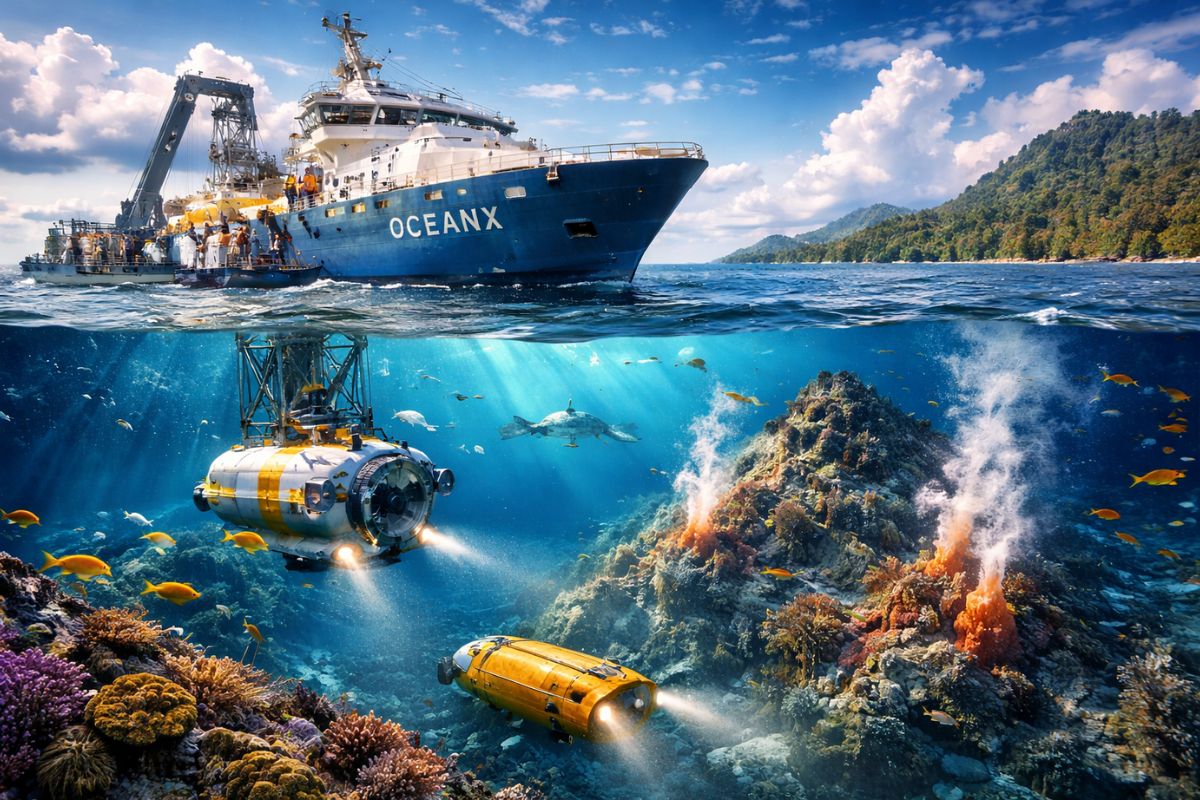

Scientific Mission in the Pacific Brings OceanX and Indonesia’s Research Agency Together to Investigate Little-Explored Seamounts, Deep Biodiversity, and Geological Activity on the Seafloor.
A new scientific expedition in the Pacific has begun with the goal of studying a little-known chain of seamounts near the island of Sulawesi, Indonesia. The mission brings together researchers from the OceanX organization and the National Research and Innovation Agency of Indonesia, known as BRIN, who seek to understand how geological processes and marine ecosystems interact in the depths of the ocean.
The initiative in the Pacific aims to investigate underwater volcanic structures, identify poorly documented species, and better understand the ecological dynamics of these submerged mountains. Scientists believe that these formations play an important role in ocean circulation, the distribution of marine organisms, and the formation of unique habitats on the seafloor.
Expedition in the Pacific Investigates Little-Known Seamounts
The scientific mission began in the coastal city of Bitung, where educational activities and meetings with local authorities were held before the departure of the research vessel.
-
She spent 73 years breathing inside an iron lung, survived the aftereffects of polio, and became the last woman in the United States dependent on the equipment before dying at 78 years old.

-
Brazilian students created a $1 filter using pine bark, cotton, and 3D-printed parts to clean cassava wastewater, reduce the toxicity of a hazardous waste, and transform contaminated water into biofertilizer.

-
Astronaut from Artemis II steps down after mission to the Moon and decision surprises after a record of 406,771 km, a historic 10-day journey, and an unprecedented achievement for Canada.

-
A fossil kept for years in a small museum in Montreal concealed 450-million-year-old soft tissue, a discovery that has only happened once before in history.


After these initial activities, the team proceeded to the region of the seamounts located in the Pacific north of Sulawesi. This area is considered one of the least studied in the deep ocean of the Indo-Pacific region.
Previous research had already identified five unknown seamounts in this area. Now, the new mission returns to the Pacific with a larger scientific team and more advanced technological tools to deepen the investigations.
Scientists Investigate Geological Activity on the Seafloor of the Pacific
An important part of the expedition is dedicated to analyzing geological activity on the Pacific seafloor.
The researchers utilize high-resolution mapping systems, visual surveys, and equipment capable of analyzing layers below the seabed. The objective is to identify volcanic structures, tectonic formations, and other elements that shape the deep ocean environment.
These seamounts are part of a region influenced by intense geological processes associated with the so-called Ring of Fire of the Pacific, an area known for intense volcanic and tectonic activity.
Deep Biodiversity Will Also Be Studied
In addition to geology, the expedition in the Pacific also dedicates an important phase to the study of marine biodiversity.
To achieve this, scientists use remotely operated vehicles, submersibles, environmental DNA collection, and various oceanographic instruments. These tools allow for capturing images of the ocean floor and identifying species present in the seamounts.
The researchers hope to discover little-known organisms and understand how these marine communities are connected across different areas of the deep Pacific.
The analysis of the collected images will be assisted by an artificial intelligence platform capable of identifying species and habitats almost in real-time.
Mission Strengthens Indonesian Marine Research
The scientific cooperation between OceanX and the BRIN agency also aims to enhance national knowledge about the oceans of the Pacific surrounding Indonesia.
Scientific authorities in the country emphasize that the study of the deep ocean is essential for understanding marine resources, natural risks, and the ecological processes that sustain biodiversity.
The expedition also has a strong scientific training component, involving young researchers and technicians who participate directly in the field activities.
During the mission, these professionals receive training in ocean mapping, sample collection, genetic analysis, and processing of scientific data.
Scientific Data Can Help in Ocean Planning
The data collected during the expedition in the Pacific could contribute to various areas of knowledge and environmental management.
Potential applications include marine spatial planning, assessment of underwater geological risks, and establishing scientific references on marine biodiversity in the northern region of Sulawesi.
This information could support future research and also help authorities develop strategies for conservation and sustainable use of the resources of the Pacific.
OceanX Seeks to Expand Knowledge About the Deep Ocean
The organization OceanX works with scientific research, education, and technology to expand knowledge about the planet’s oceans.
Its expeditions combine marine exploration, technological development, and the production of scientific data that help to better understand the functioning of marine ecosystems.
By studying little-explored regions of the Pacific, scientists hope to reveal ecological and geological processes that remain unknown to this day.
The expectation is that the mission will contribute to a greater understanding of the deep ocean and strengthen Indonesia’s scientific capacity in marine research.
And you, do you believe that the Pacific still harbors species and ecosystems completely unknown to science?