






 Portuguese
  Spanish


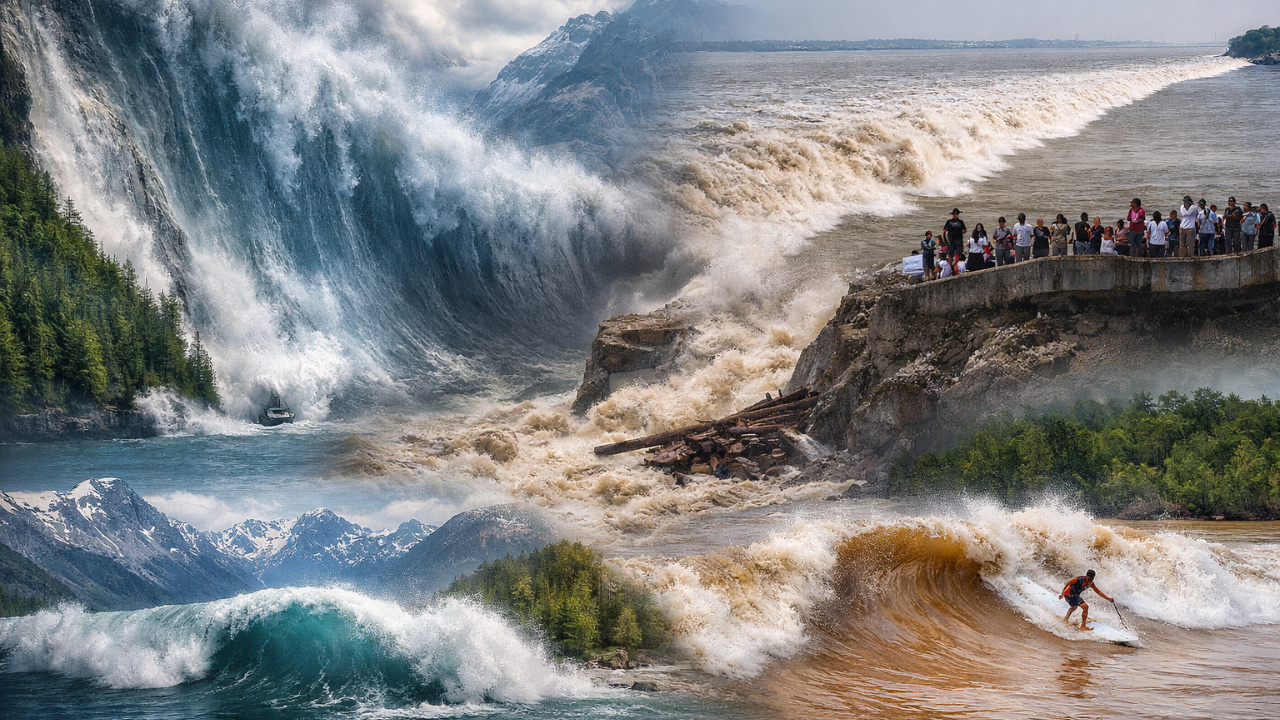


Discover Real Cases of Giant Waves in Freshwater, Including Megatsunamis, Seiches, and the Qiantang River Phenomenon.
Giant waves are not exclusive to oceans. Extreme events capable of displacing millions of cubic meters of water have been recorded in rivers, lakes, and bays, in different times and countries, triggered by landslides, flash floods, and even natural phenomena like Pororoca.
Although the term “tsunami” is associated with the sea, experts explain that similar processes can occur in freshwater environments, with equally devastating impacts.
The most impressive case occurred in 1958, in Lituya Bay, when a landslide triggered a wave over 500 meters high on the slopes.
-
Workers renovating a playground in northern England uncover 176 World War II bombs buried underground; training artifacts still contained explosives.

-
Brazilian Architect Transforms Waste into Sustainable Homes with Solar Power and Rainwater Systems for 40 Years

-
Security Guard Becomes Doctor at Louisiana Hospital Where He Once Worked, Studied Chemistry Between Shifts

-
Woman Rescued from Luxury Complex in Brazil Worked Without Pay for 55 Years, May Be Entitled to Over $300,000




Megatsunami: The Largest Wave Ever Recorded Was Not in the Ocean
When it comes to Megatsunamis, the common image is that of underwater earthquakes.
However, the largest event of its kind occurred far from the open ocean.
In Lituya Bay, Alaska, a massive landslide launched tons of rock directly into the water, displacing a colossal mass and creating a wave that exceeded 500 meters in height in the nearby areas.
Despite its impressive size, the phenomenon was not classified as a traditional ocean tsunami.
This is because there was no movement of the seabed due to seismic activity, but rather a direct impact of land on the water.
Giant Waves in Lakes: The Silent Risk
Lakes of volcanic origin or located in mountainous regions are also subject to giant waves.
Landslides, underwater avalanches, and even tremors can displace large volumes of water in just a few seconds.
This type of event often occurs with little or no warning.
Furthermore, since many lakes are close to smaller communities, the impact can be significant, even without affecting large urban centers.
Rivers and Floods: Extreme Currents and Sudden Waves
In rivers, the danger mainly arises during flash floods or the breaking of natural dams.
The force of the water can create true liquid walls that rush violently along the banks.
In 1963, for example, the breaking of the Silver Bridge dam over the Ohio River in the United States triggered a devastating flow that killed dozens.
Although it did not form a classic giant wave, the case demonstrated how extreme currents can be as destructive as maritime phenomena.
In narrow and winding rivers, hydraulic waves known as “surges” can also occur.
They propagate upstream and can surprise boats and riverside residents.
The “Silver Dragon” Phenomenon in the Qiantang River
One of the most impressive examples of giant waves in freshwater occurs in China.
In the Qiantang River, a phenomenon known as “Silver Dragon” forms.
The waves can reach up to 9 meters in height and move rapidly down the riverbed.
The phenomenon occurs due to the combination of the tide with the shape of the estuary, which channels the water and amplifies its force.
“Tsunami” Out of the Sea? Understand the Term Seiche
Experts warn that the term tsunami should be used cautiously outside the oceanic environment.
Technically, a tsunami is defined by the abrupt displacement of the seabed, usually caused by earthquakes.
In lakes and rivers, it is more appropriate to use expressions like wave of impact from a landslide or seiche.
A seiche is an oscillatory movement of water within a lake or bay, caused by strong winds or variations in atmospheric pressure.
Despite the technical differences, the effects can be comparable in strength and destruction.
Therefore, the risk should not be underestimated.
Pororoca: Brazil Also Records Giant Waves
Brazil is also part of this map of extreme phenomena.
The waves can reach up to 6 meters in height and move inland with a loud roar.
The phenomenon attracts surfers from around the world but also requires attention from local communities due to its intensity.
Freshwater Can Also Be Wild
Although rivers and lakes are often associated with tranquility, the reality can be quite different.
Under certain conditions, these environments can generate giant waves, megatsunamis, seiches, and phenomena like that of the Qiantang River or the Brazilian Pororoca.
Thus, experts emphasize that environmental monitoring and prevention are crucial.
After all, when water moves with extreme force, whether in the sea or within the continent, the impact can be equally devastating.
See more at: It’s Not Just the Sea: Rivers and Lakes Can Have Giant Waves and Extreme Currents — Even a “Tsunami” is Possible


