






 Portuguese
  Spanish


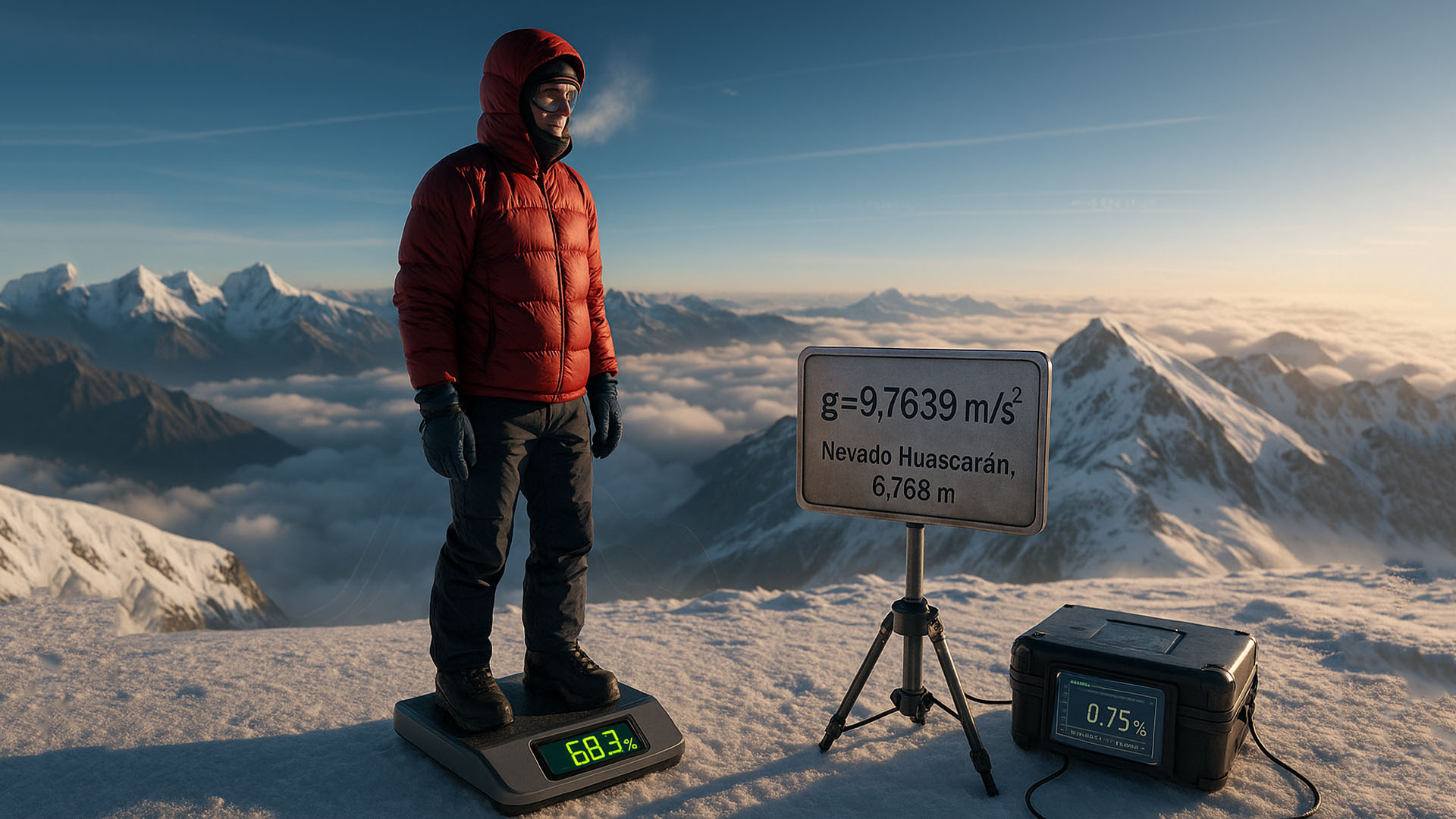


High-resolution models indicate that the top of Nevado Huascarán (Peru) registers the lowest gravitational acceleration on the planet, about 9.7639 m/s². See how this affects weight and why Earth’s gravity varies.
Researchers combined satellite and topographic data to create ultradetailed maps of Earth’s gravity. The study identified Nevado Huascarán, in South America, as a candidate for the lowest gravitational acceleration measured on the planet: 9.7639 m/s². At the other extreme, the maximum occurs in the Arctic Ocean, about 9.8337 m/s².
The global difference reaches 0.7%, greater than previously assumed. The work, published in 2013 in Geophysical Research Letters, has been a reference in high-resolution geodesy since then.
This result does not contradict the “standard” of 9.80665 m/s² used in metrology. This value is conventional and serves as an international reference since 1901, not as a local measure for each point on the globe.
-
Billionaire says the most valuable skill will help overcome job elimination caused by AI, following Bill Gates’ fears

-
A Dutchman created a ‘box’ that makes trees grow in the desert almost without water and without irrigation: the invention has already brought seedlings to dozens of countries and achieves up to 90% survival where common planting did not exceed 10%.

-
Abandoned warehouse hid a giant collection of rare computers, with over 2,000 artifacts from the 1930s to the 1980s.
-
Scientists warn that melting ice is triggering an alarming chemical transformation in preserved areas, and the first signs are already concerning researchers worldwide.




Why Does Gravity Vary: Rotation, Shape, and Altitude
Earth is not a perfect sphere. It is an oblate spheroid that is wider at the equator and flattened at the poles. Rotation reduces apparent gravity at low latitudes and altitude increases the distance to the center of the planet, further decreasing the local value of g. In combination, poles > equator by about 0.5%.
In Huascarán, these factors add up. The mountain is located at a low latitude and has an altitude of 6,768 m, which helps explain why there the acceleration is lower than in nearby cities at sea level close to the equator.
In addition to latitude and altitude, mass anomalies in the crust and mantle, such as mountain ranges and variations in density, adjust the local gravitational field. The new maps incorporate these effects by combining GOCE/GRACE, global models, and high-resolution topographic data.
How Much and Why Does Weight Change in Nevado Huascarán?
Weight is force: P = m × g. Keeping mass constant, weight depends on the local gravitational acceleration. At the Arctic extreme (9.8337 m/s²), a person weighing 70 kg would weigh about 688 N; in Huascarán (9.7639 m/s²), 683 N. The difference is ≈4.9 N (approx. 0.5 kgf), around 0.7%. In practice, you do not feel “lighter” because it is a minimal difference.
Household scales typically display mass derived from measured weight and standard gravity. In locations where g differs from the standard, the reading changes slightly. It is subtle, but measurable with geodesy and metrology equipment.
It is worth noting that this effect has no relation to weight loss. Body mass does not change while traveling; what changes is the force with which you are attracted by Earth at that point.
Where is Nevado Huascarán and Why Does It Matter
Nevado Huascarán is located in the Blanca Mountain Range, in the department of Ancash, Peru. Its southern dome reaches 6,768 m and is the highest point in the country and throughout the tropical zone. The massif is part of the Huascarán National Park, a protected area and natural heritage.
Due to its low latitude and high altitude, the summit of Huascarán is farther from the center of Earth than regions at mid-latitudes at sea level, reinforcing the decrease in g. This makes it a “natural laboratory” for testing gravity variation models.
For scientists, mapping these variations helps refine geophysical models, meteorology, navigation, and even the correction of satellites and GNSS. Improving the accuracy of local g also impacts metrology and calibration of instruments.
What the Sources Say and What Still Needs to Be Measured
The 2013 study used the GGMplus model to estimate g every ~200 m, revealing peaks and valleys in the Earth’s gravitational field and indicating Huascarán as minimum and the Arctic as maximum. New in situ campaigns may reduce uncertainties and validate estimates with absolute gravimeters.
Encyclopedias and reference databases describe the standard value (9.80665 m/s²) and explain that it is conventional, useful for comparing measurements, not for describing each location. For practical purposes, however, the variation of g between places remains small for most everyday uses.
Those who visit Huascarán may feel lighter, but the difference is subtle. The scientific merit lies in revealing how latitude, altitude, and Earth’s internal structure shape a planet that appears uniform but is not.
And you? Should Huascarán be called the “place of lowest gravity” even though it is a summit far from sea level, or does it make more sense to compare points at similar altitudes? Leave your comment and tell how you would explain this difference in gravity to someone who confuses weight with mass.





