Portuguese
  Spanish


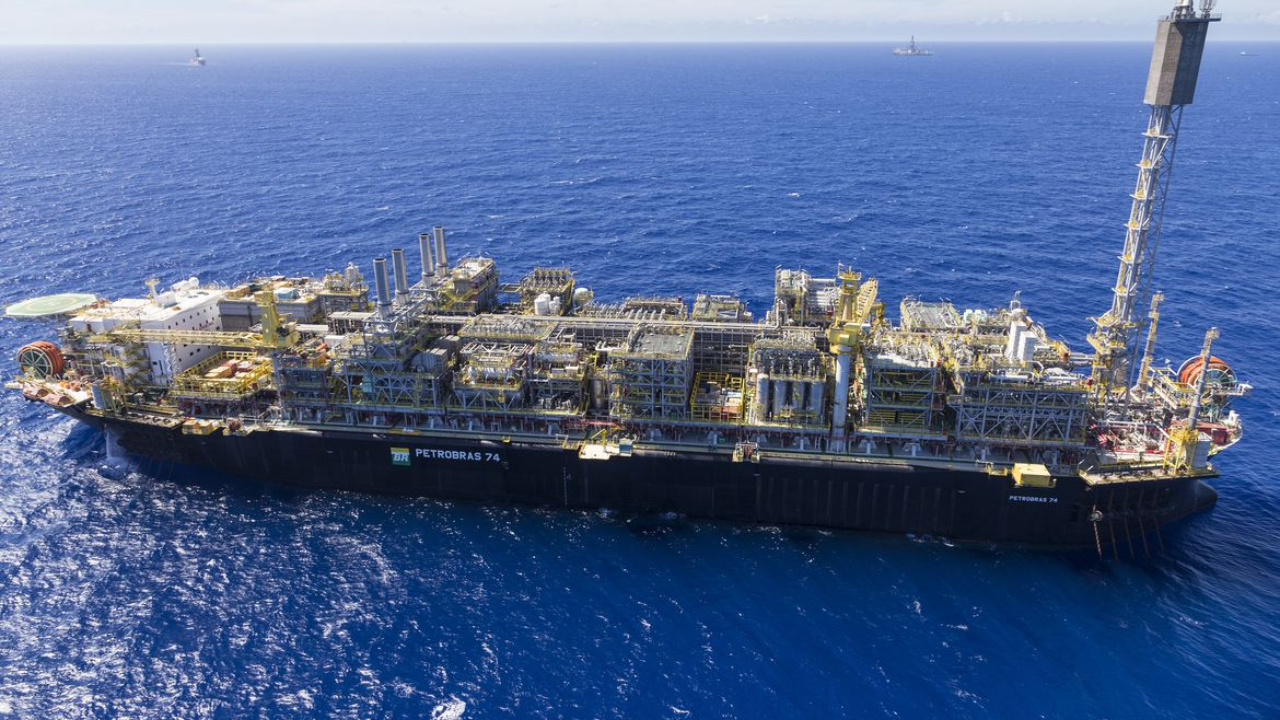

Petrobras Advances in The Pre-Salt with The New Platform P-91 in Búzios, Promising to Export Up to 7 Million m³ of Gas Per Day and Produce 180 Thousand Barrels of Oil Daily. The Project Takes Advantage of The Capacity of Rota 3 and Marks a Strategic Step in Expanding Brazil’s Energy Production.
Petrobras confirmed this Thursday (23rd) an important advancement in its strategy of expansion in the pre-salt. The new platform P-91, which will be installed in the Búzios field, in the Santos Basin, will have the capacity to produce 180 thousand barrels of oil per day and 12 million cubic meters of natural gas. Part of this volume will be reinjected, while the remainder will be directly exported to the coast, with an expectation of between 6 million and 7 million m³/day.
The unit will be a strategic hub for gas export, also integrating other platforms in the field that were not originally designed for this purpose. The state-owned company’s bet is to transform Búzios into one of the largest hubs for gas and oil production in the country, increasing the efficiency of flow and reducing operational costs.
Smart Strategy: Expansion Without New Investments in Pipelines
The Executive Manager of Structuring Programs at Petrobras, Wagner Victer, emphasized that the project was developed to take advantage of the existing slack in the Rota 3 pipeline, without the need for new infrastructure works. This strategy will allow production to reach the maximum limit of the already existing system’s capacity.
-
Qantas and Airbus Invest in Company Aiming to Convert Unsorted Household Trash into Jet Fuel

-
Brazil’s ANP Opens 86 New Oil Blocks in the Equatorial Margin, Expanding the Amazon River Mouth Frontier

-
OPEC+ Boosts Oil Supply by 188,000 Barrels per Day in July 2026, Leading to Price Drop from $112 to $89 per Barrel in Under Two Months

-
TotalEnergies Signs 20-Year Deal to Purchase 2 Million Tons of LNG from Alaska, Boosting Project Viability


“The great insight is that it will produce at the limit and fit within the space of Rota 3… There’s no need to build a gas processing unit on land or a pipeline. It’s the great insight of the project,” said Victer in an interview after the 2025 Transition Dialogues event, promoted by Eixos Agency in partnership with Firjan.
The decision represents a movement of operational optimization, ensuring economic and environmental gains by avoiding the construction of new transportation and processing structures.
Petrobras Bets on BOT Model for New Phase of The Pre-Salt
The construction of the FPSO Búzios 12 (P-91) will be contracted under the BOT (Build-Operate-Transfer) model, in which the winning company of the bidding will be responsible for the project, construction, assembly and operation of the unit for an initial period, before transferring control to Petrobras.
This format brings greater agility and predictability to investments while reducing operational risks. Interested companies will have 180 days to submit their proposals, and the minimum local content required is 25%, reinforcing the state-owned company’s commitment to the development of the national production chain.
The P-91 will be connected to 16 wells, with eight producers and eight alternating water and gas injectors, consolidating itself as one of Petrobras’s most modern and efficient platforms.
Extension of The Pre-Salt Contracts Stimulates New Investments
The recent decision by the National Energy Policy Council (CNPE) to allow the renewal of pre-salt sharing contracts for another 27 years has brought new life to the sector. Despite the P-91 project already being under development prior to the publication of Decree 12.153/2024, Victer recognized that the measure generates a positive impact on the business environment.
“The extension brings undeniable positive externalities for new investments and changes the behavior of operating companies of the assets,” pointed out the executive.
He also reinforced that without the extension, there would be a risk of long-term discontinuity. “The companies themselves would stop investing. With more time, they start investing earlier to extend the useful life of the unit,” he added.
This perspective contributes to attracting new partners and increasing the competitiveness of the sector, strengthening Petrobras’s role as a protagonist in pre-salt exploration.
P-91 and The Boaventura Energy Complex: Strategic Integration in The State of Rio
The natural gas produced and exported by P-91 will be directed to the Boaventura Energy Complex, located in Itaboraí (RJ), one of Petrobras’s main processing bases. The integration between the Búzios field and the complex reinforces the energy logistics of Rio de Janeiro, increasing the capacity for flow and optimizing the use of pre-salt gas.
This strategic connection positions the state of Rio de Janeiro as the epicenter of the company’s operations, both in oil production and in the processing and distribution of natural gas.
Búzios: The Field That Symbolizes The Future of Brazilian Oil Production
Majority operated by Petrobras, with an 88.89% stake, the Búzios field also includes the presence of Chinese companies CNPC (3.67%) and CNOOC (7.34%). The new phase of the project reinforces international partnership in the development of the pre-salt and increases technological integration between Brazil and China.
Búzios is currently the largest oil and gas producing field in Brazil and a symbol of the energy potential of the pre-salt layer. The arrival of P-91 is expected to further elevate its economic relevance, contributing to increased exports and strengthening the national energy matrix.
Petrobras’s bet on the field demonstrates confidence in the profitability of the pre-salt and the viability of large-scale gas production, even in the face of logistical and environmental challenges.