






 Portuguese
  Spanish


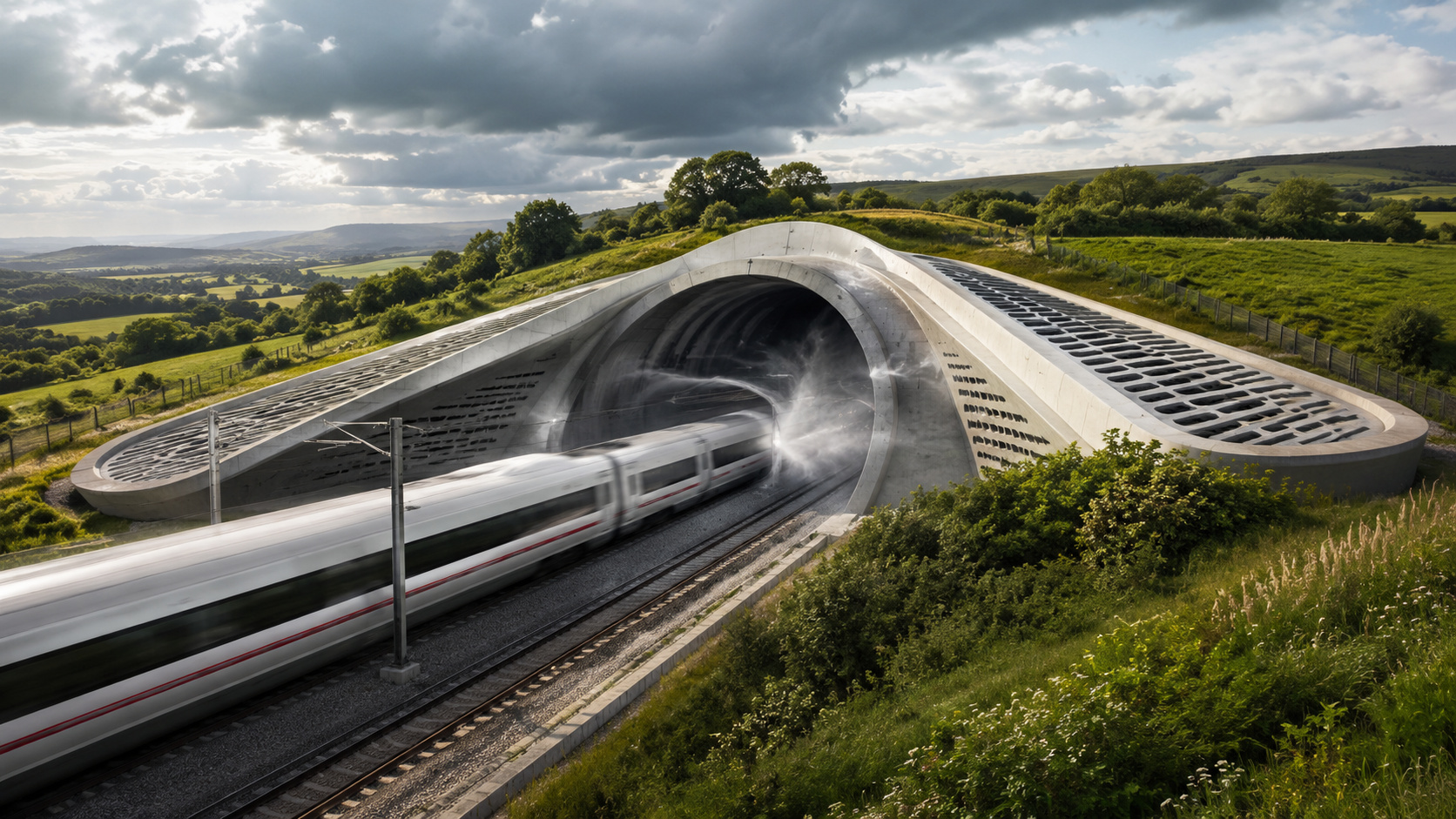


HS2 Tunnels Show That High-Speed Trains Also Require Compressed Air Control, Because the Entry of a Train at 320 km/h Can Generate Pressure, Noise, and Impact on the Comfort of Passengers and Nearby Communities
While Brazil still treats the high-speed train as a discussion about tracks, engines, and stations, the United Kingdom is already designing tunnels prepared to control the air pushed by trains at 320 km/h.
The solution appears at the portals of the Chiltern Tunnel, part of the HS2 project, where aerodynamic extensions function as air buffers. They help reduce pressure, noise, and discomfort when the train enters the tunnel at high speed.
The information was published by Heavy Lift News, a heavy engineering news site. The case shows a little-discussed part of railway engineering: in fast trains, air also becomes an obstacle and needs consideration in the design of the work.
-
Giant Earthworms up to 2 Meters Long Secretly Sustain Fertility in the Amazon Rainforest

-
Brazil Launches Ambitious Project to Recycle Toothpaste Tubes and Toothbrushes, Aiming to Revolutionize Waste Management

-
The Mystery of Roanoke: Entire Colony Vanished Without a Trace, Leaving Only “Croatoan” as a Clue and Becoming a Historical Legend
-
Namibia Plans to Build Homes for the Homeless Using Mushrooms and Invasive Plants to Tackle Housing Crisis





Why Air Becomes an Obstacle When the Train Enters a Tunnel at 320 km/h
When a train enters a tunnel at high speed, it pushes the air ahead. This air doesn’t disappear. It gets compressed and moves through the tunnel like a pressure wave.


At lower speeds, this effect is usually less noticeable. In a high-speed train system, the situation changes. The air starts to interfere with noise, comfort, and the impact generated by the passing train.
Therefore, the tunnel cannot be thought of just as a hole in the rock. It needs to have size, entrance, and ventilation prepared to deal with the compressed air that arises when the train accelerates.
How the Air Buffers at the Portals Help Relieve Pressure
The extensions installed at the portals of the Chiltern Tunnel function as a transition between the open space and the interior of the tunnel. Instead of the train entering a closed area all at once, it passes through a structure that helps the air to settle.
These portals have openings that allow the gradual release of part of the air. Thus, the pressure does not increase so abruptly inside the tunnel.
In practice, the system acts as an air buffer. It does not reduce the speed of the train but helps to soften the impact caused by the air pushed by the train at 320 km/h.
What is micropressure and why it can cause a sonic boom
Micropressure is the pressure wave that forms when the train pushes air inside the tunnel. It can reach the other end of the structure and exit to the external environment.

When this exit happens abruptly, it can produce a sound similar to a boom. This effect is a concern in high-speed projects because it involves noise and impact in nearby areas.
The role of aerodynamic portals is to reduce this risk. By allowing the air to escape gradually, the structure decreases the force of the pressure wave before it reaches the tunnel exit.
Why this engineering needs to be ready before the railway operates
This type of solution needs to be planned before the trains start running. Once the railway begins operation, correcting pressure and noise issues can become much more difficult.
In the case of HS2, the portals were designed for the anticipated speed of the trains and the tunnel’s characteristics. This includes the internal space, the structure’s entrance, and the air behavior during the passage of the train.
Heavy Lift News, a heavy engineering news site, detailed the key points of the work on the Chiltern Tunnel portals. The information reinforces that the infrastructure of a fast railway involves much more than tracks and engines.
What the UK case teaches about high-speed trains
The UK example helps illustrate why the high-speed train requires such specific engineering. Speed changes everything, including how air behaves.
In a regular train, air might seem just a detail. In a train traveling at 320 km/h, it becomes part of the design. Without control, pressure can affect noise, comfort, and the railway’s relationship with nearby communities.
That’s why the HS2 tunnels were not just designed to clear a path. They were also designed to allow air to have an escape route.
The invisible part of the work that can change the way we look at fast railways
The biggest curiosity of this project lies in what almost no one sees. The portal seems just like the entrance to a tunnel, but its function goes beyond appearance.

It helps control an invisible force, compressed air, which appears when the train enters the tunnel at high speed. This detail makes the work quieter, more comfortable, and more prepared to operate with fast trains.
The case of HS2 shows that a modern railway does not depend only on powerful machines. It also depends, therefore, on solutions capable of dealing with pressure, noise, and impact on the surroundings.
In the end, the technology of the Chiltern Tunnel portals reveals a simple lesson: in a train at 320 km/h, even the air needs planning.
If Brazil advances in high-speed train projects, do you think the country is prepared to also discuss this invisible engineering that controls pressure, noise, and comfort?









At the cost of almost £1bn per mile for HS2 I sure will design you a cool tunnel with nose suppression. Brazil do not copy the UK or it will cost you.
It is currently tens of billions of pounds over budget and around a decade behind schedule. Reports state that the now-shortened line between Birmingham and London could cost £81bn. Accounting for inflation, that would mean at least £100bn will be spent, but only 135 miles of railway built.21 Jul 2025